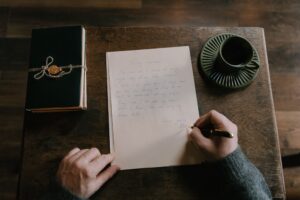

Most published books begin as something much smaller: a note, a list, a few honest lines scribbled at the end of a long day. People often assume that writers wait for a grand idea before they start, but many memoirs grow slowly out of everyday writing habits. A journal entry that seems ordinary in the moment can become the raw material for a story that helps thousands of readers years later.
One writer who shows this clearly is author Danielle Antonio Klassen, who has kept journals since the age of ten. Her first book, My Life as a Military Wife, grew out of that lifelong habit of recording daily life, and it was born from a personal tragedy. Her path from journaling to publishing offers useful lessons for anyone who has ever wondered whether their own experiences are worth writing down.
Why Journaling Is the Best Training for a Memoirist
A memoir is not written in a single burst of inspiration. It is built from memory, and memory fades quickly. Details that feel unforgettable today, like the sound of a voice, the look of a room, or the exact words of a conversation, can disappear within a few years.
Journaling protects those details. It also builds the habit that every author needs: showing up to write even when the words do not come easily. Over months and years, a journal becomes a private archive of moments, feelings, and turning points. When the time comes to write a book, that archive is a treasure.
The author featured here recorded daily observations and family life, including the experience of motherhood. Those entries later gave her something priceless: a first-hand record of how life actually felt at the time, not just how she remembered it afterward.
Step 1: Write Regularly, Not Perfectly
The most common reason people stop journaling is the belief that entries must be polished. They do not. A journal is a place to think on paper, and messy pages are a good sign that someone is being honest.
Set a small, realistic goal, such as ten minutes a day or a few sentences before bed. Consistency matters far more than length. A short entry written every day builds a stronger foundation than a long entry written once a month.
Step 2: Capture Details, Not Just Events
Saying “we moved again and I was sad” tells a reader very little. Describing the half-empty boxes, the quiet drive, and the unfamiliar street sign tells them everything.
When you write, try to record what you saw, heard, smelled, and felt. Write down the exact words people said when you can remember them. These small details are what make a memoir feel alive, and they are much easier to capture while an experience is fresh than to reconstruct later.
Step 3: Look for the Theme Running Through Your Life
After months or years of journaling, read back through your entries with a different question in mind: what keeps appearing? Perhaps it is resilience, family, faith, reinvention, or the search for belonging.
A memoir is not a complete record of everything that ever happened to you. It is a focused story about a particular part of your life and what it meant. Finding the theme helps you decide which moments belong in the book and which can stay in the journal.
For the author here, themes of love, loss, faith, and rediscovery run through the story of life as a military spouse. That clear focus is part of what makes the book easy to connect with, even for readers with very different backgrounds.
Step 4: Be Honest, Including About the Hard Parts
Readers can tell when a writer is holding back. The chapters that stay with people are usually the ones where the author admits fear, doubt, mistakes, or grief.
Honesty does not mean sharing every private detail. It means telling the truth about how events affected you and resisting the urge to make yourself look flawless. Writing through painful experiences can be difficult, so go at a pace that feels manageable. Many writers find that putting hard moments into words brings a sense of relief and clarity over time.
Step 5: Shape the Raw Material Into Scenes
Journal entries record what happened. A memoir turns those records into scenes: moments with a setting, a character, a bit of tension, and an emotional payoff.
This is where a storyteller’s training becomes valuable. Before becoming an author, she worked in church theater, college theater, and television, and developed skills in acting, singing, and dancing. That background taught her how to build a moment so that an audience feels it, and the same instinct helps on the page.
You do not need a stage background to do this. Try rewriting one journal entry as a scene. Start in the middle of the action, include a few lines of dialogue, and end on an image or feeling rather than a summary.
Writing to Heal, Writing to Help
Many people begin journaling for themselves. Some later discover that their private words can help others. The author’s stated goal is to reveal the unseen side of life, share her own upheavals and triumphs, and offer genuine advice to people finding their own way.
That shift, from writing for yourself to writing for readers, is often the moment a journal becomes a book. It does not require you to know exactly who your audience is. It only requires believing that honest experience has value beyond your own notebook.
Getting Started Today
If you have been thinking about writing your story, you do not need special software or a finished outline. Start with what you already have:
- Buy or open a notebook and write for ten minutes tonight.
- Record one detailed memory each week, focusing on sights, sounds, and conversations.
- Reread old letters, photos, or entries and note the themes that repeat.
- Pick one meaningful moment and turn it into a short scene.
- Share a page with a trusted friend and ask what stood out to them.
Final Thoughts
Every memoir begins the same way, with someone deciding that their experiences matter enough to record. Journaling is the simplest way to start, and it can grow into something far bigger than expected. Readers curious to see where a lifelong writing habit can lead can visit the author’s official website to explore her books, blog, reviews, and events.