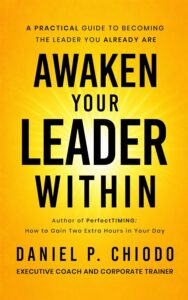

Charisma can attract attention, but attention is not the same as trust. In the workplace, employees eventually judge leaders less by how impressive they sound and more by whether their behavior is reliable. Leadership consistency becomes important because people want to know whether a leader’s words, decisions, standards, and actions can be trusted over time. In Awaken Your Leader Within, Daniel P. Chiodo repeatedly returns to the idea that leadership is demonstrated through ordinary choices rather than titles or appearances. His approach places responsibility, integrity, preparation, and repeated behavior at the center of effective leadership.
Leadership Is Revealed Through Patterns
A powerful speech can inspire people for a day. A consistent pattern of behavior can influence them for years.
Employees notice whether a manager follows through on promises, applies standards fairly, listens when someone raises a concern, admits mistakes, and behaves respectfully during stressful situations. These observations gradually become the basis for trust.
Chiodo makes this point in Chapter Four, where he explains that leadership is not simply what a person says. It is what that person consistently does. He argues that great leaders work to close the distance between their stated values and their actual behavior (pp. 35 to 37).
This matters because people learn more from repeated behavior than from occasional statements. If a leader speaks about teamwork but regularly takes individual credit, employees learn that personal recognition matters more than collaboration. If a manager talks about communication but reacts defensively when someone shares difficult information, employees learn that silence may be safer than honesty.
Leadership consistency makes expectations believable.
The Integrity Gap Can Damage Trust
Chiodo introduces a Signature Concept called the Integrity Gap. He defines it as the distance between what a leader says and what that leader actually does. Every person may experience some version of this gap, but effective leadership requires awareness and a deliberate effort to reduce it (p. 37).
The Integrity Gap can appear in subtle ways.
A manager says employee development matters but never makes time for coaching. An executive says customer service is the top priority but rewards employees only for speed. A team leader says people should speak openly but interrupts anyone who disagrees.
Each example creates a contradiction between the stated message and the lived experience.
One inconsistency may be forgiven easily. Repeated inconsistencies create a pattern, and patterns eventually become reputation.
This is why leadership integrity depends on more than good intentions. Leaders have to examine whether their schedules, decisions, conversations, and habits actually support what they claim to value.
Charisma Is Useful but Limited
Charisma can certainly help a leader communicate. Confidence can reassure people, enthusiasm can create momentum, and a strong speaking style can make ideas easier to understand.
The problem begins when charisma is used as a substitute for dependable behavior.
A leader may deliver an excellent presentation about accountability on Monday, but if that same person avoids responsibility when something goes wrong on Wednesday, the presentation loses credibility. Employees quickly learn whether inspiring language is supported by action.
By contrast, a quieter leader may not command immediate attention, yet consistently prepare, listen, communicate clearly, share credit, and make fair decisions. Over time, those behaviors can create deeper trust than personality alone.
Effective leadership therefore does not require choosing between communication skill and consistency. The strongest leaders often have both. The difference is that consistency gives communication credibility.
Leadership Consistency Matters Most Under Pressure
The value of leadership consistency becomes especially clear when circumstances become difficult. During uncertainty, people watch leaders closely. They notice whether the person remains thoughtful, whether priorities suddenly change, and whether the standards used during normal periods still apply.
In Chapter Eleven, Chiodo explains that pressure reveals character. When things go wrong, people quickly notice how leaders respond, what they prioritize, and whether they remain grounded. He also emphasizes that calm is not passivity. It is steadiness, and steadiness can build trust when uncertainty is high (p. 89).
A leader cannot ignore employees during normal operations and suddenly expect open communication during a crisis. Trust has to exist before the difficult moment arrives.
The same applies to accountability. A leader who regularly accepts responsibility is more believable when asking others to do the same. A leader who normally prepares carefully is more likely to inspire confidence when an unexpected situation requires rapid judgment.
Consistency built during ordinary periods becomes valuable during extraordinary ones.
Consistency Does Not Mean Refusing to Change
Some leaders mistakenly believe that consistency requires making the same decision regardless of changing circumstances.
That is not effective leadership.
A leader may need to change a plan, revise a strategy, extend a deadline, or reconsider a previous decision when new information appears. Adaptability is part of good judgment.
Leadership consistency should be strongest in values, honesty, fairness, preparation, and communication. A plan may change while these principles remain stable.
For example, a manager may originally promise that a project will be completed by Friday. New client requirements arrive on Wednesday and make that deadline unrealistic. Changing the deadline does not automatically represent inconsistency if the manager explains the reason clearly and takes responsibility for the new plan.
The problem would arise if the deadline changed repeatedly without explanation while the leader continued insisting that predictability was a core value.
Consistency is therefore not rigidity. It is alignment between principles and behavior.
Small Actions Shape Leadership Credibility
Leaders often focus on highly visible moments such as presentations, strategic meetings, performance reviews, and major business decisions. Employees may form their strongest impressions through smaller interactions.
Does the leader arrive prepared for meetings? Does the manager listen when someone brings an uncomfortable concern? Does the executive acknowledge the person who actually developed an idea? Does the supervisor behave respectfully toward employees at every level?
These moments seem minor when considered individually, but they create patterns.
Chiodo emphasizes throughout the manuscript that leadership often appears in ordinary moments. Earlier in the book, he describes leadership as choosing responsibility over blame, encouraging someone who needs support, and doing the right thing even when another option would be easier (pp. 3 to 4).
Repeated small choices create a leadership reputation long before a major challenge tests it.
Leaders Can Strengthen Consistency Through Reflection
One practical way to improve leadership consistency is to compare stated values with recent behavior.
A leader might identify three principles that matter most, such as respect, accountability, and preparation. The next step is to review recent actions.
If respect matters, how were disagreements handled?
If accountability matters, what happened after the leader made a mistake?
If preparation matters, how often did important meetings begin without enough information?
This type of reflection prevents leadership from becoming an abstract identity. It connects values to evidence.
Chiodo later introduces reflective frameworks such as the RWC Sweep, which asks what is right, what is wrong, and what should change. The purpose is continuous improvement through honest evaluation.
A leader does not need to be perfectly consistent. Perfection is unrealistic. What matters is noticing gaps and making deliberate adjustments.
Trustworthy Leadership Is Built Over Time
Charisma may create a strong first impression, but leadership consistency determines what happens after that impression fades.
People want leaders whose behavior makes sense over time. They want to know that promises matter, standards have meaning, mistakes can be discussed honestly, and values remain visible when pressure rises.
The most effective leaders do not depend entirely on personality to create influence. They build credibility through preparation, responsibility, fairness, integrity, and repeated follow through.
Eventually, people stop needing to ask whether the leader can be trusted because experience has already answered the question.