
Artificial intelligence (AI) has become a central part of modern life. From voice assistants like Siri and Alexa to recommendation systems on Netflix and Amazon, smart machines are everywhere. They can perform tasks that once required human intelligence, such as recognising images, understanding language, and even driving cars.
Yet, despite all these advances, today’s AI systems are still fundamentally different from what scientists and futurists call general intelligence, or AGI (Artificial General Intelligence). Understanding the distinction between smart machines and general intelligence is critical for anyone interested in the future of technology, ethics, and society.
In this article, we’ll explore the key differences, explain the limitations of today’s AI, and examine what true general intelligence would look like.
The Rise of Smart Machines
Before we dive into general intelligence, it helps to understand what today’s smart machines can do. AI systems today are often referred to as narrow AI because they are designed to perform specific tasks.
Examples include:
- Image recognition systems that can detect objects in photos
- Natural language processing systems that can translate languages or answer questions
- Recommendation engines that suggest products or movies based on past behavior
- Autonomous vehicles that can navigate roads under certain conditions
These systems are impressive, but they have limitations. They cannot generalize knowledge from one domain to another without explicit programming or retraining. For instance, a machine that can identify cats in pictures cannot suddenly start diagnosing medical images without being trained for that specific task.
What is General Intelligence?
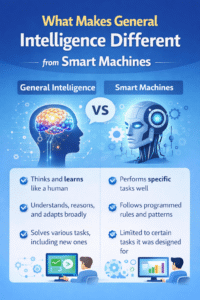
General intelligence refers to the kind of intelligence humans possess. It is the ability to learn, reason, adapt, and apply knowledge across a wide variety of domains. Unlike smart machines, which are restricted to predefined tasks, a system with general intelligence could understand and perform many different types of tasks—some of which it has never encountered before.
Key characteristics of general intelligence include:
- Learning and adaptability: The ability to learn new concepts independently
- Reasoning and problem-solving: Understanding cause and effect and making decisions in novel situations
- Transfer of knowledge: Applying knowledge from one domain to another
- Understanding context: Grasping nuances in language, culture, and human behavior
This is fundamentally different from today’s AI, which excels only in narrow, specific tasks.
Limitations of Today’s Smart Machines
While AI has made significant strides in recent years, it still has inherent limitations:
- Lack of true understanding
AI systems process data and detect patterns but do not “understand” information the way humans do. A chatbot can answer questions correctly without truly comprehending their meaning. - No common sense reasoning
Human intelligence relies heavily on common sense. For example, if someone says, “I left my keys in the fridge,” humans immediately recognize it as unusual. AI systems often fail at such reasoning. - Limited adaptability
Narrow AI cannot easily transfer knowledge between domains. A system trained to play chess cannot automatically play Go without retraining. - Dependence on large datasets
Smart machines need massive amounts of labeled data to perform well. They cannot infer rules or learn as efficiently as humans from small examples.
These limitations highlight why current AI is fundamentally different from general intelligence.
Understanding Human vs. Machine Intelligence
To further understand the difference, consider how humans and machines approach learning and problem-solving:
Humans can combine logic, creativity, and emotions in problem-solving, whereas machines operate within strictly defined parameters. This distinction forms the core of why general intelligence is such a unique challenge to achieve.
The Concept of Artificial General Intelligence (AGI)
Artificial General Intelligence (AGI) represents the next level of AI development. AGI would be capable of performing any intellectual task a human can do, with the ability to learn, reason, and apply knowledge flexibly across domains.
Unlike today’s AI, AGI would not require retraining for new tasks. It could hypothetically:
- Understand and generate natural language in context
- Solve problems it has never encountered before
- Make ethical and value-based decisions
- Adapt to unpredictable environments
AGI is still theoretical, and no system today has achieved it. Researchers are actively exploring ways to create machines with learning algorithms that resemble human cognition.
What is the Difference Between AI and AGI
At this stage, it’s helpful to answer the question: What is the difference between AI and AGI. While both terms relate to artificial intelligence, they represent fundamentally different concepts in terms of capability, scope, and flexibility. Traditional AI, often called narrow AI, is designed to perform specific tasks with high efficiency. For example, it can recommend movies based on your past preferences, identify objects in images, or even play complex games like chess at superhuman levels. These systems excel at the tasks they are trained for, but their intelligence is confined strictly to those domains. They cannot take the knowledge or skills they acquire in one area and automatically apply it to another, completely unrelated task.
- Scope of Intelligence
- AI: Narrow, task-specific, limited to what it has been trained to do
- AGI: Broad, adaptable, capable of performing any task a human can
- Learning Ability
- AI: Learns from datasets and patterns, often requiring retraining for new tasks
- AGI: Learns independently, can generalize knowledge across multiple domains
- Reasoning and Understanding
- AI: Pattern recognition and rule-based reasoning
- AGI: Context-aware reasoning, understanding nuances, and common sense
- Adaptability
- AI: Limited adaptability
- AGI: Flexible and capable of transferring skills to new challenges
In essence, AI is specialized intelligence, while AGI represents human-like, generalized intelligence.
Why AGI is Difficult to Achieve
Developing AGI is far more challenging than creating narrow AI. The difficulties include:
- Complexity of human cognition: Human intelligence is not fully understood, and replicating it is incredibly complex.
- Ethical and safety concerns: AGI could potentially surpass human intelligence, raising questions about control and responsibility.
- Computational limits: AGI would require massive computational power and sophisticated algorithms.
- Learning without supervision: Humans learn from limited examples and experience, whereas most AI relies heavily on labeled data.
These challenges mean that AGI is still a long-term goal rather than a near-term reality.
Current Approaches to AGI Research
Researchers are exploring various methods to create AGI, including:
- Neuromorphic computing
Designing computer architectures inspired by the human brain. - Reinforcement learning
Training systems through trial and error with rewards, mimicking how humans learn. - Transfer learning
Allowing AI to apply knowledge from one task to another, moving closer to generalized capabilities. - Cognitive architectures
Simulating human cognitive processes like memory, reasoning, and decision-making.
While progress is being made, no system today can match human-level general intelligence.
The Role of Ethics and Responsibility
AGI also raises ethical questions that current AI rarely encounters:
- Decision-making: How should AGI make value-based choices?
- Control: Who is responsible if an AGI system causes harm?
- Privacy: How should AGI handle sensitive personal data?
- Impact on jobs: How will AGI affect employment and society?
These considerations are crucial because AGI could fundamentally change human life.
The Future of Smart Machines and AGI
While AGI remains theoretical, smart machines are becoming increasingly capable. Advances in natural language processing, computer vision, and robotics continue to expand the applications of narrow AI.
In the future:
- Smart machines may handle more complex tasks
- Hybrid approaches could combine narrow AI with human oversight
- AGI could eventually emerge as algorithms become more sophisticated
However, until AGI is achieved, smart machines will remain specialized tools rather than independent, generalized thinkers.
Practical Implications for Businesses and Society
Understanding the difference between smart machines and general intelligence is important for organizations:
- Strategic planning
Companies must recognize the limits of AI when investing in automation. - Ethical AI deployment
Using AI responsibly requires understanding its capabilities and constraints. - Education and workforce
Preparing the workforce for collaboration with AI and potential future AGI technologies is essential.
By differentiating between smart machines and AGI, businesses can make informed decisions without overestimating current AI capabilities.
Conclusion
Smart machines have transformed the way we work, live, and interact, but they remain fundamentally different from general intelligence. Today’s AI excels in narrow, predefined tasks, while AGI aims to replicate human-level adaptability, reasoning, and understanding across domains.
Understanding what is the difference between AI and AGI clarifies why AGI is such a long-term challenge. While smart machines are tools, AGI represents potential autonomous, human-like intelligence with far-reaching implications.
As research continues, society must prepare for both the opportunities and challenges that AGI could bring. Until then, smart machines will continue to enhance our lives in specific, practical ways, while general intelligence remains a fascinating goal for the future.