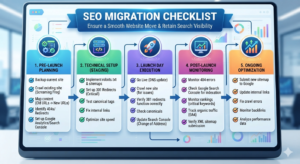

A successful website migration requires more than moving pages and updating URLs. Your SEO migration checklist should also protect the technical, content, and entity signals that search engines use to understand and rank your website. From preserving link equity and structured data to maintaining content quality and author credibility, these key steps help ensure a smooth transition without losing your existing SEO value.
1.Maintain Technical Structure and Link Equity
Protect your website’s entity signals and SEO authority by creating a clear 1:1 mapping between old and new URLs. Redirect every important old URL to its most relevant new page using a 301 redirect. Avoid sending old URLs to the homepage or unrelated pages, as Google may treat these as soft 404s.
Also, avoid redirect chains and preserve your internal linking structure. This helps search engines maintain existing backlinks, anchor text, page relationships, and topical relevance after migration.
2. Preserve Schema and Canonical Identity
Keep your website’s structured data and brand identity consistent during migration. Review and move all important Schema.org markup, such as Organization, Person, Author, SameAs, and Product schemas, to the new site.
Update the URLs in the schema while keeping key details—such as social profiles, Wikidata links, and company information—consistent. Also, make sure canonical tags point to the correct live URLs, not staging or duplicate versions. This helps search engines recognize the new site as the same entity and prevents confusion between the old and new versions.
3. Protect Content and Author Signals
As part of your SEO migration checklist, protect your website’s content quality and E-E-A-T signals during migration. Avoid making major changes to high-performing content while moving to the new site.
Keep important content, statistics, references, and H1–H3 headings as consistent as possible. Also, migrate author bios, credentials, review disclosures, and editorial policy pages correctly.
Keep author bylines linked to the right profiles so search engines can continue to recognize the experience, expertise, authority, and trust behind your content.
4.Preserve Brand Transparency and Trust Architecture
Your About Us, Contact, leadership, and trust-signal pages form the foundation of your website’s organizational entity. Keep these assets fully accessible during and after migration, maintaining identical business details, physical address locations, industry certifications, and corporate history. Ensuring this information remains consistent across your new domain architecture reinforces your brand identity within search engine knowledge graphs and prevents any disruption to your site’s core trustworthiness signals.
5.Maintain External Entity Associations and Citation Consistency
Your digital footprint extends beyond your own domain through connections to social profiles, business directories, industry associations, review platforms, and authoritative databases. During a migration, audit these off-site references to ensure all external links and structured annotations remain active and point to your updated web properties. Preserving these external citations ensures search engines can continuously validate your brand’s real-world identity and authority without signal decay.
6.Maintain Consistent Business Information
Maintaining an identical Name, Address, and Phone number (NAP), along with consistent service offerings and location details, is critical across both your new site and third-party platforms. Avoid introducing brand variations, alternate legal names, or altered location details during the migration process. Maintaining exact multi-channel consistency allows search engines and AI discovery systems to confidently anchor your digital footprint to the correct real-world entity without introducing entity resolution ambiguity.
7.Validate Post-Launch E-E-A-T Performance and AI Search Visibility
Post-migration validation extends beyond traditional organic rank tracking; you must actively monitor how search algorithms and conversational AI platforms perceive your brand identity. Audit Google AI Overviews, generative engine results, and key entity queries to verify that your experts, core offerings, and brand attributes retain accurate contextual representation. Concurrently, benchmark your post-launch metrics against pre-migration baselines—tracking indexation rates, backlink retention, structured data health, and branded search volume. Rapidly triaging any drops in referral traffic, citation coverage, or entity visibility ensures technical and content-level signal decay is remediated before it impacts overall site trust.