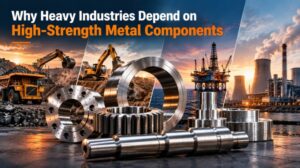

Forged components are used in some of the most demanding industries in the world. From oil and gas and power generation to aerospace, mining, construction, and heavy engineering, these components are expected to withstand high loads, repeated stress, pressure, temperature variations, and challenging operating environments.
But producing a high-quality forged component is not simply about applying force to heated metal.
Forging quality depends on a combination of material selection, temperature control, forging parameters, heat treatment, equipment, inspection, and process discipline.
For OEMs and industrial buyers, understanding these factors can help them make better decisions when evaluating forging manufacturers.
Here are some of the most important factors that influence forging quality and how manufacturers control them.
1. Raw Material Quality
The quality of a forged component starts with the quality of the raw material.
Steel and other alloys used for forging must meet the required chemical composition, mechanical properties, and application-specific standards. Variations or impurities in the starting material can affect the performance of the final component.
Manufacturers control raw material quality through:
- Supplier qualification
- Material certificates
- Chemical composition testing
- Visual inspection
- Ultrasonic or other non-destructive testing where required
- Heat and batch traceability
Maintaining traceability from the incoming material through the finished component is particularly important for critical industrial applications.
2. Forging Temperature
Temperature is one of the most important parameters in the forging process.
If the material is too cold, it may require excessive force and can develop cracks or other defects. If it is overheated, grain growth, oxidation, or other metallurgical problems can affect the final properties.
Professional forging manufacturers therefore maintain controlled heating conditions based on the material grade and component requirements.
Key controls can include:
- Controlled furnace temperatures
- Heating time
- Temperature monitoring
- Uniform heating
- Prevention of excessive oxidation
- Defined forging temperature ranges
Consistent temperature control helps ensure that the material responds predictably during deformation.
3. Forging Process and Deformation
The way metal is deformed during forging has a direct impact on the final component.
Factors such as forging force, reduction ratio, deformation sequence, die design, and material flow can influence the internal structure and mechanical properties of the component.
Manufacturers control these variables by developing appropriate forging processes for different component geometries and materials.
Proper deformation can help achieve:
- Improved structural integrity
- Better grain flow
- Reduced internal defects
- Consistent component geometry
- Required mechanical properties
For complex components, engineering analysis and process development can be particularly important before production begins.
4. Die and Tooling Condition
In processes involving dies, tooling plays an important role in maintaining dimensional accuracy and consistency.
Worn or incorrectly designed tooling can contribute to dimensional variations, surface defects, uneven material flow, and other manufacturing problems.
Manufacturers control tooling quality through:
- Tool design and validation
- Regular inspection
- Preventive maintenance
- Dimensional verification
- Controlled tooling life
- Process adjustments when required
For repeat production, maintaining tooling consistency becomes particularly important because even small variations can affect multiple components.
5. Heat Treatment
Forging alone does not always determine the final mechanical properties of a component.
Heat treatment can be used to achieve specific hardness, strength, toughness, and microstructural characteristics required by the application.
Depending on the material and specification, processes may include:
- Normalizing
- Annealing
- Quenching
- Tempering
- Solution treatment
- Ageing
Manufacturers control heat treatment through defined temperature cycles, controlled heating and cooling rates, furnace monitoring, and testing of the resulting properties.
The objective is to ensure that the finished component meets the specified mechanical and metallurgical requirements.
6. Dimensional Accuracy and Machining
Forged components often require additional machining to achieve their final dimensions and tolerances.
Even when the forging itself is produced correctly, poor machining control can affect the final component.
Manufacturers therefore monitor:
- Critical dimensions
- Geometric tolerances
- Surface finish
- Concentricity
- Flatness
- Alignment
- Machining allowances
Modern CNC machining and inspection systems can help manufacturers achieve repeatable results, particularly for complex industrial components.
7. Inspection and Non-Destructive Testing
Not every forging defect can be identified through visual inspection.
Internal discontinuities, cracks, inclusions, and other issues may require specialized inspection techniques.
Depending on the component and industry, manufacturers may use:
- Ultrasonic testing
- Magnetic particle testing
- Dye penetrant testing
- Hardness testing
- Dimensional inspection
- Chemical analysis
- Mechanical testing
- Metallographic examination
The specific inspection method depends on the material, component design, application, and customer requirements.
A strong inspection system allows manufacturers to identify potential problems before components reach the customer.
8. Process Control and Documentation
Consistent forging quality requires more than good machinery. It requires a repeatable manufacturing system.
Professional manufacturers establish documented procedures for different stages of production and monitor critical process parameters.
Documentation may cover:
- Raw material identification
- Heating parameters
- Forging operations
- Heat treatment
- Machining
- Inspection
- Testing
- Final approval
- Product traceability
This creates a manufacturing history for the component and helps identify the source of any potential quality issue.
9. Equipment and Technology
The capabilities of the manufacturing equipment can also influence forging quality.
Modern forging facilities may use advanced forging presses, hammers, ring-rolling equipment, furnaces, CNC machines, inspection systems, and digital production-monitoring tools.
Technology can help manufacturers improve:
- Process consistency
- Dimensional accuracy
- Production efficiency
- Quality monitoring
- Traceability
- Repeatability
However, technology alone does not guarantee quality. It must be combined with engineering expertise, experienced operators, proper maintenance, and strong quality systems.
How Manufacturers Build Quality Into the Forging Process
The most effective approach is to control quality throughout the manufacturing cycle rather than relying only on final inspection.
A typical quality-focused process can be viewed as:
Raw Material → Controlled Heating → Forging → Heat Treatment → Machining → Inspection → Testing → Final Approval
Each stage provides an opportunity to identify and control potential quality issues.
This process-oriented approach is particularly important when manufacturing components for critical industries where failure can result in equipment downtime, safety risks, or significant financial losses.
What OEMs Should Look for in a Forging Manufacturer
When selecting a forging supplier, OEMs should evaluate more than production capacity and price.
Important questions include:
- How does the manufacturer qualify raw materials?
- How are forging temperatures controlled?
- What forging equipment is available?
- How is heat treatment managed?
- What inspection and testing capabilities are offered?
- Is component traceability maintained?
- Does the manufacturer have relevant quality certifications?
- Can it support customized engineering requirements?
- Does it have experience in the target industry?
These factors can provide a better indication of a supplier’s ability to deliver consistent forged components.
The Role of CHW Forge
For manufacturers serving demanding industrial applications, maintaining quality across every stage of production is essential.
CHW Forge operates in sectors including heavy engineering, power generation, oil & gas, mining, construction, aerospace, and other industrial applications. Its manufacturing approach combines forging capabilities with engineering, heat treatment, machining, inspection, and quality processes.
For OEMs, this type of integrated manufacturing capability can make supplier qualification and long-term component sourcing more reliable.
Final Thoughts
Forging quality is the result of many interconnected factors.
Raw material quality, temperature control, deformation, tooling, heat treatment, machining, inspection, equipment, and process documentation all contribute to the performance of the final component.
For OEMs, understanding these factors makes it easier to evaluate forging manufacturers based on actual manufacturing capability rather than simply comparing quotations.
In industries where component failure can have significant consequences, quality should not be treated as the final checkpoint. It should be built into every stage of the forging manufacturing process.