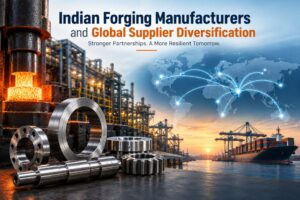

Global manufacturing supply chains are becoming more complex.
For years, many OEMs relied heavily on established manufacturing regions for critical components. While this approach offered scale and efficiency, recent disruptions have highlighted the risks of depending too heavily on a single country, region, or supplier.
As a result, supplier diversification has become an increasingly important part of industrial procurement strategy.
For companies that depend on forged components, India is emerging as an important sourcing destination.
With its established engineering ecosystem, growing manufacturing capabilities, skilled workforce, and expanding global supply-chain connections, Indian forging manufacturers can play an important role in helping OEMs build more flexible and resilient supplier networks.
What Is Supplier Diversification?
Supplier diversification means developing relationships with multiple qualified suppliers or sourcing locations instead of relying on a single source.
For an OEM, this could mean:
One supplier → Multiple qualified suppliers
or:
One manufacturing region → Multiple manufacturing regions
The objective is not necessarily to replace an existing supplier.
Instead, diversification provides an additional sourcing option when circumstances change.
This can help businesses manage risks related to:
- Supply disruptions
- Transportation delays
- Capacity constraints
- Raw material availability
- Geopolitical changes
- Unexpected production interruptions
- Increasing manufacturing costs
For industries that depend on critical forged components, having alternative qualified suppliers can be particularly valuable.
Why Forged Components Need Reliable Supply Chains
Forged components are used across industries such as:
- Heavy engineering
- Mining
- Oil & gas
- Power generation
- Construction
- Infrastructure
- Aerospace
- Industrial equipment
Many of these components are not simple off-the-shelf products.
They may require specific materials, dimensions, heat treatments, machining processes, inspection procedures, and documentation.
This means replacing a supplier is not always as simple as finding another manufacturer.
OEMs need suppliers with the right technical capabilities, quality systems, production capacity, and engineering experience.
That is where India can become strategically important.
Why India Is Becoming Relevant to Global Sourcing
India has developed a strong industrial and engineering ecosystem over several decades.
Its manufacturing sector supports major industries including automotive, infrastructure, energy, heavy engineering, and industrial equipment.
The country’s forging industry is also increasingly connected to international markets.
For global OEMs, Indian forging manufacturers can provide an opportunity to diversify sourcing while maintaining access to engineering-intensive manufacturing capabilities.
The value proposition is therefore broader than manufacturing cost.
It includes:
Engineering expertise + Manufacturing capability + Quality + Customization + Supply-chain flexibility
1. An Additional Manufacturing Base for OEMs
Supplier diversification works best when the additional supplier can genuinely meet the technical requirements of the OEM.
Indian forging manufacturers can provide an additional manufacturing base for companies already sourcing components from other regions.
This can be especially useful for businesses looking to implement a multi-source or China + 1 strategy.
Rather than moving an entire supply chain immediately, OEMs can gradually qualify Indian suppliers for selected components and applications.
This creates flexibility while reducing dependence on a single sourcing location.
2. Engineering and Custom Manufacturing
Industrial forging often involves more than producing standard shapes.
OEMs may require components manufactured according to specific:
- Drawings
- Material grades
- Dimensions
- Tolerances
- Mechanical properties
- Heat-treatment requirements
- Inspection standards
A capable supplier must therefore have both manufacturing and engineering expertise.
India’s engineering talent and industrial ecosystem provide a strong foundation for this type of customized manufacturing.
For OEMs, this can make Indian suppliers relevant not only for high-volume production but also for specialized engineering requirements.
3. Quality and Traceability
Diversification does not mean compromising on quality.
Before adding a new supplier, OEMs typically need to evaluate:
- Quality management systems
- Material traceability
- Inspection capabilities
- Mechanical testing
- Non-destructive testing
- Heat-treatment controls
- Documentation
- Production consistency
Indian forging manufacturers serving global customers need to demonstrate their ability to meet these requirements consistently.
For procurement teams, supplier qualification should therefore focus on measurable manufacturing capabilities rather than country of origin alone.
4. Managing Total Cost, Not Just Purchase Price
Cost diversification is another reason OEMs consider multiple sourcing locations.
However, comparing suppliers only on component price can produce misleading results.
The actual sourcing cost can include:
Component price + Tooling + Logistics + Duties + Quality costs + Inventory + Supplier management
A supplier with a slightly higher quoted price may provide better overall value through reliable delivery, consistent quality, lower rejection rates, and stronger engineering support.
Indian forging manufacturers can therefore be evaluated as part of a broader total-cost strategy.
5. Building Supply Chain Resilience
A diversified supply chain gives companies more options when unexpected events occur.
If one supplier experiences a production problem, capacity limitation, or logistics disruption, a qualified alternative may help reduce the impact on the OEM’s operations.
However, supplier diversification should not mean simply having multiple names on a vendor list.
The suppliers must be properly qualified, technically capable, and able to scale when required.
This is why developing long-term relationships with reliable forging manufacturers is important.
CHW Forge: Supporting Global Industrial Supply Chains
India’s forging ecosystem includes manufacturers with decades of experience serving demanding industrial applications.
CHW Forge is one such Indian forging manufacturer, with roots dating back to 1956.
The company serves industries including heavy industrial equipment, mining, oil & gas, power generation, construction, infrastructure, engineering, and aerospace.
Its manufacturing portfolio includes forged and rolled components such as rings and gear rings, flanges, shafts, discs, hubs, hollow forgings, sleeves, and shells.
CHW Forge also works with materials including carbon steel, alloy steel, stainless steel, duplex steel, aluminium, and titanium alloys.
For global OEMs evaluating supplier diversification, capabilities such as forging, heat treatment, machining, inspection, material traceability, and customized manufacturing can be important considerations when qualifying a new supplier.
What OEMs Should Consider Before Adding an Indian Supplier
Supplier diversification should be approached strategically.
Before selecting an Indian forging manufacturer, OEMs should evaluate:
Manufacturing Capability
Can the supplier manufacture the required component size, weight, geometry, and volume?
Quality
Can the manufacturer consistently meet the required quality and inspection standards?
Engineering
Can the supplier support customized components and technical requirements?
Capacity
Can production be scaled if demand increases?
Delivery
Does the supplier have experience managing export orders and international logistics?
Traceability
Can the supplier provide appropriate material and production documentation?
Long-Term Partnership
Is the manufacturer capable of supporting the OEM beyond a single purchase order?
These questions can help distinguish a genuine strategic supplier from a short-term sourcing option.
The Future of Supplier Diversification
Global manufacturing is unlikely to return to a model where companies depend on only one manufacturing region.
Instead, OEMs are increasingly looking for supply chains that combine:
Cost efficiency + Quality + Flexibility + Resilience
India has an opportunity to play a larger role in this model.
For the forging industry, this means Indian manufacturers can become more than alternative suppliers. They can become strategic partners within global OEM supply chains.
The focus, however, should remain on capability.
India’s opportunity will ultimately depend on manufacturers continuing to invest in technology, quality, engineering expertise, workforce development, and reliable global delivery.
Final Thoughts
Supplier diversification is no longer simply a procurement tactic. For many global OEMs, it is becoming an important part of long-term supply-chain planning.
Indian forging manufacturers can contribute to this strategy by providing an additional manufacturing base for companies seeking greater flexibility, competitive production, engineering capabilities, and supply-chain resilience.
The decision should not be about choosing one country over another.
It should be about building a stronger network of qualified suppliers across multiple manufacturing locations.
For global OEMs evaluating their next sourcing opportunity, Indian forging manufacturers deserve a place in that conversation.