
Peru is one of Latin America’s major mining markets, with copper, gold and silver supporting a large industrial sector. As mining projects expand into remote areas, companies face a practical challenge beyond equipment and production: how to provide reliable accommodation and support facilities for project workers.
For mining companies, EPC contractors and project developers, modular construction offers a flexible way to address this requirement.
The Growing Need for Mining Accommodation
Remote mining projects often have limited access to hotels, housing and public infrastructure. During construction or expansion, hundreds of workers, engineers, supervisors and subcontractors may need to stay close to the project site.
A complete mining camp may include worker accommodation, site offices, dining rooms, kitchens, bathrooms, laundry facilities, medical rooms and recreation areas.
Building all these facilities using traditional construction methods can require considerable time, labour and material transportation. For remote projects, logistics can become a major part of the construction challenge.
Prefabricated mining camp buildings provide an alternative by moving much of the manufacturing process from the remote site to a controlled factory environment.
Why Modular Buildings Suit Remote Mining Projects
The main advantage of modular construction is not simply speed. It is the ability to coordinate manufacturing, transportation and installation as one system.
Flat-pack buildings, for example, can be transported in a compact configuration and assembled at the destination. This can help reduce transportation requirements when a project needs a large number of units.
Modular buildings can also be arranged according to the actual requirements of the project. Accommodation blocks, offices, dining facilities and other buildings can be combined into a complete workforce camp.
For projects with changing workforce requirements, modular construction can provide additional flexibility. A camp can be planned for expansion during peak construction and adjusted when workforce demand decreases.
Designing a Mining Camp Around Operations
A successful mining camp should not be designed only around the number of beds.
The layout should consider worker shifts, meal schedules, management offices, sanitation, medical support, transportation routes and emergency access.
For example, accommodation should provide practical living conditions for workers during extended assignments, while dining and welfare facilities should support peak shift periods. Offices should be positioned according to project management and site-control requirements.
This means the best solution is often a project-specific modular accommodation system, rather than a standard building package.
What Buyers Should Consider
When selecting a modular building supplier for a mining project, procurement teams should look beyond the unit price.
Important considerations include transportation efficiency, installation requirements, insulation and structural performance, customization, maintenance and potential reuse.
The supplier’s production capacity and experience with international projects are also important, particularly when a large number of buildings must be delivered within a defined project schedule.
For temporary mining projects, the possibility of dismantling and relocating buildings can also influence the overall lifecycle value of the investment.
GS Housing at EXPOMINA PERÚ 2026
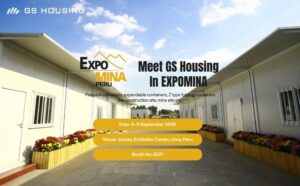
GS Housing will participate in EXPOMINA PERÚ 2026, held from September 9–11, 2026, at the Centro de Exposiciones Jockey in Lima.
At Booth E221, GS Housing will present portable building solutions designed for applications including mining camps, workforce accommodation and site offices.
Its product range includes flat-pack container houses, Z-type folding buildings and expandable container houses. These systems can be configured for different project functions and workforce requirements.
The company is also scheduled to participate in mining exhibitions in Indonesia and Kazakhstan during September 2026, strengthening its engagement with mining contractors and project developers across international markets.
A Flexible Approach to Future Mining Infrastructure
As Peru continues to develop its mining sector, supporting infrastructure will become increasingly important. Worker accommodation needs to be delivered efficiently while meeting the operational requirements of remote project sites.
Modular construction provides one practical approach by connecting factory production, transportation, installation and future reuse.
For mining companies and contractors planning new projects in Peru, modular workforce accommodation is therefore worth considering at the early planning stage—not simply as temporary housing, but as part of the wider project infrastructure strategy.