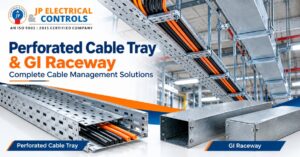

Modern electrical installations require safe, organized, and durable systems for routing and supporting cables. Whether it is an industrial plant, commercial building, power project, solar installation, or infrastructure facility, proper cable management helps keep electrical systems organized and accessible. Cable Tray, Perforated Cable Tray, and GI Raceway are widely used solutions for different cable routing requirements.
JP Electrical & Controls provides cable management products designed for industrial and commercial applications, helping customers select suitable solutions according to cable type, load, installation environment, and project requirements.
What Is a Cable Tray?
A Cable Tray is a support system designed to route and organize electrical, power, control, instrumentation, and communication cables. Instead of allowing cables to run loosely across ceilings, walls, floors, or equipment areas, cable trays provide a structured pathway.
Cable trays are available in different designs, materials, sizes, thicknesses, and finishes. The appropriate type depends on the application, cable quantity, environmental conditions, required load capacity, and installation requirements.
A well-designed cable tray system can make cable installation more organized while also providing convenient access for inspection, maintenance, and future cable additions.
Perforated Cable Tray for Organized Cable Routing
A Perforated Cable Tray is manufactured with regularly spaced holes or slots across its base and side sections. These perforations can provide flexibility for cable fixing and installation while maintaining a strong support structure.
Perforated cable trays are commonly used in commercial buildings, factories, electrical rooms, data centers, solar projects, and industrial facilities.
Benefits of Perforated Cable Tray
Some of the key advantages include:
- Organized routing of multiple cables
- Convenient cable installation
- Easy access for inspection and maintenance
- Flexible cable fixing arrangements
- Suitable for different cable capacities
- Available in different sizes and materials
- Can be used for various industrial and commercial applications
For projects where cables need to be routed systematically while maintaining accessibility, perforated cable trays can provide a practical cable management solution.
What Is a GI Raceway?
A GI Raceway is a galvanized iron or galvanized steel enclosure used to route and protect electrical cables and wires. Unlike an open cable tray, a raceway generally provides a more enclosed pathway for cables.
GI raceways can be useful where cables need additional protection from dust, accidental contact, mechanical exposure, or environmental conditions.
They are commonly used in industrial facilities, commercial buildings, offices, electrical rooms, factories, warehouses, and infrastructure projects.
Cable Tray vs GI Raceway
Both Cable Tray and GI Raceway are used for cable management, but their construction and applications are different.
A cable tray generally provides an open support structure, making cable installation and inspection relatively convenient. A GI raceway provides a more enclosed pathway and can offer additional physical protection to the cables inside.
The choice between the two depends on several factors, including:
- Type of cables
- Cable quantity
- Cable weight
- Required protection
- Installation environment
- Available space
- Maintenance requirements
- Project specifications
- Indoor or outdoor installation
- Required material and finish
For some projects, both systems may be used in different sections of the same electrical installation.
Applications of Perforated Cable Tray
Perforated cable trays can be used across many sectors where organized cable routing is required.
Industrial Plants
Factories and manufacturing facilities often contain power cables, control cables, instrumentation cables, and machine wiring. A perforated cable tray system can help route these cables systematically.
Commercial Buildings
Offices, hospitals, hotels, shopping centers, and educational institutions require organized electrical and communication cabling. Cable trays can provide dedicated pathways for these systems.
Solar Power Projects
Solar installations involve multiple electrical connections between solar modules, junction boxes, inverters, and distribution equipment. Proper cable management helps maintain an organized installation.
Power and Electrical Projects
Power generation, distribution, and electrical infrastructure projects require reliable cable support systems. Cable trays can be designed according to the cable load and project requirements.
Data Centers
Data centers contain extensive power and communication cabling. Organized cable pathways can help make inspection, identification, and maintenance more convenient.
Applications of GI Raceway
GI raceways are commonly considered where cables require a more enclosed and protected route.
Typical applications include:
- Industrial electrical installations
- Commercial buildings
- Electrical control rooms
- Factories and workshops
- Office wiring
- Machinery wiring
- Panel-to-equipment connections
- Infrastructure projects
- Cable routing in areas requiring additional protection
The galvanized finish can also make GI raceways suitable for applications where resistance to environmental exposure is an important consideration.
Why Choose the Right Cable Management System?
Selecting the right cable management product is important for both new installations and electrical system upgrades.
A properly selected Cable Tray, perforated tray, or GI raceway can help improve:
Cable Organization: Cables remain routed through defined pathways.
Maintenance Access: Properly arranged cables can be easier to inspect and identify.
Installation Efficiency: Structured pathways can simplify cable installation.
Space Management: Cable routing can be planned according to available installation space.
Future Expansion: Proper planning can leave room for additional cables where required.
How to Select the Right Cable Tray
Before selecting a Cable Tray, project engineers and contractors should consider the following factors:
1. Cable Load
Determine the total weight of cables that the tray needs to support.
2. Tray Dimensions
Width and height should be selected according to the number, size, and arrangement of cables.
3. Material
Depending on the installation environment, options such as galvanized steel, stainless steel, aluminum, or other materials may be considered.
4. Corrosion Protection
Outdoor, humid, chemical, or industrial environments may require suitable corrosion-resistant finishes.
5. Support Arrangement
The spacing and design of supports should be appropriate for the expected cable load and installation conditions.
6. Future Requirements
Where possible, cable management systems should account for potential future cable additions.
Why Choose JP Electrical & Controls?
JP Electrical & Controls offers cable management solutions for industrial, commercial, electrical, power, solar, and infrastructure applications. Its product range includes cable trays and related cable management products designed for different project requirements.
The company focuses on providing solutions based on factors such as material, dimensions, thickness, application, surface finish, and cable management requirements.
Whether you need a Perforated Cable Tray, standard Cable Tray, or GI Raceway, selecting a product according to the actual project requirements is important for achieving an organized and maintainable electrical installation.
Conclusion
A reliable cable management system plays an important role in modern electrical installations. Cable Tray, Perforated Cable Tray, and GI Raceway each provide different solutions for routing, supporting, organizing, and protecting electrical cables.
Perforated cable trays are a practical choice for organized and accessible cable routing, while GI raceways can be considered when cables require a more enclosed pathway and additional protection. The right solution should be selected based on cable load, dimensions, material, environment, installation method, and project specifications.
JP Electrical & Controls provides cable management solutions for industrial and commercial requirements. If you are planning an electrical installation and looking for a suitable Cable Tray, Perforated Cable Tray, or GI Raceway, you can discuss your requirements with the company and select a solution suited to your project.