
Paryushan is a time when the rhythm of everyday life gently changes. Alongside prayer, reflection and forgiveness, food becomes an important part of the spiritual journey. Eating mindfully, observing restraint and choosing simple preparations can help devotees turn their attention inward. For many families, the festival is therefore not simply about what is placed on the plate, but about the intention with which it is prepared and consumed.
Understanding Food During Paryushan
At the heart of Jain Food traditions is the principle of ahimsa, or non-violence. Dietary practices seek to minimise harm and encourage mindful consumption. During Paryushan, these principles are observed with greater discipline, although specific practices can differ between individuals, families and Jain traditions.
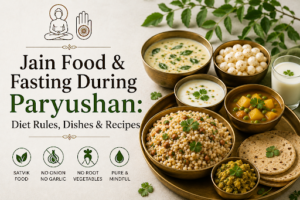
A traditional Jain religion food routine generally avoids ingredients such as onion, garlic and root vegetables. During Paryushan, families also refrain from eating fresh vegetables and focus on permitted grains, pulses and dairy products. Freshly prepared, simple food is often preferred, keeping the meal uncomplicated and the mind focused on the purpose of the observance.
This makes Jain vegetarian Food particularly relevant during the festival. Rather than elaborate cooking, the emphasis is on purity, restraint and awareness. Simple ingredients can come together beautifully in nourishing preparations without making food the centre of the occasion.
What Are the Fasting Rules During Paryushan?
There is no single fasting pattern followed by everyone. The practice may range from eating less or restricting particular foods to observing Ekasana, Ayambil or a complete fast. Paryushan fasting rules should therefore be understood according to one’s tradition, personal capacity and guidance from a knowledgeable religious teacher.
Ekasana involves eating one meal in a day, while Biyasana involves two meals. Ayambil is a more austere practice in which food is kept particularly simple and certain ingredients are avoided. More intensive fasting practices are also observed during Paryushan.
One of the most rigorous observances is Atthai, an eight-day fast associated particularly with Paryushan. Traditional Jain sources describe it as abstaining from food for eight consecutive days, with water consumed according to the rules of the particular practice. Such austerities are undertaken as spiritual disciplines and should not be attempted casually.
Another important practice is Chauvihar, in which food and water are avoided after sunset until the following morning. The underlying idea is restraint and awareness rather than simply going hungry.
Simple Jain Dishes for Paryushan
For those who are eating during the festival, a Jain meal can be comforting without being elaborate. Think of freshly prepared grains, pulses, dairy and permitted ingredients, combined with mild seasoning.
Some familiar Jain Dishes can include simple dal preparations, khichdi made with permitted grains, paneer-based preparations, kadhi and homemade rotis, depending on the particular dietary practice being followed. Traditional Paryushan menus can vary considerably, and what is permitted for one observance may not be appropriate for another.
The beauty of this cuisine lies in its simplicity. A warm bowl of dal, a softly cooked grain preparation or a lightly seasoned paneer dish can feel deeply satisfying when prepared with care. During a period devoted to self-restraint, even familiar food can become an exercise in gratitude.
And when planning Paryushan recipes, it helps to begin with dishes that use a small number of ingredients and require uncomplicated preparation.
- Moong Dal Khichdi: A soothing combination of rice and moong dal, lightly seasoned with permitted spices and prepared without onion, garlic or root vegetables.
- Jain Dal Dhokli: Soft wheat dumplings simmered in a mildly spiced dal, making for a wholesome and comforting traditional meal.
- Plain Upma: A simple semolina preparation with cumin and suitable dry spices, offering a light yet satisfying option.
- Lapsi: A traditional sweet made with cracked wheat, ghee and jaggery, often enjoyed as a simple festive treat.
- Kadhi: A gently spiced yoghurt-based preparation that can be paired with rice or another permitted grain. The exact ingredients and preparation should be adjusted according to the vrat being observed.
Food as a Path to Mindfulness
Paryushan reminds us that nourishment does not have to be about abundance. Choosing less, eating mindfully and being conscious of every ingredient can create a sense of discipline that extends beyond the dining table.
This inward focus can also contribute to mental peace. The festival’s emphasis on introspection, forgiveness and restraint creates an opportunity to step away from constant consumption and distraction. Food becomes one small part of a larger spiritual practice centred on awareness and self-purification.
The spirit of Paryushan can be experienced on a much larger scale at SRMD Paryushan Mahaparva 2026, being held from 8 to 15 September 2026 at the Dome SVP Stadium, Worli, Mumbai. Over eight days, the venue will bring together devotees and seekers for daily Snatra Puja, Pujya Gurudevshri Rakeshji’s morning and evening pravachans, and a vibrant line-up of special spiritual and cultural experiences, including Sound Bath, Global Youth LIVE, meditation, bhakti and a celebration of Mahavir Janma Kalyanak.
The concluding day will focus on Samvatsarik Aradhana, mental peace, and forgiveness. With the programme bringing together spiritual discourses, devotion, culture and community at one of Mumbai’s prominent venues, the celebration is set to be a significant Paryushan gathering in the city.
A Festival Beyond Food
Ultimately, Paryushan cannot be reduced to a list of permitted or prohibited ingredients. Food and fasting are meaningful because they support a deeper journey of self-discipline, compassion and reflection. For some, that journey may involve a complete fast; for others, it may mean eating simply and consciously while participating in prayers and spiritual practices.
As families prepare their kitchens and devotees prepare their hearts, the simplest meal can become a reminder of the festival’s deeper message: consume with awareness, live with restraint, and make space for forgiveness. In that sense, the true nourishment of Paryushan extends far beyond the plate.