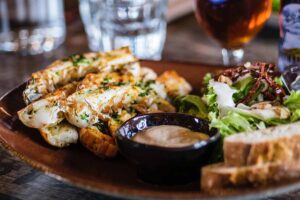

Most people treat starters as a holding pattern. Something to pick at while the real food is prepared. On an Indian menu that is a mistake, because the appetizer section is often where a kitchen does its most technical and most interesting work.
Mains are where a restaurant plays it safe, because mains are what sells. Starters are where it shows you what it can actually do. So when you are judging an indiaas restaurant amsterdam, the top of the menu tells you more than the middle of it.
Why the appetizer section is the real test
A main course has to appeal to everyone. It gets ordered most, so it is built to be reliable rather than adventurous. The familiar names live there precisely because they are safe.
Starters carry less of that commercial weight, which frees the kitchen up. This is where you find the techniques that take skill, the regional dishes that take knowledge, and the combinations that take confidence. A kitchen with range shows it here first.
Which means a thin, generic starter section is a warning, and a deep, varied one is a promise.
The tandoor appetizers, and what they demand
At Rasoi the tandoor section is the clearest signal. These are dishes cooked in a clay oven that runs extremely hot, and the technique does not forgive a careless cook.
Tandoori Lasooni Prawns at 14,95 and Tandoori Pomfret at 13,95 are both chef’s signatures, and both are seafood, which is harder to cook in a tandoor than chicken because it overcooks in seconds. A kitchen putting signature status on tandoor seafood is making a statement about its control of the oven.
Dahi ke Kebab at 12,95 is the one that really tests a cook. It is made from hung yoghurt bound with herbs, then fried until golden. Yoghurt is not a natural thing to shape and fry, and getting a crisp exterior over a soft, barely held interior is genuinely difficult.
And Malai Broccoli Kebab at 13,95 takes a vegetable that is not traditionally Indian at all and gives it the tandoor treatment in a spiced cream marinade. That is a kitchen experimenting with confidence rather than sticking to the script.
The vegetarian starter that borrows a court technique
Mushroom Galouti Kebab at 11,50 deserves its own mention, because it is the cheapest item in the section and also one of the most accomplished.
Galouti is a technique from Lucknow, developed historically for a nawab who had lost his teeth, requiring meat pounded to a paste so fine the kebab practically dissolves on the tongue. Doing that with mushroom instead of meat is a deliberate translation of a court technique into vegetarian cooking.
That a kitchen bothers to do this, and prices it as the cheapest thing in the section, tells you it is not treating its vegetarian options as an afterthought.
The street food, which is a different kind of skill
Alongside the tandoor sits a street food section, and this tests something else entirely: timing and balance rather than fire control.
Pani Puri at 8,00 is hollow crisp shells filled with spiced water and potato, a dish that works for seconds after assembly and requires precision to get the balance of sour, spicy and sweet right. Papdi Chaat at 9,00 and Banarasi Tikki Chaat at 9,95 layer crisp elements under yoghurt and chutney, where the whole point is contrast between textures that are actively fighting to collapse into each other.
These are not easy dishes. They look casual and they are the opposite. A kitchen that does them well is one that understands balance, and balance is the hardest thing to teach.
How to use the appetizers to judge the place
Order two starters from different parts of the section on your first visit. One from the tandoor, one from the street food.
The tandoor dish tells you about the kitchen’s control of heat and timing. The street food dish tells you about its sense of balance and freshness. Between them you have tested the two hardest skills a kitchen has, for under thirty euros, before the mains have even arrived.
If both land, the mains will almost certainly be fine, because the hard parts are already proven. If the starters are careless, no main is going to rescue the meal.
Ordering them as part of the meal, not before it
One practical point. Indian appetizers are not a separate course in the European sense, to be cleared before the mains arrive.
They work better brought together with everything else, or shortly before, so the dry and grilled textures sit alongside the gravies rather than being a prelude you have forgotten by the time the curry lands. Tell the kitchen you want them with the meal rather than ahead of it.
The contrast is the point. A charred tandoor prawn next to a rich gravy does something neither dish does alone, and that only works if they share the table.
Where to find it
Rasoi sits at Maasstraat 10 in Rivierenbuurt, with several public parking options nearby and Amsterdam Zuid station close by. For anyone coming from the centre, it is a short run south, and an indian restaurant near amsterdam central that rewards the small journey is worth more than a convenient one that does not.
Start at the top of the menu. It is where the kitchen is trying hardest, and it is the fastest way to find out whether a place is worth a second visit before you have committed to a whole meal.