
Picture a furniture retailer in Surat that spends months on a new website. The design is clean, the product photos are sharp, and the pages load quickly on a phone. Three months after launch, the owner opens the analytics report and finds that most visitors are existing customers or people who typed the shop’s name directly. Almost nobody is discovering the store through search.
That gap between having a website and being found is where organic search visibility comes in. A site earns attention from search engines when it is technically sound, answers real questions, and shows relevance for the topics and places it serves. Doing all of that consistently takes planning, which is why many businesses work with an SEO agency in India instead of managing it alone.
The right partner shortens the learning curve and helps you avoid expensive mistakes. The wrong one can burn a year and leave your site in worse shape. This guide covers what good SEO work involves, how to judge a provider, and how to measure progress honestly.
Why SEO Matters for Modern Businesses
Most buying journeys start with a search. People look up a product, compare a few options, read reviews, and only then contact a business. If your site does not appear during that process, a competitor shapes the decision before you get a chance to.
Organic visibility also compounds. A well-built page that answers a question clearly can keep bringing in visitors for months without a fresh payment for every click. That makes search engine optimization a different kind of asset from paid ads, which stop delivering the moment the budget stops.
One distinction is worth keeping in mind: visibility is not the same as meaningful traffic. A page that ranks for a broad term may attract many visitors who never buy. A page that ranks for a specific, high-intent phrase may attract fewer people who are ready to call. Good SEO aims for the second group. Over time, appearing across many useful searches also builds brand discovery, because people start to recognize and trust a name they keep seeing.
What Does an SEO Agency in India Actually Do?
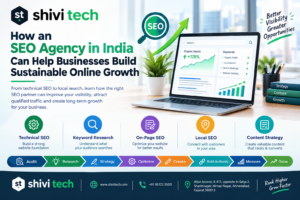
Rankings are the visible result, but the work behind them is much wider. A capable agency handles several connected areas.
Technical SEO
Search engines need to reach your pages, understand them, and store them in their index. Technical SEO makes sure that happens. An agency checks whether important pages can be crawled, whether any are blocked by mistake, and whether the right pages are indexed while duplicate or thin ones stay out.
It also covers page speed, mobile usability, and site architecture. A clear structure, where key pages sit a few clicks from the homepage and link to each other logically, helps visitors and crawlers alike. Internal linking carries much of that weight, because it signals which pages matter most. Broken links, redirect chains, and duplicate content are the usual technical errors, and they often sit unnoticed for years.
Keyword Research and Search Intent
Keyword research is not about finding the biggest number in a tool. It is about understanding what a person wants when they type a query. Four types of intent come up repeatedly:
- Informational: the searcher wants to learn something, such as “how does GST invoicing work.”
- Commercial: they are comparing options, such as “best accounting software for small teams.”
- Transactional: they are ready to act, such as “buy cotton kurtis online.”
- Navigational: they are looking for a specific brand or site.
Search volume alone can mislead. A phrase with 500 monthly searches and strong buying intent is often worth more than one with 20,000 searches from casual browsers. A good agency matches each keyword to the right kind of page, so service pages target transactional queries and guides target informational ones.
On-Page SEO
On-page work turns research into pages. Title tags and meta descriptions explain a page’s purpose in search results. Headings give the content structure, and URLs should be short and readable. The layout should match what the searcher expects, whether that is a comparison table, a step-by-step process, or a price range. Internal links then connect each page to related ones.
Online stores have extra details to cover, such as category structure, product page content, and duplicate variants. Working through a proper ecommerce SEO checklist helps catch problems that are easy to miss when a catalog grows.
Content Strategy
Content is where many SEO programs either work or stall. Publishing a blog post every week does not build authority on its own. What helps is topical depth: covering a subject so completely, from beginner questions to specialist concerns, that search engines and readers treat your site as a dependable source.
In practice, that means building clusters. A central service page is supported by guides, comparisons, and FAQs that link back to it. Each piece should offer something the top five results do not, such as original examples, a clear opinion, or knowledge of how the work is actually done. Strong content and copywriting also keeps the writing clear enough that a customer reads to the end, which matters more than word count.
Local SEO
For a business that serves a specific city or region, local search works differently from general search. Results lean on proximity, relevance, and prominence. A local SEO agency usually starts with the Google Business Profile: accurate categories, service areas, opening hours, photos, and regular updates. It then builds local landing pages that are genuinely different from one another, not the same text with a city name swapped in.
Consistent citations (your name, address, and phone number across directories) reinforce trust, and a steady flow of real reviews adds reputation signals. If you are comparing providers, this guide to choosing a local SEO agency covers questions worth asking before you sign anything.
How to Choose the Right SEO Company in India
Comparing an SEO company in India is easier when you score every provider against the same criteria.
- Industry understanding. Ask how they would approach your sector. A law firm and a fashion store face very different search behavior.
- Technical capability. They should be able to explain how they diagnose crawl and indexation problems and what they check before touching content.
- Content expertise. Ask to see writing they have produced and who writes it.
- Transparency. You should know what work is done each month and why.
- Reporting and communication. Look for plain-language reports tied to business goals, and a named contact who responds.
- Strategy. A proposal that arrives without an audit or any questions about your business is a template.
- Case studies. Ask for examples with context: the starting point, the actions taken, and what changed. Be careful with results shown without explanation.
- Realistic expectations. A trustworthy agency will tell you what it cannot know until it has examined your site.
If a provider cannot answer these clearly in the first conversation, that tells you something.
SEO Red Flags Businesses Should Watch For
Some warning signs are easy to spot once you know them. Anyone who guarantees a number one ranking is promising something no agency controls, since search engines make those decisions. Fixed timelines such as “first page in 30 days” for competitive terms deserve the same suspicion.
Poor practices also show up in the work itself: keyword stuffing that makes pages awkward to read, copy-paste content reused across clients, or bulk backlinks from irrelevant directories and automated tools. Low-quality links can invite penalties or simply do nothing. An agency that starts without a technical audit is guessing. One that cannot show what it did last month, or sends reports full of impressions and no outcomes, lacks transparency. A useful test: if you could not explain the agency’s work to a colleague after reading its report, ask more questions.
How Long Does SEO Take to Produce Results?
There is no honest single answer, and any agency that gives one before reviewing your site is guessing. Several factors set the pace: the condition of your website, the level of competition, your industry, the authority your domain already has, the quality of your content, the strength of your technical foundation, the amount of search demand, and how consistently the work is carried out.
A new site in a crowded market, competing with long-established brands, will move more slowly than an established local business with a clean site and few competitors. Early signs such as better indexation, rising impressions, and stronger engagement often appear before leads do. Treat SEO as a long-term growth channel, closer to building a shop’s reputation than running a weekend sale.
What Should a Good SEO Strategy Measure?
Rankings are a useful signal but a poor goal. A page can hold position three for a keyword that never leads to a sale. A better scorecard includes:
- Organic traffic, and especially qualified organic traffic: visitors who view key pages, stay engaged, and take action
- Search visibility across relevant keywords, not just flattering ones
- Conversions and leads from organic search, such as form fills, calls, bookings, and purchases
- Revenue, where tracking allows it
- Local visibility, including Google Business Profile views, calls, and direction requests
- Engagement, such as time on page and pages per visit
- Technical health, including crawl errors, indexation coverage, and page speed
Agree on these before work begins so you have a baseline to compare against.
Building a Sustainable SEO Growth Framework
A repeatable process keeps SEO from turning into a pile of unrelated tasks. One practical sequence is Audit → Research → Strategy → Optimize → Create → Build Authority → Measure → Improve.
- Audit. Review technical health, existing content, backlinks, analytics, and local listings to set a baseline.
- Research. Study keywords, search intent, competitors, and the questions your customers actually ask.
- Strategy. Prioritize by impact and effort, and decide which pages to fix, merge, or create.
- Optimize. Resolve technical issues and improve titles, headings, internal links, and speed.
- Create. Build new pages and guides from the research, not from guesswork.
- Build Authority. Earn relevant links, mentions, and reviews through useful content and genuine outreach.
- Measure. Compare results against the baseline using the KPIs you agreed on.
- Improve. Refresh pages that underperform, expand what works, and feed the findings back into the next round.
Why Shivi Tech
Shivi Tech is a digital solutions company based in Ahmedabad, Gujarat, India, that combines search work with website development. That pairing is practical, because many SEO problems begin with how a site was built. As an SEO Agency in India, the team covers SEO and search growth, local SEO, and white label SEO for agencies that need a delivery partner. On the development side, it works with WordPress, WooCommerce, and Shopify.
The approach starts with an audit of the current site and your goals, then ties technical fixes, content, and local work to business outcomes instead of rankings alone. That suits startups, growing companies, eCommerce brands, and agencies that want search growth built on a solid website.
Final Thoughts
Sustainable growth from search comes from steady, well-chosen work, not shortcuts. Whichever partner you choose, insist on clear goals, honest timelines, and reporting you can understand. If you want to learn more about strategic SEO and digital solutions, you can explore what Shivi Tech offers.