
Every business owner eventually asks the same question: why isn’t my website bringing in customers? The product is solid, the service is good, but the phone isn’t ringing and the inbox isn’t filling up. Nine times out of ten, the answer isn’t the business. It’s the absence of a real strategy for getting found online.
This is where an internet marketing service comes in. Done right, it connects your business to the people already searching for what you offer, on Google, and increasingly, inside AI tools like ChatGPT, Gemini, and Perplexity. This guide breaks down what an internet marketing service actually does, why it matters more in 2026 than ever before, and how to choose one that will actually move the needle for your business.
What Is an Internet Marketing Service and Why It Matters Now
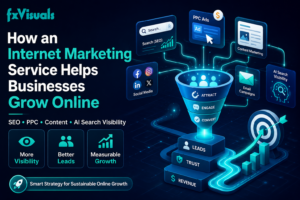
An internet marketing service is the umbrella term for the strategies businesses use to attract, convert, and retain customers online. That includes search engine optimization, paid advertising, content marketing, social media management, and email campaigns, all working together instead of operating as disconnected tactics.
The stakes have changed. Search behavior isn’t limited to typing a query into Google and scrolling through ten blue links anymore. People ask questions directly to AI assistants and expect a direct answer, often without ever visiting a website. If your business isn’t structured to show up in both traditional search results and AI-generated answers, you’re invisible to a growing share of your market.
That’s the shift a modern internet marketing service has to account for: ranking well in classic search while also being the source that AI Overviews and chatbots pull from when they answer a customer’s question.
Core Components of a Modern Internet Marketing Service
A real internet marketing service isn’t one tactic. It’s a set of coordinated channels, each doing a different job in the customer’s path to purchase.
Search Engine Optimization (SEO)
SEO is the foundation. It’s the practice of structuring your website and content so search engines understand what you offer and trust you enough to rank you for it. That includes technical health (site speed, mobile usability, crawlability), on-page optimization (headings, internal linking, keyword placement), and off-page signals like backlinks and citations. If you want a deeper look at how this works in practice, our SEO services page covers the full approach.
Pay-Per-Click Advertising (PPC)
While SEO builds long-term visibility, PPC gets you in front of buyers immediately. Google Ads and paid social campaigns let you target specific keywords, demographics, and intent signals, paying only when someone clicks. It’s the fastest lever to pull when you need leads now, not in six months.
Content Marketing
Content is what fuels both SEO and AI visibility. Blog posts, guides, case studies, and video all give search engines and AI models material to understand your expertise and answer questions on your behalf. Thin, generic content doesn’t cut it anymore. Google’s Helpful Content system and AI answer engines both reward depth, originality, and content written by people who actually know the subject.
Social Media Marketing
Social platforms build brand recognition and trust signals that indirectly support SEO. Consistent, relevant posting also gives you a distribution channel that doesn’t depend entirely on algorithm changes at Google.
Email Marketing
Once someone converts, email keeps them engaged. It’s still one of the highest ROI channels available, and it plays a growing role in retention and repeat business.
How an Internet Marketing Service Helps Businesses Grow Online
Increased Online Visibility
The core job of an internet marketing service is making sure your business appears where your customers are looking, whether that’s a Google search, a map pack result, a social feed, or an AI-generated summary. Without visibility, none of your other marketing efforts matter.
Higher Quality, More Qualified Leads
Broad visibility is only useful if it attracts the right people. A well-run campaign targets specific search intent, meaning the traffic coming to your site is already close to making a decision. That’s the difference between a hundred random visitors and ten visitors who are ready to buy.
Stronger Brand Trust and Authority
Search engines and AI models increasingly evaluate content through the lens of E-E-A-T: Experience, Expertise, Authoritativeness, and Trustworthiness. A consistent internet marketing strategy builds these signals over time through original content, credible backlinks, positive reviews, and a well-structured website. That trust translates directly into higher rankings and, just as important, into customer confidence once they land on your site.
Better Conversion Rates
Marketing isn’t just about traffic. A good internet marketing service also looks at what happens after someone arrives on your site: page speed, clear calls to action, mobile experience, and messaging that matches what the visitor was searching for. Small changes here often produce bigger revenue gains than chasing more traffic.
Measurable, Trackable ROI
Unlike traditional advertising, digital marketing can be measured down to the individual click, call, or form submission. That means budgets can be adjusted based on actual performance instead of guesswork, and businesses can see exactly what’s working.
Internet Marketing in the Age of AI Search
This is the part of the landscape that’s changed the fastest, and it’s the part most businesses are still catching up on. Google’s AI Overviews now answer a large share of search queries directly in the results page, before a user ever clicks a link. At the same time, tools like ChatGPT, Gemini, and Perplexity have become genuine research and discovery channels in their own right.
For a business, this means visibility now depends on two things happening at once: ranking in traditional search, and being structured in a way that AI systems can pull from confidently. That requires clear, well-organized content, accurate and consistent information across your website, and semantic structure that helps machines understand context, not just keywords.
We’ve written in more detail about what this shift looks like in practice. If you want to understand how AI Overviews and Google’s AI Mode are changing click-through behavior, that’s a useful starting point. From there, our technical SEO checklist for AI visibility walks through the specific fixes most sites need, and our piece on structuring content for AI search covers what “AI-ready” content actually looks like at the page level.
The businesses that adapt to this now will have a real head start. The ones that wait will spend the next few years trying to catch up.
How to Choose the Right Internet Marketing Service for Your Business
Not every agency or freelancer offering “internet marketing” is equipped to handle what’s described above. Here’s what to actually look for.
Proven experience across your industry or a similar one. Ask for real examples, not vague claims. A service with actual case studies and results is showing you E-E-A-T in action, not just talking about it.
A strategy grounded in your business goals, not generic templates. Your business isn’t identical to your competitor’s. The approach shouldn’t be either.
Transparency in reporting. You should be able to see exactly what’s being done and what results it’s producing, in plain language, not buried in jargon.
Technical capability, not just content output. SEO today involves site architecture, structured data, page speed, and increasingly, how your content is formatted for AI systems to read and cite. That takes real technical skill.
A team that understands where search is heading, not just where it’s been. Given how quickly AI search has changed the landscape, this matters more now than it did two years ago.
This is the kind of work our team at fxVisuals focuses on daily, building strategies that account for both classic search rankings and how AI tools surface and cite content. If you’re evaluating options, our digital marketing services page outlines how we structure that work end to end.
Common Mistakes Businesses Make with Internet Marketing
Chasing rankings instead of intent. Ranking for a keyword nobody with buying intent searches for doesn’t grow your business. Strategy should start with what your customers are actually asking, not just what has search volume.
Keyword stuffing and thin content. Google’s spam policies specifically target content created primarily to manipulate rankings rather than help users. It doesn’t work anymore, and it can actively hurt your visibility.
Ignoring technical SEO. A slow, unstructured, hard-to-crawl website will underperform no matter how good the content is.
Treating SEO and paid ads as separate, unrelated efforts. The best results come from channels working together, with paid data informing organic strategy and vice versa.
No plan for AI search. Businesses still optimizing purely for the traditional ten blue links are already behind. AI-generated answers are pulling a growing share of search traffic, and content that isn’t structured for that context gets left out entirely.
Frequently Asked Questions
What does an internet marketing service actually include?
It typically includes SEO, pay-per-click advertising, content marketing, social media management, and email marketing, coordinated as one strategy rather than run separately.
How long does it take to see results from an internet marketing service?
Paid advertising can produce leads within days. SEO and content marketing usually take three to six months to show meaningful ranking and traffic growth, since search engines need time to trust and index new signals.
Is SEO still worth it with AI Overviews and chatbots answering questions directly?
Yes, and arguably more than before. AI systems pull their answers from well-structured, trustworthy web content. Strong SEO fundamentals are what make a business eligible to be cited by AI Overviews, ChatGPT, and similar tools in the first place.
Can a small business benefit from an internet marketing service, or is it only for large companies?
Small businesses often see the biggest relative gains, since they’re usually starting from low visibility. A focused local SEO and content strategy can meaningfully change lead flow within months.
What’s the difference between digital marketing and internet marketing?
The terms are largely interchangeable today. Internet marketing specifically refers to strategies executed online, while digital marketing can sometimes include broader digital channels like SMS or connected TV. In practice, most agencies use the terms to mean the same thing.
Ready to Grow Your Business Online?
Getting found by the right customers, on Google and increasingly in AI search, isn’t optional anymore. It’s the difference between a website that sits idle and one that actually drives revenue.
If you’re ready to build a strategy that covers both, contact our team for a consultation, or explore our full range of digital marketing services to see how we can help your business grow online.