
Artificial intelligence is rapidly becoming part of everyday business operations. From recruitment and customer service to healthcare, finance, software development, and decision support, organizations are increasingly relying on AI to improve efficiency and create new products.
But as AI adoption grows, one question is becoming increasingly important:
Do the people developing, deploying, and using AI understand how to use it responsibly?
This is where EU AI Act Article 4, also searched as Art 4 EU AI Act and EU AI Act Artikel 4, becomes relevant.
Article 4 focuses on AI literacy, recognizing that responsible AI cannot depend entirely on technical controls, policies, or documentation. Organizations also need people with an appropriate level of knowledge and understanding to work with AI systems responsibly.
For AI startups, SaaS companies, enterprise AI vendors, compliance teams, CTOs, and AI product leaders, this creates an important shift. AI governance is no longer simply a legal or compliance function. It is becoming an operational capability that involves teams across the organization.
This article explores what EU AI Act Article 4 means for businesses, why AI literacy matters, and how organizations can connect AI literacy with broader AI governance and compliance operations.
What Is EU AI Act Article 4?
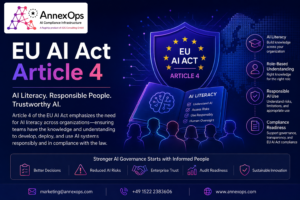
EU AI Act Article 4 addresses the need for providers and deployers of AI systems to take measures to ensure a sufficient level of AI literacy among their staff and other persons dealing with the operation and use of AI systems on their behalf.
The idea behind the requirement is straightforward: people working with AI should have enough knowledge and understanding to use those systems appropriately.
AI literacy can involve understanding:
- The capabilities and limitations of AI systems
- Potential risks associated with AI use
- Responsible AI practices
- Appropriate human oversight
- The context in which an AI system is being used
- The responsibilities associated with operating or deploying AI
The exact level of knowledge needed can vary depending on the role, technical knowledge, experience, education, and context in which the AI system is used.
This is important because AI literacy should not be treated as a generic training program where every employee receives the same information.
A developer working directly on an AI model may require a different level of understanding than a business employee using an AI-powered application.
Why Art 4 EU AI Act Matters for Modern Businesses
AI governance often focuses heavily on technology.
Organizations assess models, data, security controls, documentation, and risk classifications. These are all important, but governance can fail if the people responsible for AI do not understand the systems they are managing.
Consider a company that deploys an AI tool for employee recruitment.
The technical team may understand how the system works, while HR employees may use its outputs every day. If those employees do not understand the system’s limitations or when human review is necessary, the organization can create governance problems even if the technology itself is functioning as designed.
This is why the Art 4 EU AI Act is significant.
It places attention on the human side of AI governance.
Organizations need to think about who interacts with AI, what they need to know, and how that knowledge supports responsible use.
AI Literacy Is Not Just Employee Training
One common misconception is that Article 4 simply means organizations need to conduct an AI training session.
Training can certainly be part of an AI literacy strategy, but effective governance goes further.
Organizations need to connect knowledge with practical processes.
For example, employees may understand that AI systems can produce inaccurate outputs. But what happens when an employee identifies a potentially harmful output?
Who should they report it to?
How is the issue documented?
Who decides whether the AI system needs to be changed?
How is the decision recorded?
These questions demonstrate why AI literacy and AI Governance need to work together.
Knowledge gives people the ability to recognize issues. Governance processes give them a structured way to respond.
The Growing AI Governance Gap
Many organizations have adopted AI faster than they have developed governance processes.
A typical enterprise may have AI systems being used across several departments:
- Marketing
- Human resources
- Customer service
- Finance
- Product development
- Legal
- IT
- Operations
Each department may use different tools and follow different processes.
At the same time, technical documentation may be stored in engineering repositories, compliance information may exist in spreadsheets, and governance decisions may be recorded in emails or meeting notes.
This creates fragmented visibility.
When an organization needs to answer a customer questionnaire or prepare for an assessment, teams may spend significant time searching for information that already exists somewhere inside the organization.
As AI portfolios grow, this approach becomes increasingly difficult to maintain.
From AI Literacy to Operational AI Governance
AI literacy becomes much more valuable when it is supported by structured governance.
Organizations should consider building processes that connect employees, AI systems, risks, documentation, and accountability.
A practical governance framework can include:
Clear Ownership
Every AI system should have clearly defined responsibilities.
Teams should understand who owns the system, who manages compliance activities, who performs risk assessments, and who is responsible for oversight.
Structured Governance Workflows
Governance should become part of existing business processes rather than a separate activity performed only when compliance teams request it.
Workflows can support AI reviews, approvals, documentation updates, risk assessments, and governance decisions.
Centralized AI Documentation
AI-related information should be organized so that relevant teams can access it when needed.
Centralized AI Documentation can improve collaboration between engineering, compliance, legal, security, and product teams.
Continuous AI Risk Management
AI risks can change as systems, models, data, and use cases evolve.
For that reason, AI risk management should be treated as an ongoing process rather than a one-time assessment.
Article 4 and High-Risk AI Systems
Article 4 should also be considered alongside the broader risk-based approach of the EU AI Act.
The regulation introduces different obligations depending on the type and potential risk of an AI system.
Organizations dealing with high-risk AI systems may face additional requirements around areas such as risk management, technical documentation, transparency, human oversight, and monitoring.
For these organizations, AI literacy becomes one part of a much larger governance framework.
Employees need to understand their responsibilities, while organizations need processes capable of supporting documentation, risk management, oversight, and compliance evidence.
This is particularly important for AI companies serving regulated industries or enterprise customers.
Enterprise Procurement Is Raising AI Governance Expectations
AI governance is increasingly becoming part of enterprise procurement.
Large organizations evaluating AI vendors may ask questions about:
- AI system governance
- Risk management
- Documentation
- Human oversight
- Transparency
- Compliance processes
- Monitoring
- Responsible AI practices
This means AI companies may need to demonstrate more than technical capabilities.
They may also need to demonstrate that their organization has mature processes for managing AI responsibly.
For startups and SaaS providers trying to enter enterprise markets, governance maturity can therefore become a commercial advantage.
A company that can clearly explain how its AI systems are governed may be better positioned to respond to procurement reviews and customer due diligence.
How AI Compliance Software Supports Governance
As AI adoption expands, managing governance through spreadsheets and disconnected documents becomes increasingly difficult.
This is where AI compliance software can provide operational support.
A centralized compliance environment can help teams organize governance activities, documentation, risk management, and evidence.
The purpose is not to replace legal, compliance, or technical professionals.
Instead, it can reduce manual administrative work and provide greater visibility into AI governance activities.
For organizations preparing for the EU AI Act, this approach can help connect compliance requirements with everyday operations.
Building an AI Literacy Program That Scales
Organizations should avoid treating AI literacy as a one-time activity.
AI technology changes quickly, and employees may take on new responsibilities as AI becomes integrated into more business processes.
A scalable approach can include:
Role-based learning: Different teams receive information relevant to their responsibilities.
Ongoing awareness: Employees receive updates as AI tools, processes, and regulatory expectations change.
Practical governance: Employees know what to do when they identify an AI-related concern.
Clear accountability: People understand who is responsible for AI-related decisions.
Documentation: Training and governance activities are organized so organizations can demonstrate their approach when appropriate.
This turns AI literacy into an ongoing component of organizational governance.
How AnnexOps Helps Operationalize AI Compliance
AI literacy is only one part of an effective AI governance strategy. Organizations also need operational infrastructure to manage governance activities as their AI portfolios grow.
AnnexOps helps AI-driven organizations operationalize compliance through structured workflows, centralized documentation, governance tracking, AI risk management, and audit-ready processes.
The platform is designed to help organizations move away from fragmented compliance activities and build more structured AI compliance operations.
AnnexOps supports areas including:
- AI Governance
- AI risk management
- Centralized AI documentation
- Governance workflows
- Compliance tracking
- Audit readiness
- Annex IV documentation management for applicable high-risk AI systems
This operational approach can help organizations connect governance responsibilities across technical, legal, compliance, and product teams.
Ready to Strengthen Your AI Governance?
If your organization is evaluating its readiness for EU AI Act Article 4, building AI literacy processes, or looking for a more structured approach to AI compliance operations, AnnexOps can help you explore how governance can become part of your everyday AI operations.
Learn how AnnexOps helps AI-driven companies prepare for the EU AI Act with clarity and confidence.
Contact: marketing@annexops.com
Phone: +49 1522 2383606
Why AI Literacy Should Be Viewed as a Strategic Capability
The significance of EU AI Act Artikel 4 extends beyond regulatory compliance.
Organizations with knowledgeable teams are better positioned to make informed decisions about AI adoption.
They can identify potential risks earlier, understand when human oversight is necessary, communicate more effectively across departments, and respond more confidently to customer questions.
This can create benefits beyond compliance.
AI literacy can support:
- Better internal decision-making
- Stronger AI governance
- Improved collaboration
- Greater customer confidence
- More consistent AI adoption
- Better preparation for evolving regulation
In this context, AI literacy becomes part of the organization’s broader approach to trustworthy AI.
Conclusion
EU AI Act Article 4 highlights a fundamental principle of responsible AI: technology alone cannot create trustworthy AI.
Organizations also need people who understand AI and governance processes that allow them to apply that knowledge effectively.
For AI startups, SaaS companies, enterprise vendors, and organizations deploying AI, the right approach is to connect AI literacy with structured governance, documentation, risk management, human oversight, and continuous monitoring.
Rather than treating Article 4 as a one-time training requirement, organizations can use it as an opportunity to build a stronger AI governance culture.
As AI becomes increasingly important to business operations, organizations that invest in both knowledgeable teams and scalable compliance operations will be better prepared for changing regulatory expectations and growing enterprise demands.
AI literacy is not simply about understanding AI. It is about giving people the knowledge and governance structure needed to use AI responsibly.
Ready to Operationalize Your EU AI Act Compliance?
Don’t wait until customers or regulators ask how your organization manages AI.
AnnexOps helps AI-driven organizations build structured compliance operations through centralized documentation, AI risk management, governance tracking, and audit-ready workflows.
Learn how AnnexOps can help your organization prepare for the EU AI Act with greater clarity and confidence.
📧 marketing@annexops.com
📞 +49 1522 2383606