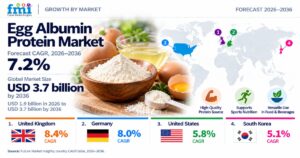

The global egg albumin protein market is projected to grow from USD 1.9 billion in 2026 to USD 3.7 billion by 2036, registering a compound annual growth rate (CAGR) of 7.2%, according to Future Market Insights (FMI).
Get detailed market forecasts, competitive benchmarking, and pricing trends:
https://www.futuremarketinsights.com/reports/sample/rep-gb-15308
Egg albumin protein is used in food formulations that require protein alongside functional properties such as foaming, thickening, binding and gel formation. Its established applications in bakery products, confectionery, prepared foods and dry mixes support demand for liquid, dried and standardized egg-white ingredients.
Processed egg availability supports ingredient demand
Food manufacturers increasingly require ingredients that deliver both nutritional content and predictable processing performance. Egg albumin can help incorporate air into whipped products, bind ingredients and form structure during heating, making it relevant to several manufacturing applications.
Processed-egg output provides an important supply indicator. In the United Kingdom, egg-product production reached 19.4 thousand tonnes in the second quarter of 2026, up 32.3% from the same period a year earlier, according to the Department for Environment, Food & Rural Affairs (DEFRA).
Germany also has a substantial domestic egg-production base. The country’s statistical authority, Destatis, reported that Germany produced 13.7 billion eggs during 2025. These supply conditions support opportunities for processors converting eggs into ingredients for food manufacturing.
Where growth is fastest
FMI projects stronger growth in the United Kingdom and Germany than in the other profiled markets over the 2026–2036 forecast period.
- United Kingdom — 8.4% CAGR: Rising processed-egg output provides a larger raw-material base for ingredient production. Suppliers still need to demonstrate stable functional performance and maintain clear origin and allergen records.
- Germany — 8.0% CAGR: Domestic egg production and established bakery, confectionery and prepared-food manufacturing support demand. Consistent viscosity, water retention and heat-set behavior remain important for ingredient qualification.
- Japan — 7.2% CAGR: Demand from bakery, confectionery, foodservice and other processed-food applications supports the use of liquid and powdered egg ingredients.
- United States — 5.8% CAGR: Established egg-breaking and processing operations support the availability of dried egg whites, isolates and liquid formats. Suppliers must continue to meet processing and allergen-control requirements.
- South Korea — 5.1% CAGR: Processed-egg imports and government supply measures can help address domestic availability constraints, although sourcing costs and documentation remain important.
What leads the market
FMI identifies three significant segments within the egg albumin protein market for 2026.
- Regular/unflavored products — 74.2%: Neutral sensory properties allow manufacturers to use the same ingredient grade across products with different final flavor profiles.
- Bakery and confectionery — 20.5%: Egg albumin supports aeration in products such as cakes and meringues and helps create structure during heating.
- Thickening — 20.4%: Protein behavior during processing supports viscosity development, water retention and gel formation under suitable formulation conditions.
The hurdle: allergen control and supplier qualification
Egg-allergen requirements can lengthen ingredient approval and complicate changes to established formulations. Food manufacturers must ensure that ingredient declarations, cross-contact controls and cleaning records support the finished product’s labeling and applicable regulatory requirements.
FMI identifies tailored and fermentation-derived albumen as an opportunity for manufacturers seeking additional supply options and specific functional properties. Commercial suitability will depend on the intended application, processing requirements and the ability to demonstrate consistent performance.
Recent developments and industry investment
Developments in fermentation, analytical testing and processed-egg supply illustrate activity across the broader ingredient sector.
- June 15, 2026: The EVERY Company and Huvepharma announced a fourfold expansion in fermentation-derived ovalbumin production capacity, using more than nine million liters of installed fermentation capacity and focusing on OvoPro.
- September 16, 2025: The FDA closed GRAS Notice No. 1249 with no questions for ovalbumin produced using Trichoderma reesei for defined food applications.
- January 23, 2026: Ovostar presented liquid and dried egg products for food manufacturing, foodservice and distribution at Gulfood 2026.
These developments relate to alternative ovalbumin production, regulatory review and processed-egg products. They should not be interpreted as evidence that every product is interchangeable with conventional egg albumin or approved for every application.
FMI profiles the following companies among the notable participants in the market: Kewpie Corporation, Rembrandt Foods, Taiyo Kagaku Co., Ltd., Rose Acre Farms, Ovostar, Merck KGaA, HiMedia Laboratories Pvt. Ltd., Sanovo, NOW Health Group and JW Nutritional LLC.
Analyst perspective
“Egg albumin protein demand will be higher for grades that remain stable during heating, mixing and storage. In my experience, complete qualification records and repeatable performance will decide which grades enter regular production.” — Nandini Roy Choudhury, Principal Consultant, Future Market Insights.
What this means for food manufacturers and ingredient buyers
- Qualify ingredients under actual production conditions. Test foaming, thickening, solubility, water retention and heat-set behavior using the intended formulation and manufacturing process. Performance in a laboratory test alone may not establish suitability for full-scale production.
- Include allergen documentation in supplier selection. Review ingredient specifications, labeling information, cross-contact controls and cleaning records before approving a new supplier. Ensure that changes to the ingredient or production process are reflected in the appropriate documentation.
- Assess alternative supply options against technical requirements. Conventional and fermentation-derived ovalbumin may offer different sourcing and production considerations. Compare consistency, functional performance, application suitability and supply arrangements before changing an approved ingredient grade.
For detailed forecasts, flavor-type and application segmentation, country-level growth rates and competitive analysis, read Future Market Insights’ Egg Albumin Protein Market Report:
https://www.futuremarketinsights.com/reports/egg-albumin-protein-market
Explore More Research Reports by FMI
Egg Powder Market –
https://www.futuremarketinsights.com/reports/egg-powder-market
Eggshell Membrane Powder Market –
https://www.futuremarketinsights.com/reports/eggshell-membrane-powder-market
Salted Egg Yolk Ingredients Market –
https://www.futuremarketinsights.com/reports/salted-egg-yolk-ingredients-market
About Future Market Insights (FMI)
Future Market Insights, Inc. (FMI) is an ESOMAR-certified, ISO 9001:2015 market research and consulting organization, trusted by Fortune 500 clients and global enterprises. With operations in the U.S., UK, India, and Dubai, FMI provides data-backed insights and strategic intelligence across 30+ industries and 1200 markets worldwide.
For Press & Corporate Inquiries
Rahul Singh AVP – Marketing and Growth Strategy
Future Market Insights, Inc.
+91 8600020075
For Sales: sales@futuremarketinsights.com
For Media: Rahul.singh@futuremarketinsights.com
For Web: https://www.futuremarketinsights.com/