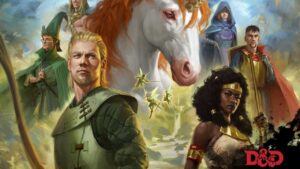

Dungeons & Dragons, commonly known as D&D, is one of the most influential tabletop role-playing games ever created. Unlike traditional board games, D&D does not require players to follow a fixed path or reach a single predetermined ending. Instead, players create characters, explore imaginary worlds, make decisions, overcome challenges, and develop stories together. At the center of the experience is imagination, with one player usually serving as the Dungeon Master, or DM, who describes the world and helps guide the adventure.
D&D was created during the 1970s by Gary Gygax and Dave Arneson. The game grew from the tabletop wargaming community, where players controlled armies and fought battles according to detailed rules. Gygax and Arneson helped transform that idea by allowing players to control individual fantasy characters rather than entire armies. This created a new kind of game in which players could become heroes within an imaginary world.
The basic concept of D&D is simple. Each player creates a character. That character may be a brave fighter, a mysterious wizard, a skilled rogue, a powerful cleric, or another fantasy adventurer. Characters have different abilities, personalities, backgrounds, and goals. As the game continues, they gain experience, become stronger, discover new abilities, and develop their own stories.
The Dungeon Master has a different role. The DM describes the environment, controls non-player characters, introduces enemies and challenges, and explains what happens as the players make decisions. The DM does not normally play against the other participants. Instead, the DM helps create the world in which the adventure takes place.
One of the most interesting features of D&D is that there is no single correct way to solve a problem. Imagine that a group of adventurers discovers a locked door. They might search for a key, attempt to pick the lock, break the door, cast a spell, look for another entrance, or try to convince someone to open it. The rules provide a framework for determining what happens, but the players’ choices shape the story.
Dice are an important part of this process. D&D uses several types of dice, including the famous twenty-sided die, commonly called a d20. When a character attempts something uncertain, the player may roll a die and add relevant bonuses. The result helps determine whether the character succeeds or fails. This combination of player decisions and random outcomes creates unexpected moments.
Character creation is another major part of D&D. Players choose a character’s abilities and often select a race or species, class, background, and other characteristics depending on the edition and rules being used. A character’s class determines many of their abilities and their general role within the adventuring group. Fighters may specialize in combat, wizards use powerful magic, rogues rely on agility and specialized skills, and clerics often combine magical abilities with support and combat.
However, a character is more than statistics. Players are encouraged to give their characters personalities, relationships, fears, ambitions, and histories. Two characters with the same class can therefore feel completely different. One fighter might be a serious soldier seeking redemption, while another could be a cheerful wandering adventurer who loves exploring new places.
Teamwork is also central to D&D. A party of adventurers usually contains characters with different strengths and weaknesses. Success often depends on cooperation. One character might protect the group during combat, another might heal injured companions, another might solve a puzzle, and another might use social skills to negotiate with an important character.
Combat is an important part of many D&D adventures, but it is not the only activity. Players can investigate mysteries, explore dangerous environments, negotiate with powerful characters, solve puzzles, search for hidden treasures, and participate in political or social conflicts within the fictional world.
The flexibility of the game allows D&D to support many different styles of storytelling. One campaign might focus on heroic battles against monsters, while another could emphasize exploration, mystery, comedy, political intrigue, or character relationships. The same basic rules can support very different experiences depending on the players and the Dungeon Master.
D&D has also developed a rich tradition of fantasy settings. Different worlds can contain their own histories, cultures, religions, magical systems, kingdoms, monsters, and legendary figures. Some campaigns use published settings, while others are completely invented by the Dungeon Master or the group.
Magic is another defining element of D&D. Characters can encounter enchanted weapons, magical creatures, mysterious artifacts, ancient spells, and supernatural locations. Magic can change the way players approach problems. A locked door, for example, might become irrelevant if a character possesses a spell that allows the party to bypass it.
Perhaps the most important feature of D&D is storytelling. Unlike a novel or movie, the story is not completely written in advance. The players help create it while they play. A simple decision can produce consequences that affect the campaign for many sessions. A character the players decide to help might later become an important ally. An enemy they allow to escape might return with a new plan.
This makes every D&D campaign different. Even if two groups use the same adventure, their experiences can be completely different because their decisions, dice rolls, personalities, and relationships are different.
D&D has also become an important part of popular culture. Over the years, it has influenced video games, novels, television, movies, fantasy literature, and other forms of entertainment. More importantly, it has introduced millions of people to collaborative storytelling and role-playing.
The game’s lasting appeal comes from the freedom it gives players. There is no screen telling them exactly what to do and no predetermined path that must be followed. Instead, players are encouraged to imagine possibilities and make choices. The rules provide structure, while the players provide creativity.
Ultimately, Dungeons & Dragons is more than a game about fighting monsters and collecting treasure. It is a shared storytelling experience in which people create characters, explore imaginary worlds, solve problems, take risks, and build memories together. The dice may determine whether a character succeeds, but the players decide what their characters attempt.
That combination of imagination, cooperation, uncertainty, and storytelling is what has allowed D&D to remain popular for decades. Whether played by beginners discovering tabletop role-playing for the first time or experienced players who have spent years exploring fantasy worlds, D&D continues to provide something that few other games can offer: the opportunity to create an adventure that belongs entirely to the people sitting around the table.