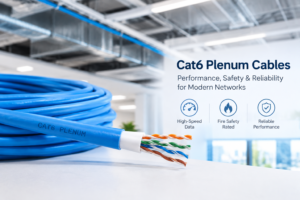

A network is easy to ignore when it works. Video calls stay clear, files move quickly, and nobody thinks about the cables behind the walls. When something goes wrong, though, the cabling is often where the investigation starts.
Good network cabling affects more than speed. It also affects how a building handles risk. Cables run through ceilings, shafts, and the spaces that carry air through a building, so the materials they’re made from matter.
Cat6 Plenum Cables are designed for this situation. They pair the performance of a Cat6 Ethernet cable with a jacket built to meet stricter fire-safety requirements. This guide covers what they are, where they fit, how they compare with other options, and how to choose and install them well.
What Are Cat6 Plenum Cables?
Cat6 in Plain Terms
Cat6 is a category of twisted-pair Ethernet cable. It is built to support Gigabit Ethernet and, over shorter distances, 10 Gigabit speeds. Compared with older Cat5e, it typically has tighter twisting and often an internal separator, which helps limit interference between the wire pairs.
What “Plenum-Rated” Means
“Plenum-rated” describes the outer jacket and insulation, not the data performance. A plenum-rated Ethernet cable is made with materials tested to resist flame spread and produce limited smoke. In the United States, this is generally associated with a CMP rating under the National Electrical Code (NEC) and related testing standards.
Standard Cat6 vs. Cat6 Plenum
Both types carry data the same way. The difference is the jacket:
- Standard Cat6 usually has a PVC jacket suited to general-purpose use.
- Cat6 Plenum uses a low-smoke, flame-retardant jacket, often made from FEP or a similar compound, so it can be installed in plenum spaces.
Why Plenum Rating Matters in Network Cabling
What Is a Plenum Space?
A plenum is an area that carries air as part of a building’s heating, ventilation, and air conditioning (HVAC) system. Common examples are the space above a drop ceiling or beneath a raised floor, when that space is used for air return.
Why Cable Choice Matters There
Air moves freely through these spaces. If a fire starts, smoke and fumes can travel through the plenum to other parts of the building. For that reason, building and fire codes commonly require cables in these areas to have jackets that limit flame spread and smoke.
A few practical points:
- Fire safety: Plenum jackets are tested to resist burning and slow its spread.
- Smoke characteristics: They are designed to produce less smoke than standard jackets.
- Jacket material: Materials like FEP are chosen for these properties, though they are typically stiffer and more expensive.
Requirements vary by location, so check the applicable code or ask the local authority having jurisdiction (AHJ) before installing.
Key Features of Cat6 Plenum Cables
High-Speed Data Transmission
Cat6 supports Gigabit Ethernet and, over limited distances (up to about 55 meters under typical conditions), 10GBASE-T. That makes it a solid fit for modern workloads such as cloud applications, video conferencing, and large file transfers.
Improved Bandwidth
Cat6 is specified up to 250 MHz, compared with 100 MHz for Cat5e. The extra headroom helps the cable handle higher-frequency signals with less degradation.
Durable Construction
Plenum jackets are built to meet demanding flame and smoke tests. Quality cables also use well-made conductors and insulation, which helps them hold up over years of service when installed correctly.
Reduced Signal Interference
Tighter twists and, in many designs, a spline or separator between pairs help reduce crosstalk. Less interference generally means a more stable connection, especially in bundles of many cables.
Plenum-Rated Outer Jacket
This is the feature that sets the cable apart. It lets one cable type be used in both plenum and non-plenum areas, which can simplify planning where a run passes through different spaces.
Benefits of Using Cat6 Plenum Cables
- Better network performance: Cat6 offers more headroom than Cat5e, which helps with busy networks and high-bandwidth tasks.
- Enhanced safety: The jacket is designed to meet fire and smoke requirements for plenum spaces.
- Reliable long-term connectivity: Quality materials and proper installation support stable performance over time.
- Suitability for demanding environments: Buildings with dense cabling or strict code requirements often benefit from plenum-rated cable.
- Support for modern requirements: Cat6 handles current needs well and gives some room for growth, though no cable can guarantee it will meet every future standard.
Actual results depend on installation quality, connected equipment, and cable length.
Where Are Cat6 Plenum Cables Commonly Used?
| Setting | Why plenum-rated Cat6 can be appropriate |
|---|---|
| Office buildings | Drop ceilings often serve as air return spaces, so code may require plenum cable for runs above them. |
| Commercial spaces | Retail, hospitality, and mixed-use buildings often share HVAC systems, and cabling must meet code throughout. |
| Data centers | Dense cabling and strict safety practices make low-smoke, flame-retardant jackets a common choice, along with Cat6’s performance. |
| Schools and educational institutions | Many people occupy these buildings, so safety requirements are taken seriously, and networks must support learning devices. |
| Healthcare facilities | Reliable connectivity matters for patient systems and records, and safety standards are high. |
| Buildings with plenum air spaces | Wherever cables pass through air-handling spaces, plenum-rated cable is typically what code requires. |
Cat6 Plenum vs. Cat6 PVC Cables
Neither option is better in every case. The right choice depends on where the cable will run.
| Factor | Cat6 Plenum (CMP) | Cat6 PVC (CM/CMR) |
|---|---|---|
| Jacket material | Low-smoke, flame-retardant compounds such as FEP | Polyvinyl chloride (PVC) |
| Fire and smoke characteristics | Designed to limit flame spread and smoke; meets stricter tests | Meets general-purpose or riser requirements; produces more smoke |
| Suitable environments | Plenum spaces, and generally other areas too | Non-plenum areas such as walls, risers (if riser-rated), and open spaces |
| Cost | Typically higher | Typically lower |
| Flexibility | Often a bit stiffer | Often more flexible and easier to handle |
When Each May Be Appropriate
- Choose plenum-rated cable when the run goes through a plenum space or when local code or building policy calls for it.
- Choose PVC cable for non-plenum areas where code allows it, especially if budget and flexibility are priorities.
Note that a higher-rated cable can usually replace a lower-rated one, but not the other way around. Always confirm with local code.
How to Choose the Right Cat6 Plenum Cable
Before buying, work through these checks:
- Required length. Measure the actual route, not the straight-line distance. Cat6 channels are generally limited to 100 meters in total, including patch cords. Add some slack for service loops.
- Conductor quality. Look for solid copper conductors for permanent installs. Be cautious with copper-clad aluminum (CCA), which doesn’t meet the same standards and can perform poorly. Solid-copper cable is also what most structured cabling standards expect for horizontal runs.
- Performance requirements. Consider your current speeds and what you may need later. If 10 Gigabit is likely, check the cable’s specifications and distance limits.
- Certifications and standards. Look for CMP marking on the jacket, listing by a recognized testing lab (such as UL or ETL), and compliance with TIA/EIA-568 category requirements.
- Installation environment. Confirm whether the route crosses plenum spaces, risers, or outdoor areas, since each has its own requirements.
- Manufacturer reliability. Choose suppliers who provide clear specifications, consistent quality, and responsive support.
Installation Tips for Cat6 Plenum Cables
- Follow applicable standards. Installation should comply with local electrical and fire codes, along with TIA standards. If you’re unsure, a qualified installer can help.
- Avoid excessive bending or pulling. Keep the bend radius at or above the manufacturer’s recommendation (commonly about four times the cable diameter) and avoid pulling too hard, which can damage the conductors and affect performance.
- Maintain proper separation. Keep data cables away from power lines and other sources of electromagnetic interference. Follow code-required distances.
- Use compatible components. Connectors, jacks, and patch panels should be rated for Cat6. A weak link anywhere in the channel can limit performance.
- Terminate carefully. Keep the untwisted portion of each pair as short as possible at the termination point.
- Test after installation. Use a certification tester to check the channel for continuity, length, and performance. Testing catches problems early, when they’re easier to fix.
Why Choose TS Cables for Cat6 Plenum Cables?
TS Cables offers networking cable solutions for homes, offices, and larger commercial environments. Its range includes Ethernet cables for different infrastructure needs, with a focus on dependable quality and clear product information.
When comparing suppliers, it helps to see specifications, cable types, and use cases laid out plainly. You can browse the available options at TS Cables to see how different cable types might fit your project, whether it’s a small office upgrade or a larger network infrastructure build-out.
Conclusion
Cat6 Plenum Cables are a practical option for networks where performance and installation safety both matter. They deliver the speed and bandwidth of Cat6, and their jackets are designed for the demands of plenum spaces.
That said, the best cable is the one that suits the building, the route, and the network’s needs. Check local code, confirm the installation environment, and compare quality indicators such as conductor material and certifications. With the right choice and careful installation, your cabling can support the network reliably for years.