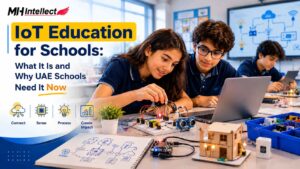

Quick Answer
The Internet of Things connects physical devices, sensors, networks, and automated systems so they can collect, share, and respond to real-world data. For schools, this creates an engaging way to teach science, technology, engineering, mathematics, coding, data, and automation through practical projects. Students can build connected systems, analyse sensor data, troubleshoot problems, and understand how smart technologies operate in real-world environments.
Introduction
As smart buildings, connected transport, automated systems, and environmental monitoring become part of everyday life, schools have an opportunity to help students understand how these technologies actually work. IoT education for schools connects science, technology, engineering, mathematics, coding, and data through practical projects, allowing students to work with sensors, connected devices, and automation while developing problem-solving, creativity, collaboration, and future-ready technology skills.
Why IoT Education Matters for Schools
IoT education for schools turns abstract STEM concepts into something students can physically build and test. Instead of simply reading about sensors or automation, learners can create systems that respond to changes in temperature, light, moisture, movement, or other environmental conditions.
Through IoT education, students can develop:
- Systems thinking and technical reasoning
- Data collection and interpretation skills
- Coding and computational thinking
- Engineering problem-solving
- Collaboration and communication
- Creativity through design and experimentation
This makes connected technology a practical platform for developing skills that extend beyond the technology classroom.
How IoT Works in the Classroom
A strong IoT project can take students through a simple but powerful learning cycle: understand the components, collect data, programme a response, test the system, identify problems, and improve the design.
For example, students could build a smart environmental monitoring system using sensors to collect information and trigger an automated response. They can then investigate why the system behaves differently under changing conditions and use evidence to improve its performance.
This is the real value of IoT in education. Students are not simply using connected devices; they are learning how those devices sense, communicate, process information, and respond.
Connecting IoT With STEAM Learning
IoT naturally connects multiple disciplines. Science helps students understand physical conditions and environmental changes. Mathematics supports measurement and data analysis. Technology introduces sensors, connectivity, and programming, while engineering encourages students to design reliable systems.
Schools interested in broader interdisciplinary applications can explore IoT and STEAM Education for examples of how connected technology can support project-based learning.
IoT and Real-World Applications
IoT technologies in modern cities, healthcare, transportation, logistics, agriculture, and smart buildings surround students. This allows schools to connect classroom projects with technologies students may encounter in future careers.
For UAE schools, this connection can be particularly engaging. Students can explore smart energy systems, environmental monitoring, automated irrigation, intelligent buildings, and connected infrastructure. Smart Sustainability Systems for Schools provides further examples of how IoT can be connected with sustainability and practical school projects.
How MH Intellect Supports IoT Learning
MH Intellect helps schools develop structured technology and STEM learning experiences through IoT, robotics, coding, AI, engineering, STEM labs, teacher training, and project-based programmes. The focus is on helping educators connect technology with meaningful learning objectives rather than treating IoT as a standalone activity.
A structured programme can help students progress from understanding basic sensors and controllers to building connected systems, analysing data, troubleshooting faults, and improving their designs.
Build a Future-Ready IoT Learning Environment
IoT education gives students more than an introduction to connected devices. It develops the ability to understand systems, work with data, solve technical problems, and improve real-world solutions through experimentation.
Ready to introduce practical IoT learning into your school? Book a consultation with MH Intellect to explore customised IoT, STEM, robotics, coding, and technology education programmes designed around your school’s learning goals.