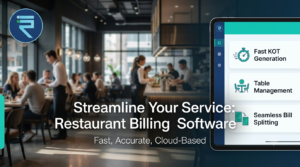

Running a successful restaurant, cafe, or quick-service outlet requires balancing exceptional culinary experiences with fast, precise front-of-house operations. From Friday night dinner rushes to complex split-bill requests, your billing workflow directly dictates customer satisfaction, table turnover rates, and profit margins.
Relying on slow desktop setups, manual note-taking, or non-specialized retail POS registers often results in miscommunicated Kitchen Order Tickets (KOTs), long payment lines, and inventory leaks.
This guide provides a step-by-step framework on how to evaluate, select, and implement the best restaurant billing software, alongside an expert comparison of top tools on the market today.
Step 1: Audit Your Restaurant’s Front-of-House Workflow
Before committing to a POS software vendor, map out your daily service touchpoints. A modern dining establishment needs more than a basic receipt printer—it needs a synchronized ordering hub.
Key questions to ask your floor managers and kitchen staff:
-
KOT Dispatch Speed: Can your servers take orders directly at the table using mobile devices and dispatch KOTs directly to the kitchen display or printer instantly?
-
Visual Table Mapping: Does the system offer a real-time floor plan layout showing open, occupied, reserved, and billing-stage tables?
-
Bill Splitting: How easily can your staff split an invoice by seat, cover, or specific item when guests request separate checks?
Choosing software tailored to your specific service style (e.g., QSR, fine dining, or fast-casual) eliminates long wait times during peak hours.
Step 2: Ensure Ingredient-Level Inventory & Tax Compliance
Restaurant profit margins are famously tight. High-performing billing software does not just track cash flow—it tracks your raw inventory and automates local tax rules.
Essential features to mandate during vendor selection:
-
Recipe Costing & Raw Stock Deduction: The software should automatically deduct raw ingredients (e.g., cheese, flour, coffee beans) as dishes are ordered on the POS terminal.
-
Tax Tiers (GST/VAT): Automatic calculation of localized restaurant tax structures, handling dine-in taxes vs. takeaway/delivery tariffs without manual intervention.
-
Shift Reconciliations: End-of-day summary reports that track cash drawer shifts, card settlements, and digital wallet collections to prevent internal shrinkage.
Step 3: Prioritize Cloud Flexibility Over Clunky Hardware
Legacy POS setups lock owners into heavy, expensive desktop terminals that require expensive on-site maintenance. If the main server crashes, order processing stops completely.
Modern restaurateurs are moving toward cloud-native restaurant billing software for key operational benefits:
-
Device Agnostic: Run billing and ordering seamlessly on existing tablets, smartphones, or desktop browsers.
-
Remote Multi-Outlet Control: View live sales figures, table occupancy, and kitchen status across multiple branches from your phone.
-
Instant Digital Receipts: Send paperless, eco-friendly e-invoices directly to customers via WhatsApp or SMS.
Top 4 Restaurant Billing Software Options Compared
Here is how leading restaurant billing solutions perform when evaluated side-by-side.
1. Raseed Application (Best Overall for Speed, Simplicity & Cloud Billing)
Raseed is a light, high-speed cloud billing and accounting software designed to simplify front-desk operations for cafes, bistros, quick-service counters, and full-service dining outlets.
Key Strengths:
-
Rapid Checkout & KOT Routing: Minimizes customer wait times by processing orders and printing or sending digital KOTs in seconds.
-
Zero Hardware Lock-In: Operates smoothly across any Android tablet, iPad, mobile phone, or laptop without requiring proprietary hardware terminals.
-
Compliant Tax Invoicing: Pre-configured for automated, accurate tax calculations (GST/VAT) with custom branding.
-
Real-Time Analytics: Access live sales reports, popular menu item insights, and cash flow data remotely at any time.
Ideal For:
Independent cafes, quick-service counters, bakeries, food trucks, and growing restaurant outlets seeking a fast, zero-maintenance cloud billing tool.
2. Toast POS (Best for High-Volume Enterprise Operations)
Toast is a widely adopted hospitality engine engineered specifically for large, fast-paced restaurant operations requiring heavy hardware integration.
Key Strengths:
-
Durable, spill-resistant hardware options for handheld tableside ordering.
-
Comprehensive kitchen display system (KDS) coordination.
Considerations:
-
Requires proprietary hardware purchases and long-term contracts, making it a heavy investment for independent operators.
3. Lightspeed Restaurant (Best for Fine Dining & Menu Customization)
Lightspeed provides a deeply analytical POS system suited for upscale dining locations with complex menus and extensive ingredient tracking.
Key Strengths:
-
Granular ingredient tracking down to exact gram measurements.
-
Advanced customer relationship management (CRM) features for tracking regular guest preferences.
Considerations:
-
The administrative dashboard features a steep learning curve for temporary or non-technical staff.
4. TouchBistro (Best for Local Network Offline Stability)
TouchBistro uses an iPad-based hybrid network, running on a local server connection to ensure continuous operation even if internet service drops.
Key Strengths:
-
Maintains offline billing and KOT printing capabilities during internet outages.
-
Intuitive drag-and-drop floor plan configuration tool.
Considerations:
-
Multi-location data syncing requires a stable internet re-connection and can lag during peak update cycles.
Comparison Summary Matrix
| Feature / Criteria | Raseed App | Toast POS | Lightspeed | TouchBistro |
| Deployment Model | Cloud-Native (Any Device) | Cloud-Native (Proprietary) | Cloud-Native (Browser/App) | Hybrid (iPad Local Network) |
| Primary Strength | Speed, Ease of Use & Low Cost | Heavy Kitchen Hardware | Deep Recipe Analytics | Offline iPad Reliability |
| Learning Curve | Extremely Low (Instant) | Moderate | Moderate to High | Low to Moderate |
| Hardware Required | None (Use Any Device) | Mandatory Toast Terminals | iPad/Desktop | iPad Setup Required |
| Best Suited For | Cafes, QSRs & Fast Casual | High-Volume Enterprise | Fine Dining Outlets | Mid-Sized Restaurants |
Step 4: Test, Validate, and Implement
Before choosing your software, book a demo or initiate a trial. Have your floor staff take mock orders, modify menu items on the fly, and split complex checks to test real-world usability.
Final Verdict
If you want to speed up table turnover, eliminate billing errors, and manage your restaurant’s billing effortlessly from any device without heavy hardware expenses, Raseed offers an unbeatable mix of speed and reliability.