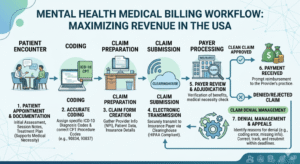

The demand for behavioral health services across the United States has reached an all-time high. While this shift has brought mental health into the mainstream spotlight, it has also placed an immense administrative burden on therapists, psychologists, and psychiatrists. For many practitioners, the clinical side of helping patients is a passion, but the administrative side—specifically billing for mental health providers—is a source of constant frustration. Unlike traditional physical medicine, behavioral health claims face unique scrutiny, complex pre-authorization rules, and distinct coding structures that can easily lead to denials.
Understanding the nuances of the American healthcare reimbursement system is no longer optional; it is a necessity for keeping a practice sustainable. When a private practice or clinic struggles with its financial workflow, clinical care inevitably suffers. Implementing streamlined systems, staying updated on changing regulations, and knowing when to look for external expertise can transform a struggling practice into a thriving, resilient healthcare business.
Why Behavioral Health Billing is Uniquely Challenging
Many practitioners transition from institutional settings to private practice assuming that filing an insurance claim is a straightforward, uniform process. However, the realities of American healthcare quickly reveal that behavioral health requires a highly specialized approach.
The Problem of Time-Based Coding
Unlike an orthopedic visit or a routine physical exam, which are often billed based on the complexity of the medical decision-making, mental health encounters are heavily tied to time.
-
CPT Code 90834: Psychotherapy, 45 minutes with patient.
-
CPT Code 90837: Psychotherapy, 60 minutes with patient.
-
CPT Code 90791: Psychiatric diagnostic evaluation (untimed, but strict limits on frequency).
If a session lasts 50 minutes, coding it as a 60-minute session constitutes fraudulent billing, while coding it under a lesser time bracket loses the practice well-deserved revenue. Tracking exact face-to-face time is vital for audit protection.
Prior Authorization and Medical Necessity
Insurance payers frequently question the “medical necessity” of long-term mental health treatment. While a broken bone has a clear healing timeline, conditions like major depressive disorder, PTSD, or generalized anxiety require ongoing care that doesn’t always follow a linear path. Providers must meticulously document functional impairments and treatment goals to justify continued care to insurance adjusters who may have zero clinical background in psychology.
The Essential Pillars of Financial Health for Therapists
To build an efficient administrative workflow, providers must look at their practice through the lens of a comprehensive financial ecosystem. This ecosystem relies on several distinct but interconnected administrative functions.
1. Accurate Translation of Services
Every clinical interaction must be translated into standard alphanumeric formats that insurance companies understand. This requires precise medical coding services to ensure that diagnostic codes (ICD-10) align perfectly with procedure codes (CPT). For example, if a practitioner uses a dual-diagnosis approach addressing both substance abuse and depression, the sequence of these codes can determine whether a claim is paid or rejected.
2. Comprehensive Claim Management
Once coded, the claims must be scrubbed for errors, submitted to clearinghouses, and tracked until payment is received. Utilizing dedicated medical billing services helps eliminate common data-entry mistakes, such as mismatched policy IDs, incorrect modifier usage (like Modifier 95 for telehealth), or missing provider demographics.
3. Integrated Practice Workflows
When a practice tries to separate coding from billing entirely, details fall through the cracks. Merging these workflows into cohesive medical billing and coding services creates a seamless bridge between the clinical note and the final remittance advice. This integration ensures that the nuances of a session are accurately reflected in the financial documentation.
4. Holistic Revenue Lifecycle Management
The financial health of a clinic isn’t just about submitting claims; it encompasses the entire lifecycle of a patient’s account. This starts from the moment a patient calls to check their benefits, extends through copay collection, covers denial management, and ends with final balance resolution. Broad revenue cycle management services give providers a macro-view of their practice’s financial performance, tracking key metrics like Days in Accounts Receivable (AR) and clean claim rates.
+------------------------------------------------------------------------+
|                 The Behavioral Health Billing Cycle                    |
+------------------------------------------------------------------------+
|                                                                        |
|  1. Insurance Verification -> 2. Accurate Coding -> 3. Claim Scrubbing  |
|                                     |                                  |
|  6. Patient Collections    <- 5. Denial Management <- 4. Clearinghouse |
|                                                                        |
+------------------------------------------------------------------------+
The Critical Role of Payer Enrollment and Credentialing
Before a provider can even think about submitting a claim for an in-network patient, they must be officially recognized by the insurance network. This is where many new practices hit a brick wall.
The process of insurance paneling is notoriously slow, often taking anywhere from three to nine months. If a provider treats a patient before the credentialing effective date, the insurance company will completely deny the claims, and the provider cannot retroactively bill the patient for the full amount in most cases.
Investing time and resources into professional credentialing services is essential for any expanding practice. These services manage the tedious paperwork, CAQH profile updates, primary source verifications, and contract negotiations required to get providers in-network quickly. Without proper credentialing, a practice cannot effectively utilize standard billing workflows, leaving thousands of dollars on the table.
Common Pitfalls that Drain Practice Revenue
-
Inadequate Documentation for Interactive Complexity (+90785): This add-on code is frequently used when billing for children or situations involving play therapy, translators, or disruptive family members. However, audit teams look closely at these claims. If the documentation doesn’t explicitly justify why the session required interactive complexity, the payer will claw back the funds.
-
Misunderstanding Telehealth Modifiers: The shift to remote therapy revolutionized the industry, but regional payer rules for telehealth vary wildly. Using the wrong place of service (POS) code or missing modifiers can result in instant denials.
-
Neglecting the Eligibility Verification Stage: Assuming a patient’s insurance is active just because they present a physical card is a costly mistake. Deductibles reset annually, employer plans change without notice, and behavioral health benefits are frequently managed by entirely different carve-out networks.
Streamlining Your Practice Operations
For independent practitioners and mid-sized clinics, managing these administrative hurdles internally often leads to clinician burnout. When a licensed therapist spends ten hours a week arguing with insurance representatives on the phone, they are losing ten hours of billable client time.
Outsourcing these burdens to specialized professionals allows clinicians to return to what they do best: providing exceptional care. Many modern practices find that partnering with a comprehensive partner like 247 Medical Billing Services helps stabilize their cash flow. By leveraging expert assistance across medical billing services, medical coding services, and unified medical billing and coding services, practices reduce their error rates significantly. Furthermore, integrating robust revenue cycle management services alongside proactive credentialing services ensures that the practice can scale organically, add new clinicians without friction, and maintain a healthy, predictable bottom line.
Frequently Asked Questions
1. What is the difference between a psychiatric diagnostic evaluation (90791) and a standard psychotherapy session code?
CPT code 90791 is used for the initial assessment and diagnostic interview. It is typically billed once per patient at the start of treatment (unless there is a significant break in care). It does not include active therapeutic intervention. Standard psychotherapy codes (like 90834 or 90837) are used for ongoing treatment sessions after a diagnosis and treatment plan have been established.
2. Can I bill for a family therapy session if the primary patient is not present?
Yes, under specific codes. CPT code 90846 is utilized for family psychotherapy without the patient present. However, the focus of the session must still directly benefit the treatment goals of the primary identified patient, and this must be clearly detailed in the clinical documentation.
3. How do insurance “carve-outs” affect mental health billing?
A carve-out occurs when an employer or primary health insurance company separates behavioral health benefits from general medical benefits. The mental health benefits are managed by a completely different third-party administrator. Providers must ensure they verify eligibility with the specific carve-out company and send claims to their unique address, rather than the main medical insurance address.
4. Why are 60-minute psychotherapy sessions (90837) frequently flagged for audits?
Many insurance companies look closely at 90837 because it has a higher reimbursement rate than the 45-minute code (90834). If a provider routinely bills every single patient for 90837, payers may audit the practice to verify that the sessions actually lasted the full duration and that a 60-minute session was clinically necessary for the patient’s condition.