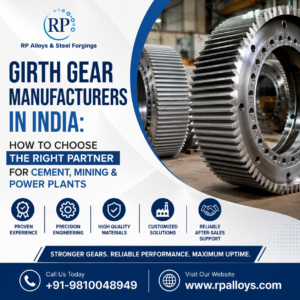

Why Girth Gears Are the Backbone of Heavy Rotating Equipment
If you run a cement plant, a mining operation, or a power generation facility, you already know that a single point of failure in your kiln, ball mill, or rotary dryer can shut down production for days. At the center of that rotating equipment sits one critical component: the girth gear.
A girth gear is a large-diameter ring gear mounted around a rotary kiln, ball mill, or dryer shell. It transfers torque from the drive motor to the shell, keeping the entire system rotating smoothly under enormous loads, heat, and dust. Because girth gears operate continuously — often for 20+ years — the quality of the casting, the precision of the machining, and the metallurgy of the alloy steel used all directly determine plant uptime.
This is why choosing the right girth gear manufacturer in India isn’t just a procurement decision. It’s a reliability decision.
What Goes into Manufacturing a Reliable Girth Gear
A girth gear that performs for decades doesn’t happen by accident. It requires control at every stage:
- Alloy Selection and Casting
The process starts with selecting the right alloy steel grade based on the load, speed, and environment the gear will operate in — whether that’s the abrasive dust of a cement kiln or the corrosive conditions of a chemical plant. In-house foundries that control melting, pouring, and heat treatment can maintain tighter consistency than manufacturers who outsource casting.
- Precision Machining
Once cast, the gear blank needs to finish machining to exact tooth profiles, bore tolerances, and surface finishes. Even small deviations in tooth geometry can cause vibration, noise, and premature wear once the gear is under load in the field.
- Quality Testing
Reputable manufacturers test hardness, dimensional accuracy, and material integrity before a girth gear ever leaves the shop floor. This is especially important for large-diameter gears, where a defect discovered after installation is far more costly to fix.
- Under-One-Roof Manufacturing
Manufacturers that handle casting, machining, and assembly in-house — rather than coordinating between multiple vendors — tend to offer better consistency, shorter lead times, and clearer accountability if something needs rework.
Industries That Depend on Heavy Cast & Machined Components
Girth gears are just one part of a much larger family of components that heavy industries rely on. Support rollers, pinions, shafts, mill heads, bearing housings, thrust rollers, wire rope pulleys, and tyre/riding rings all work together to keep rotating equipment running. Industries that depend most heavily on these components include:
- Cement plants — kilns, grinding mills, and rotary equipment
- Mining & minerals — crushers, ball mills, and material handling systems
- Metals processing — ladles, liners for converters, and furnace equipment
- Power generation — turbine and boiler auxiliary components
- Paper mills — rotating drums and processing equipment
- Sugar plants — crushing and milling machinery
- Chemical plants — corrosion-resistant processing components
Questions to Ask Before You Order a Girth Gear or Cast Component
- Is casting done in-house, or outsourced? In-house casting generally means tighter quality control.
- What’s the typical lead time for custom specifications? Component size and complexity should determine this require a realistic timeline, not a generic one.
- Can they share past experience with your specific industry? A manufacturer with three decades of experience across cement, mining, and power generation will understand load conditions your equipment faces.
- What quality and sustainability practices are in place? Ask about material sourcing, energy use in production, and testing protocols.
About R.P. Alloys & Steel Forgings
R.P. Alloys & Steel Forgings has been manufacturing finished-machined alloy steel cast components for heavy engineering industries since 1990. With an in-house foundry and machining shop, the company delivers girth gears, support rollers, pinions, shafts, mill heads, bearing housings, and other critical components to cement, mining, metals processing, power generation, paper, sugar, and chemical industries worldwide — all under one roof, from casting through to finished assembly.
To discuss specifications or request a quote, reach out at info@rpalloys.com or +91-9810048949.
Frequently Asked Questions
What industries use girth gears?
Girth gears are used primarily in cement kilns, ball mills, rotary dryers, and other large rotating equipment across cement, mining, power generation, and minerals processing industries.
How long do alloy steel girth gears typically last?
With proper alloy selection, casting quality, and maintenance, girth gears can operate reliably for two decades or more.
What’s the difference between a girth gear and a pinion?
The girth gear is the large ring gear mounted on the rotating shell; the pinion is the smaller gear driven by the motor that meshes with the girth gear to transfer torque.
Why choose an in-house foundry and machining shop over outsourced manufacturing?
When casting, machining, and assembly happen under one roof, quality control is tighter, lead times are shorter, and there’s a single point of accountability for the finished component.