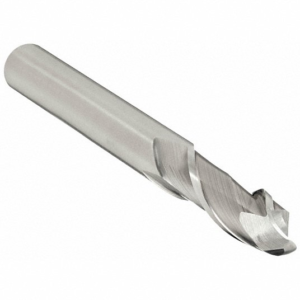

Tool life sets the ceiling on machining throughput, scrap rates, and surface quality. When cutting edges fail early, schedules slip and cost per part rises. Two PVD films do most of the heavy lifting on cutting and forming tools today, and understanding what each one delivers is the foundation of a defensible specification.
What Titanium Nitride Coating Brings to Cutting and Forming Tools
Titanium nitride coating has been the workhorse of precision machining for decades. It deposits a hard, wear-resistant film at roughly 2,300 HV with a coefficient of friction in the 0.4 range. The familiar gold color makes wear patterns easy to identify during inspection, which simplifies regrind and replacement scheduling.
Typical applications include drills, end mills, taps, punches, and forming dies running on carbon steels, low-alloy steels, and aluminum at moderate cutting speeds. TiN bonds well to both high-speed steel and carbide substrates, which broadens the range of tooling that can move through a single coating program. The maximum operating temperature for TiN sits at roughly 600°C. Below that ceiling, the coating delivers steady performance with predictable wear. Above it, oxidation accelerates and the film loses its protective properties.
What Aluminum Titanium Nitride Coating Adds
Aluminum titanium nitride coating addresses the thermal ceiling directly. Adding aluminum to the chemistry forms a thin aluminum oxide layer at the cutting edge as the tool heats up. That oxide layer slows further oxidation and stabilizes the coating at temperatures TiN cannot survive.
Hardness rises into the 3,400 to 3,600 HV range. Maximum operating temperature climbs to around 700°C. The combination makes AlTiN the preferred choice for high-speed cutting, dry or near-dry machining, and harder workpiece materials such as stainless steels, hardened tool steels, and certain superalloys.
The economic case follows physics. Tools coated with AlTiN run faster, hold geometry longer at elevated temperatures, and tolerate reduced coolant. Each of those translates into higher throughput per shift and lower cost per part on the right operation.
Side by Side: Where Each Coating Wins
The choice between them is rarely a coin flip. It is governed by cutting speed, expected edge temperature, and workpiece chemistry.
Titanium nitride coating performs reliably on softer steels and aluminum alloys at moderate speeds with adequate coolant. It is the right call for general-purpose tooling running below 600°C edge temperatures.
Aluminum titanium nitride coating performs reliably at higher speeds, in dry conditions, and on tougher materials. It is the right call when edge temperatures push past 600°C or when production economics demand higher feeds and speeds.
Many shops run both coatings across different tool families, matching each film to the operations it handles best. Treating either as a default tends to leave performance and savings on the table.
How These Coatings Translate to Longer Tool Life
The mechanisms are straightforward. Hardness resists abrasive wear at the cutting edge. Low friction reduces heat generation and built-up edge formation. Oxidation resistance preserves protective properties at temperature. When all three properties match the operation, tools run longer between regrinds, hold dimensional accuracy through more parts, and produce more consistent surface finishes.
Predictable wear also improves scheduling, because tool changes happen on plan rather than in response to surprise failures. The cost argument compounds over time. Fewer regrinds reduce labor and tooling spend. Fewer scrapped parts protect material costs. Tighter cycle-time control supports throughput commitments. Across a year of production, the savings from the right coating routinely exceed the cost of the coating itself by a wide margin.
Verifying That the Coating Performs
Specification is half the equation. Verification confirms that the coating delivers what the data sheet claims. Standard tools include tribometers for friction measurement, calotest instruments for thickness, X-ray fluorescence for composition, and optical microscopy for surface inspection. Together, they give engineers the evidence base needed to trust the coating across long production runs.
Conclusion
Choosing between titanium nitride and aluminum titanium nitride is a temperature and economics decision before it is anything else. TiN handles general-purpose work below 600°C with reliable, low-cost results. AlTiN handles harder materials and higher speeds where heat is the limiting factor. Matching each coating to the operation it suits best is where real tool-life gains and cost-per-part improvements show up across a production schedule.