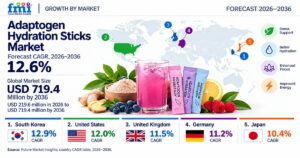

The global adaptogen hydration sticks market is projected to grow from USD 219.6 million in 2026 to USD 719.4 million by 2036, registering a compound annual growth rate (CAGR) of 12.6%, according to Future Market Insights (FMI).
Get detailed market forecasts, competitive benchmarking, and pricing trends:
https://www.futuremarketinsights.com/reports/sample/rep-gb-34864
The category combines hydration-oriented powder servings with adaptogens and functional botanical ingredients in a format designed to be mixed with water. FMI identifies ashwagandha as the leading adaptogen segment, while stress balance is projected to lead functional positioning. Citrus flavors and supermarket distribution also account for substantial shares of their respective categories.
For manufacturers, the opportunity lies in combining a clear hydration purpose with acceptable taste, appropriate ingredient selection and product labeling that meets the requirements of each target market.
Portable hydration creates an opportunity for functional beverage brands
Single-serve powder sticks offer a familiar preparation method: consumers add the product to water when needed. Adding botanical ingredients gives brands another way to differentiate their formulations, but hydration performance must remain clear and independently assessable.
Ashwagandha is an important ingredient in this category because of its established use in stress-oriented supplement formulations. The US National Institutes of Health’s Office of Dietary Supplements, in its Ashwagandha: Health Professional Fact Sheet, reviews human studies on stress, anxiety and sleep while noting that further research is needed and longer-term safety remains uncertain.
For product developers, this makes formulation and communication important commercial considerations. Ingredient dosage, mineral composition, flavor acceptance and the wording of permitted claims must be assessed together before a product moves into retail packaging.
Where growth is fastest
FMI’s country-level forecasts show South Korea leading the five profiled markets between 2026 and 2036.
- South Korea — 12.9% CAGR: A regulated health-functional-food framework makes ingredient recognition and label review important considerations for manufacturers preparing market-entry plans.
- United States — 12.0% CAGR: A broad dietary supplement market creates opportunities for portable functional products. Structure-function claims must be distinguished from disease-treatment claims under applicable US requirements.
- United Kingdom — 11.5% CAGR: The Food Standards Agency published its response to the ashwagandha call for evidence in June 2026, keeping botanical safety documentation relevant for brands and retailers.
- Germany — 11.2% CAGR: The German Federal Institute for Risk Assessment has raised concerns about potential health risks associated with ashwagandha supplements, making ingredient assessment and cautious consumer communication important.
- Japan — 10.4% CAGR: Japanese-language labeling and the notification framework for Foods with Function Claims can affect the preparation of product labels and functional positioning.
The forecasts indicate expected market growth, not the absolute size of each country’s market. Similar growth rates can also require different launch strategies because ingredient rules, labeling frameworks and retail requirements vary by country.
What leads the market
FMI’s 2026 estimates identify five leading segments across different dimensions of the market.
- Ashwagandha — 39.4% of adaptogen demand: Its established role in stress-oriented formulations makes it a prominent ingredient choice for brands developing water-mix products.
- Stress Balance — 33.9% of function demand: This positioning connects the product with everyday routines beyond exercise-specific hydration occasions.
- Citrus — 27.9% of flavor demand: Familiar lemon and lime profiles give manufacturers a recognizable flavor direction for mineral-containing powders.
- Wellness Enthusiasts — 30.7% of end-user demand: Existing interest in daily wellness routines and mixable products supports this consumer segment.
- Supermarkets and Hypermarkets — 50.8% of sales-channel demand: Grocery distribution offers access to routine shopping occasions and broader functional beverage assortments.
These shares describe separate market categories and should not be added together.
The hurdle: botanical safety, claims and repeat-use performance
The main commercial challenge is balancing the hydration proposition with the requirements associated with botanical ingredients. Safety reviews and claim restrictions can affect ingredient selection, label wording and retail onboarding.
In the United States, the Food and Drug Administration distinguishes permissible structure-function claims for dietary supplements from disease claims. In the United Kingdom and Germany, assessments concerning ashwagandha safety create additional considerations for manufacturers and retailers.
Product performance presents another challenge. Mineral ingredients can affect taste, while botanical dosage and flavor systems must remain compatible with the intended serving. If the product is difficult to drink or its purpose is unclear, initial consumer interest may not translate into repeat purchases.
FMI identifies mainstream retail distribution as an opportunity for brands that can communicate the product’s intended use clearly, maintain acceptable flavor and provide the documentation buyers need to assess the formulation.
Recent developments and industry investment
Developments among companies with adjacent hydration, functional beverage and wellness capabilities illustrate activity in portable formats and retail distribution.
- October 14, 2025: Cymbiotika announced its arrival at Target stores nationwide and on Target.com, expanding its reach through a major retail channel.
- April 14, 2025: Thorne announced Daily Electrolytes in portable stick packs designed to be mixed with water.
- February 17, 2025: MUDWTR announced its appearance at Natural Products Expo West 2025, extending its presence beyond a direct-to-consumer-only model.
These developments concern adjacent hydration and functional wellness products. They should not be interpreted as confirmation that every company has launched a dedicated adaptogen hydration stick.
FMI identifies Moon Juice, Four Sigmatic, MUDWTR, Cymbiotika, Golde, Navitas Organics, Thorne and Om Mushroom Superfood as notable companies with relevant hydration, adaptogen, functional mushroom or mixable-powder capabilities.
The competitive field includes hydration-oriented wellness brands, functional mushroom beverage specialists and superfood powder businesses. Their relevant capabilities differ, and the presence of an adjacent product range does not establish a company’s share of the adaptogen hydration sticks market.
Analyst perspective
“Hydration has to remain the first job of the stick. Product teams should qualify the adaptogen dose and mineral profile together, then test flavor acceptance and claim language before committing to retail packaging.” — Nandini Roy Choudhury, Principal Analyst, Future Market Insights
What this means for functional beverage manufacturers and retailers
- Validate hydration performance and taste separately from the botanical proposition. Test the mineral formulation, serving instructions and flavor acceptance before making decisions about packaging or large production runs. A recognizable botanical ingredient cannot compensate for an unsatisfactory drinking experience.
- Review ingredients and claims market by market. Assess the intended ingredient dosage, available safety evidence, applicable labeling rules and permitted claims before entering a new country. A formulation or marketing statement acceptable in one jurisdiction may require changes elsewhere.
- Match retail expansion with buyer documentation. Prepare clear ingredient information, usage instructions and supporting product documentation before approaching supermarkets or specialist retailers. Ensure that product descriptions explain the intended hydration use without making unsupported disease-treatment claims.
For detailed market forecasts, segment shares, country-level growth rates and competitive analysis, read Future Market Insights’ Adaptogen Hydration Sticks Market Report:
https://www.futuremarketinsights.com/reports/adaptogen-hydration-sticks-market
About Future Market Insights (FMI)
Future Market Insights, Inc. (FMI) is an ESOMAR-certified, ISO 9001:2015 market research and consulting organization, trusted by Fortune 500 clients and global enterprises. With operations in the U.S., UK, India, and Dubai, FMI provides data-backed insights and strategic intelligence across 30+ industries and 1200 markets worldwide.
For Press & Corporate Inquiries
Rahul Singh AVP – Marketing and Growth Strategy
Future Market Insights, Inc.
+91 8600020075
For Sales: sales@futuremarketinsights.com
For Media: Rahul.singh@futuremarketinsights.com
For Web: https://www.futuremarketinsights.com/