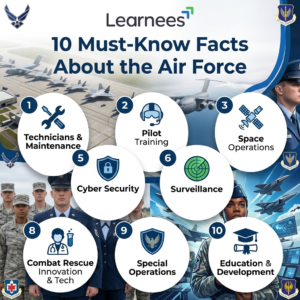

The Indian Air Force (IAF) is one of the country’s key defence forces and plays an important role in protecting India’s airspace and supporting operations during emergencies and national security situations. For students and defence aspirants interested in building a career in the armed forces, understanding how the Air Force works, what career opportunities it offers, and what preparation is required can be a useful first step. Whether you are considering the NDA, AFCAT, Agniveervayu, or another Air Force entry route, knowing the basics can help you make better-informed career decisions.
In this blog, we will explore 10 important facts about the Air Force that every defence aspirant should know.
Table of Contents
- What Is the Indian Air Force?
- Fact 1: The Indian Air Force Was Established in 1932
- Fact 2: The IAF Has Multiple Roles
- Fact 3: The Air Force Offers Different Career Paths
- Fact 4: Flying Is Not the Only Career Option
- Fact 5: Physical Fitness Is Important
- Fact 6: Technical Knowledge Can Be Valuable
- Fact 7: Discipline Is a Major Part of Air Force Life
- Fact 8: Selection Usually Involves Multiple Stages
- Fact 9: Training Is an Important Part of the Journey
- Fact 10: Preparation Should Start Early
- How to Start Preparing for an Air Force Career
- Common Questions About the Air Force
- Explore Defence Opportunities with Learnees
What Is the Indian Air Force?
The Indian Air Force (IAF) is the air arm of the Indian Armed Forces. Its responsibilities include protecting India’s airspace, conducting air operations, supporting other defence forces, and assisting during certain humanitarian and disaster-relief operations.
The IAF includes personnel working across areas such as flying, engineering, administration, logistics, medical services, communications, and other specialised functions.
For students interested in defence careers, the Air Force provides several entry opportunities depending on educational qualifications, age, eligibility, and the particular recruitment notification.
10 Must-Know Facts About the Air Force
1. The Indian Air Force Was Established in 1932
The Indian Air Force was established on 8 October 1932. This date is observed every year as Indian Air Force Day.
Over the decades, the organisation has developed significantly in terms of aircraft, technology, training, operational capabilities, and specialised personnel.
For defence aspirants, the history of the IAF is useful for understanding how India’s air power has evolved over time.
2. The IAF Has Multiple Roles
The Air Force does much more than operate aircraft.
Its responsibilities can include:
- Air defence
- Air operations
- Surveillance and reconnaissance
- Transport and logistics
- Search and rescue support
- Humanitarian assistance
- Disaster-relief support
- Support to other armed forces
This means an Air Force career can involve different responsibilities depending on the branch, role, training, and qualifications of the individual.
3. The Air Force Offers Different Career Paths
One of the most important facts for students is that there is not just one way to join the Air Force.
Depending on eligibility and recruitment rules, aspirants may explore routes such as:
|
Entry Route |
Broad Candidate Category |
Career Stage |
|
NDA |
Students after Class 12 |
Officer entry |
|
AFCAT |
Graduates meeting eligibility requirements |
Officer entry |
|
Agniveervayu |
Eligible candidates under the Agnipath scheme |
Airmen-level entry |
|
Other notified entries |
Varies by recruitment notification |
Depends on entry |
Eligibility requirements can change, so candidates should always check the latest official notification before applying.
4. Flying Is Not the Only Career Option
When people think about the Air Force, fighter aircraft and pilots often come to mind. However, the organisation also requires professionals in several other areas.
Depending on the entry route, careers may involve:
- Engineering
- Administration
- Logistics
- Accounts
- Education
- Meteorology
- Communication and technical roles
- Medical services
- Ground-based support
This makes it important for students to understand different branches instead of assuming that an Air Force career only means becoming a pilot.
5. Physical Fitness Is Important
Defence careers generally require candidates to maintain an appropriate level of physical fitness.
Depending on the entry and selection process, candidates may have to meet prescribed standards related to:
- Height
- Weight
- Vision
- Physical fitness
- Medical fitness
- Other health-related requirements
The exact standards vary by entry and should be checked in the relevant official notification.
Students preparing for defence examinations can benefit from developing healthy habits, regular physical activity, sufficient rest, and a balanced routine.
6. Technical Knowledge Can Be Valuable
Modern air operations depend heavily on technology.
Aircraft systems, communication equipment, navigation, radar, electronics, engineering, information systems, and other technologies play important roles in modern aviation and defence.
For students with an interest in Physics, Mathematics, engineering, electronics, or technology, certain Air Force career paths may be particularly relevant.
However, the required educational background depends on the specific entry route.
7. Discipline Is a Major Part of Air Force Life
Discipline is an important aspect of military service.
Air Force personnel work within structured systems that involve:
- Following procedures
- Teamwork
- Time management
- Responsibility
- Leadership
- Professional conduct
- Physical and mental preparedness
Students interested in defence careers should understand that preparation is not limited to passing an examination. Developing consistency, responsibility, and good time-management habits can also be useful.
8. Selection Usually Involves Multiple Stages
Depending on the entry route, Air Force recruitment can involve several stages.
A selection process may include components such as:
- Written examination or computer-based test
- Shortlisting
- Physical or fitness-related assessment, where applicable
- Psychological or aptitude assessment, where applicable
- Interview or selection-board assessment, depending on entry
- Medical examination
- Final selection based on applicable rules and vacancies
The exact process varies significantly by entry.
Therefore, candidates should avoid preparing solely from old information and should refer to the latest recruitment notification.
9. Training Is an Important Part of the Journey
Selection is only one part of becoming an Air Force professional.
Selected candidates undergo training appropriate to their entry and role. Training can focus on areas such as:
- Military discipline
- Physical fitness
- Leadership
- Technical knowledge
- Professional skills
- Teamwork
- Role-specific responsibilities
The duration and structure of training depend on the entry and career category.
This is why aspirants should understand both the selection process and the training journey before choosing a particular defence career path.
10. Preparation Should Start Early
Preparing for an Air Force career requires consistency.
For students considering routes such as NDA, it can be useful to strengthen academic fundamentals during school. Graduates preparing for AFCAT and other examinations can focus on the syllabus, previous-year questions, mock tests, current affairs, reasoning, English, and other relevant sections.
A simple preparation approach can include:
Step 1: Understand Eligibility
First, check:
- Age requirements
- Educational qualifications
- Nationality requirements
- Physical standards
- Medical standards
- Other entry-specific conditions
Step 2: Understand the Syllabus
Download and study the latest syllabus for your chosen examination.
Step 3: Build Strong Fundamentals
Focus on important subjects and concepts rather than memorising everything without understanding.
Step 4: Practise Previous-Year Questions
Previous-year papers can help you understand question patterns, difficulty levels, and frequently tested concepts.
Step 5: Take Mock Tests
Regular mock tests can help you practise time management and identify areas that need improvement.
Step 6: Maintain Fitness
Include regular physical activity and maintain healthy daily habits alongside academic preparation.
Step 7: Follow Official Updates
Always verify important information such as application dates, eligibility, examination patterns, vacancies, and selection procedures through official recruitment notifications.
NDA vs AFCAT: A Basic Comparison
Students often hear about both NDA and AFCAT when exploring Air Force careers. While both can lead to officer-level careers, they are intended for different stages of education.
|
Feature |
NDA |
AFCAT |
|
Typical education stage |
After Class 12 |
Graduation |
|
Entry type |
Officer entry |
Officer entry |
|
Exam conducted by |
UPSC |
Indian Air Force |
|
Suitable for |
Eligible school students |
Eligible graduates |
|
Selection |
Written exam + subsequent selection stages |
Written exam + applicable subsequent selection stages |
|
Career focus |
Defence officer career |
Officer career through specified branches |
Note: Eligibility, subjects, age limits, branches, and other conditions vary by notification. Candidates should check the latest official information before applying.
How to Choose the Right Air Force Preparation Path
Before joining a coaching program or purchasing a preparation course, students can compare several factors.
Consider checking:
- Syllabus coverage
- Faculty experience
- Mock-test availability
- Previous-year paper practice
- Study material
- Doubt-solving support
- Course duration
- Fees
- Reviews from learners
- Online/offline learning options
- Location and accessibility
Comparing these factors can help students understand which preparation option matches their learning requirements and goals.
Common Mistakes Air Force Aspirants Should Avoid
1. Depending on outdated information
Defence recruitment rules and notifications can change. Always verify current information.
2. Ignoring physical fitness
Academic preparation alone may not be sufficient for entries that include physical or medical requirements.
3. Not practising mock tests
Knowing concepts is important, but exam practice is also necessary.
4. Ignoring previous-year questions
Previous-year papers can provide useful insight into the examination pattern.
5. Choosing a course without comparison
Students should compare courses, faculty, study material, tests, fees, and reviews before making a decision.
6. Starting preparation without understanding eligibility
Before investing significant time in preparation, check whether you meet the requirements for your intended entry.
Frequently Asked Questions About the Air Force
1. When was the Indian Air Force established?
The Indian Air Force was established on 8 October 1932.
2. When is Indian Air Force Day celebrated?
Indian Air Force Day is observed on 8 October every year.
3. Is becoming a pilot the only Air Force career option?
No. The Air Force has various roles and branches involving flying, engineering, administration, logistics, technical functions, medical services, and other areas, depending on the entry and eligibility.
4. Can students join the Air Force after Class 12?
Yes, eligible candidates can explore entry routes such as NDA and other notified opportunities, depending on their qualifications and the applicable recruitment rules.
5. Can graduates join the Air Force?
Yes. Eligible graduates can explore routes such as AFCAT and other applicable entries.
6. Is physical fitness important for Air Force aspirants?
Yes. Depending on the entry, candidates may have to meet prescribed physical and medical standards.
7. Should I join coaching for Air Force preparation?
Coaching is not necessarily required for every student. Some candidates prepare independently, while others prefer structured courses, faculty guidance, mock tests, and study material. Students should compare available options based on their individual learning needs.
8. Where should I check the latest Air Force eligibility requirements?
Candidates should refer to the latest official recruitment notification for accurate information about age, qualifications, medical standards, examination pattern, vacancies, and selection procedures.
Conclusion
A career in the Indian Air Force requires more than an interest in aircraft or defence. Aspirants need to understand their preferred entry route, eligibility requirements, examination pattern, physical and medical standards, and training expectations. Starting preparation early, maintaining consistency, practising mock tests, improving academic fundamentals, and keeping track of official notifications can help candidates approach their preparation in a more organised way. Visit here : https://www.learnees.com/courses/search?category=Defence
Explore Defence Education Opportunities with Learnees
Choosing the right preparation resources can be an important part of your defence journey. Learnees – An Education Marketplace helps students and parents discover, explore, compare, and connect with coaching institutes, courses, and education providers.
If you are exploring preparation options for NDA, AFCAT, Agniveervayu, or other defence-related examinations, you can use Learnees to explore available courses and providers and compare options based on your requirements.
Explore. Compare. Connect. Learn with Learnees.