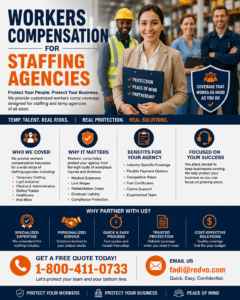

Workers’ Compensation for Staffing Agencies: Complete Guide
Staffing agencies face a unique workers’ compensation challenge. The agency may hire and pay the worker, while a client company controls the worker’s daily activities and workplace. This makes proper insurance, employee classification, claims handling, and client contracts especially important.
With more than 15 years of experience, Redvo Insurance Solutions has focused on helping businesses understand complex commercial insurance needs. For staffing agencies, the goal is not simply to purchase a policy. The right coverage should match the workers you place, the states where they work, the risks they face, and the requirements of your client contracts.
Workers Compensation For Staffing Agencies
This guide explains how workers’ compensation works for staffing agencies, what affects cost, how temporary employees are covered, and what agencies should consider when requesting a quote.
What Is Workers’ Compensation for Staffing Agencies?
Workers’ compensation is insurance that generally provides benefits for employees who suffer covered work-related injuries or illnesses. Benefits can include medical care and wage replacement, subject to the applicable state law and policy.
Staffing agencies have an unusual exposure because their employees often work at locations owned and operated by other companies. The agency may be the employer of record, while the client supervises the employee’s daily work.
In many staffing arrangements, the agency maintains the workers’ compensation policy for the temporary workers it places. However, the exact legal arrangement can vary by state and contract.
How Does Workers’ Compensation Work for Staffing Agencies?
A typical staffing arrangement involves three parties:
- The staffing agency.
- The temporary or placed employee.
- The client company.
The agency usually hires and pays the employee. The client company typically controls the employee’s daily work and workplace.
If the employee suffers a work-related injury, the claim is generally handled under the applicable workers’ compensation policy. The staffing contract should clearly identify insurance responsibilities, reporting procedures, and other risk-transfer requirements.
Many client companies also request proof of insurance before accepting temporary workers. Certificates of insurance and appropriate policy endorsements can therefore become an important part of the staffing relationship.
Workers’ Compensation Requirements for Staffing Agencies
Staffing agencies should review several areas before placing employees:
- State workers’ compensation requirements
- Employee status and eligibility
- Payroll reporting
- Workers’ compensation classification codes
- Work locations
- Client contract requirements
- Claims reporting procedures
- Multi-state coverage
Classification is especially important. A staffing agency may place office employees, warehouse workers, drivers, construction laborers, healthcare workers, or industrial employees. These jobs can have very different levels of workplace risk.
Using the wrong classification can result in inaccurate premiums and problems during an insurance audit. Workers’ compensation premiums are generally tied to payroll, classification rates, and experience modification, although the final premium can include other rating factors and state-specific charges.
What Does Staffing Agency Workers’ Compensation Insurance Cover?
Coverage depends on the applicable state law and policy, but workers’ compensation generally addresses work-related employee injuries and occupational illnesses.
Common benefits can include:
- Medical treatment
- Wage replacement
- Rehabilitation benefits
- Disability benefits
- Death benefits for eligible dependents
Workers’ compensation is generally a no-fault system, meaning an injured employee does not normally have to prove employer negligence to receive covered benefits.
The agency should also have a clear process for reporting injuries quickly. Delayed reporting can complicate claims administration and may create compliance problems depending on state rules.
Workers’ Compensation Insurance for Temporary Employees
Temporary employees are an important part of the staffing business model, but they still need proper workers’ compensation treatment.
A temporary worker may spend only a few days or weeks at one client site and then move to another assignment. The agency therefore needs accurate records showing:
- Where the employee worked
- What job the employee performed
- Payroll for the assignment
- Applicable classification
- Start and end dates
- Client information
The shorter duration of an assignment does not automatically eliminate workers’ compensation responsibilities.
How Much Does Workers’ Compensation Insurance for Staffing Agencies Cost?
There is no single workers’ compensation insurance cost for every staffing agency.
The premium can change significantly based on:
- Total payroll
- Employee job classifications
- State
- Claims history
- Experience modification factor
- Type of staffing
- Number of employees
- High-risk placements
- Policy structure
The classification of the work can have a major effect on premium. A staffing agency placing office personnel may have a very different exposure from an agency placing construction or industrial workers.
For that reason, a realistic workers’ compensation insurance for staffing agencies cost cannot be determined from revenue alone. Payroll and the type of work being performed are critical inputs.
How to Get a Workers’ Comp Insurance Quote for a Staffing Agency
To obtain an accurate workers’ comp insurance for staffing agencies quote, prepare detailed information before approaching an insurer or broker.
Important information includes:
- Annual payroll
- Employee count
- Job descriptions
- Workers’ compensation classifications
- States of operation
- Client industries
- Claims history
- Current policy information
- Experience modification information, when applicable
Accurate information can help prevent major differences between the quoted premium and the final audited premium.
How to Choose the Right Workers’ Compensation Insurance for Staffing Companies
Start by understanding your workforce.
An agency placing administrative employees has a different risk profile from one placing construction labor, warehouse workers, drivers, or industrial employees.
Next, review your claims history and classification structure. Then compare coverage terms, carrier appetite, service, and pricing.
Do not choose a policy only because the quoted premium is low. A policy that does not properly address your staffing operations can create bigger problems later.
Workers’ Compensation Claims for Staffing Agencies
When an employee is injured, the staffing agency should have a documented reporting process.
The employee should report the injury according to the agency and applicable state procedures. The client should also communicate the incident to the staffing agency promptly.
The agency should document:
- Date and time of injury
- Worksite location
- Job being performed
- Description of the incident
- Witness information
- Medical treatment
- Client contact information
Fast communication helps the agency, client, insurer, and injured worker move through the claims process more efficiently.
How Can Staffing Agencies Reduce Workers’ Compensation Costs?
Cost control starts with risk control.
Staffing agencies can work with clients to establish clear safety expectations before placing employees. Employees should receive appropriate job and safety information, especially when they enter unfamiliar workplaces.
Agencies can also:
- Track claims carefully
- Review recurring injuries
- Improve employee training
- Verify job classifications
- Maintain accurate payroll records
- Develop return-to-work procedures
- Review claims with their insurance professional
- Evaluate policies before renewal
Reducing workplace injuries can help improve the agency’s overall loss experience, although premium changes depend on the applicable rating system and insurer.
Workers’ Compensation for High-Risk Staffing Agencies
High-risk staffing agencies can face additional challenges when seeking coverage.
Examples include agencies placing workers in:
- Construction
- Manufacturing
- Warehousing
- Industrial operations
- Heavy labor
- Transportation
- Certain healthcare environments
Higher-risk classifications can produce significantly higher workers’ compensation costs than lower-risk office classifications. This makes accurate classification, safety procedures, and claims management especially important.
Agencies with previous claims, high experience modifications, non-renewals, or difficult classifications may need to approach insurers that understand staffing-industry risks.
Workers’ Compensation Requirements for Staffing Agencies by State
Workers’ compensation laws are state-specific. A staffing agency should never assume that a requirement in one state automatically applies in another.
For example, Oregon distinguishes temporary staffing providers from worker-leasing arrangements, while California explains that classification, payroll, and experience modification are important parts of premium calculation.
Agencies operating across state lines should confirm:
- Whether coverage is required
- Which employees must be covered
- Where coverage must apply
- State-specific reporting rules
- Required policy endorsements
- Client contract requirements
For an agency operating nationwide, state-by-state compliance review is much safer than using one generic rule.
Conclusion
Workers’ compensation for staffing agencies is more complicated than simply buying an insurance policy. Staffing companies have to manage employee classifications, payroll, temporary placements, client relationships, claims, state requirements, and changing workplace risks.
The right coverage should reflect the actual jobs your employees perform and the states where they work. Accurate classification and payroll reporting can help prevent unnecessary premium problems, while strong safety and claims-management practices can help control long-term costs.
Workers Comp Insurance Agency understands that staffing agencies need practical insurance solutions built around their real operations. Whether you operate a small temporary staffing business or manage a larger multi-state staffing company, reviewing your workers’ compensation program carefully can help protect your employees, your clients, and your business.
|
Call now on (+1800-411-733) |
|
Email 📧 -(fadi@redvo.com) |
Must Visit This Link:-
Workers Compensation For Staffing Agencies in California
Workers Compensation For Staffing Agencies In Florida
Workers Compensation For Staffing Agencies in Georgia
Workers Compensation For Staffing Agencies in Illinois
Workers Compensation For Staffing Agencies in New Jersey
Workers Compensation For Staffing Agencies in New York
Temporary Staffing Agency Workers Compensation in Georgia
Staffing Agencies in Jones