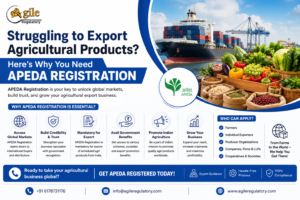

India has become one of the leading exporters of agricultural and processed food products across global markets. To encourage exporters and improve the quality of agricultural exports, the Indian government provides various export promotion schemes and incentives. However, businesses must complete specific regulatory requirements before accessing these benefits.
One of the most important steps for exporters dealing with scheduled agricultural products is obtaining APEDA Registration. Issued by the Agricultural and Processed Food Products Export Development Authority (APEDA), this registration helps exporters legally operate in international markets and access various export support programs.
Whether you are a farmer producer organization, manufacturer, merchant exporter, or food processing company, understanding the APEDA registration process can help you expand your export business successfully.
What is APEDA Registration?
APEDA Registration is a mandatory registration required for exporters dealing with products listed under the APEDA Act, 1985. APEDA works under the Ministry of Commerce and Industry, Government of India, to promote the export of agricultural and processed food products.
After successful approval, exporters receive an APEDA Certificate, also known as Registration-Cum-Membership Certificate (RCMC). This certificate confirms that the exporter is registered with APEDA and eligible to participate in export promotion activities.
Why is APEDA Registration Important for Exporters?
Exporting agricultural products requires compliance with quality standards, documentation requirements, and international trade regulations. APEDA registration provides exporters with several advantages, including:
- Eligibility to access government export promotion schemes
- Recognition as an approved agricultural product exporter
- Support for improving product quality and packaging standards
- Assistance in participating in international trade fairs
- Better credibility among overseas buyers
- Guidance for meeting international export requirements
For businesses planning long-term growth in global markets, obtaining an APEDA certificate is an important step.
Products Covered Under APEDA Registration
APEDA regulates and promotes the export of various agricultural and processed food products.
Common product categories include:
- Fruits and vegetables
- Processed food products
- Meat and meat products
- Dairy products
- Honey
- Pickles and sauces
- Cereals and grains
- Herbal and agricultural products
- Poultry products
- Confectionery items
Exporters should check whether their product category falls under APEDA’s scheduled products before starting the registration process.
Understanding APEDA RCMC Certificate
The APEDA RCMC (Registration-Cum-Membership Certificate) is issued after successful registration with APEDA. It serves as proof that an exporter is registered with the authority.
The APEDA RCMC helps exporters:
- Apply for export benefits
- Participate in APEDA promotional activities
- Receive updates related to export regulations
- Build trust with international buyers
The certificate is generally required for exporters who want to take advantage of government export support programs.
Step-by-Step APEDA Application Process
The APEDA Application process is completed online, making it easier for exporters to obtain registration.
Step 1: Visit the APEDA Registration Portal
Exporters need to access the official registration platform and begin the application process.
Step 2: Provide Business Details
Applicants need to submit information such as:
- Company details
- Exporter details
- Contact information
- Product categories
- Business address
Step 3: Upload Required Documents
The applicant must upload supporting documents, including business and export-related details.
Step 4: Pay Registration Fees
The applicable registration fee needs to be submitted online.
Step 5: Verification and Approval
After reviewing the application and documents, APEDA issues the registration certificate.
Once approved, exporters can download their APEDA certificate and begin using APEDA services.
Documents Required for APEDA Registration
Exporters generally require the following documents:
- Import Export Code (IEC) issued by DGFT
- PAN card
- GST registration certificate
- Company incorporation documents (if applicable)
- Bank certificate or cancelled cheque
- Business address proof
- Product details
- Export-related information
Providing accurate documents helps avoid delays during the approval process.
Is APEDA License Required for Export?
Many exporters commonly search for an APEDA license, but APEDA primarily provides registration and certification services rather than a traditional license.
The APEDA registration acts as official authorization for exporters dealing with APEDA-scheduled products. Having a valid APEDA certificate ensures that exporters comply with regulatory requirements and can participate in export promotion activities.
Benefits of Hiring an APEDA Consultant
Although the registration process is online, exporters may face challenges while preparing documents, understanding requirements, or resolving application issues.
An experienced APEDA Consultant can help with:
- Checking product eligibility
- Preparing the APEDA application
- Reviewing required documents
- Avoiding application errors
- Completing registration procedures
- Handling queries during the approval process
Professional assistance saves time and helps exporters complete registration smoothly.
How Agile Regulatory Helps With APEDA Registration
Agile Regulatory provides complete regulatory support for exporters looking to obtain APEDA registration and expand their business internationally.
Our experts assist with:
- APEDA registration consultation
- APEDA application preparation
- Documentation support
- APEDA RCMC guidance
- Export compliance assistance
- Government registration support
With experience in handling various business compliance requirements, Agile Regulatory helps exporters simplify the registration process and focus on growing their international market presence.
Common Mistakes Exporters Should Avoid
Many businesses experience delays due to simple mistakes during registration.
Common errors include:
- Submitting incomplete documents
- Incorrect business information
- Applying without an active IEC
- Selecting the wrong product category
- Delaying compliance procedures
Proper preparation and expert guidance can help avoid these issues.
Conclusion
Government export incentives can provide valuable support to businesses looking to expand internationally, but proper registration is the first step. APEDA Registration helps exporters gain official recognition, access export promotion opportunities, and build credibility in global markets.
Obtaining an APEDA certificate, completing the APEDA application correctly, and maintaining compliance with export regulations can significantly improve business opportunities.
If you need assistance with APEDA registration, APEDA RCMC, or export compliance procedures, Agile Regulatory provides end-to-end consultancy support. Our experts help exporters complete documentation, registration, and regulatory processes efficiently, allowing businesses to focus on achieving global growth.
Frequently Asked Questions (FAQs)
1. What is APEDA Registration?
APEDA Registration is a mandatory registration for exporters dealing with agricultural and processed food products listed under APEDA’s scheduled categories.
2. What is an APEDA Certificate?
An APEDA Certificate is the registration certificate issued after approval of an exporter’s application. It confirms that the exporter is registered with APEDA.
3. Is APEDA License and APEDA Registration the same?
Generally, APEDA does not issue a traditional license. Exporters usually require APEDA registration, which provides official authorization to export scheduled products.
4. What is APEDA RCMC?
APEDA RCMC stands for Registration-Cum-Membership Certificate. It proves that an exporter is registered with APEDA and eligible for export-related benefits.
5. Can I submit an APEDA Application online?
Yes, exporters can submit their APEDA application online by providing required business details, documents, and registration fees.
6. Why should I hire an APEDA Consultant?
An APEDA consultant helps exporters understand requirements, prepare documents, complete applications correctly, and avoid delays during the registration process.
7. How can Agile Regulatory help with APEDA Registration?
Agile Regulatory provides complete assistance for APEDA registration, documentation, APEDA RCMC support, application filing, and export compliance solutions to help businesses complete the process smoothly.