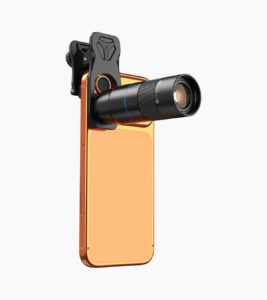

Stand in a small room trying to photograph the whole space, or try to fit a group of ten people into frame without backing into a wall, and you’ll hit the same wall a phone’s native camera always has — it simply doesn’t see wide enough. A wide angle lens for mobile fixes that instantly, which is why it’s usually the first lens photographers add to a mobile lens kit.
In short: a wide angle lens is one of the most useful single additions to any mobile setup because it solves a problem no amount of stepping backward or software cropping fixes — a limited field of view. If you’re building a mobile lens kit and choosing where to start, or comparing options for the best camera lens for mobile, a well-made wide-angle is usually the most broadly useful first purchase.
Why a Wide Angle Lens Solves a Real Problem
A phone’s standard lens has a fixed field of view — usually somewhere around 26-28mm equivalent. That’s fine for most everyday shots, but it falls short in specific, common situations: interiors, landscapes, architecture, and group photos where you physically can’t step back far enough to fit everything in frame. A wide-angle lens attachment widens that field of view — often to 170° or more — capturing significantly more of the scene without cropping or stitching multiple shots together.
This is different from a phone’s built-in “ultra-wide” mode, which on many models is a lower-resolution secondary sensor. A quality clip-on or case-mounted wide-angle lens, built with real glass, can outperform a phone’s native ultra-wide in both field of view and edge sharpness.
What to Look for in a Wide Angle Lens for Mobile
Not all wide-angle lenses perform the same, and the difference shows up most at the edges of the frame:
- Real glass optics, not plastic. Glass controls distortion and colour fringing far better, especially toward the edges where wide lenses are most likely to show weaknesses.
- A metal housing. Plastic bodies flex slightly with handling, which can throw off alignment over time.
- Anti-distortion coating. Without it, straight lines near the edge of the frame (door frames, horizons, building edges) warp visibly — a common giveaway of a low-quality wide lens.
- A stable, case-based mount. A lens-thread case (commonly 17mm or 37mm) keeps the lens centred consistently, which matters more with wide-angle lenses than almost any other type, since even slight misalignment causes visible vignetting (dark corners).
Building a Mobile Lens Kit Around a Wide Angle Lens
A single lens rarely covers everything you’ll want to shoot, which is why serious mobile photographers build a small kit rather than buying one lens and stopping there.
| Kit Addition | Why It Pairs Well With a Wide-Angle Lens |
|---|---|
| Macro lens | Covers the opposite end — close-up detail a wide lens can’t capture |
| Zoom lens | Covers distant subjects, which a wide-angle deliberately excludes |
| Lens-thread case | Keeps all your lenses mounted consistently, avoiding vignetting |
| Tripod or holder | Useful for low-light interior and landscape shots taken with the wide lens |
A practical, well-rounded mobile lens kit typically starts with a wide-angle lens for its versatility, then adds a macro lens for close-up work and a zoom lens if distant subjects come up often — three lenses covering three genuinely different problems, rather than several overlapping lenses that all do roughly the same job.
Is a Wide-Angle the Best Camera Lens for Mobile Photography?
There’s no single best camera lens for mobile that suits everyone — it depends entirely on what you shoot most. That said, a wide-angle lens tends to be the most broadly useful starting point for a few specific reasons:
- It solves a problem that affects the widest range of everyday photography situations — travel, interiors, architecture, group shots.
- Unlike a zoom lens, it doesn’t require a tripod to get sharp results, making it more practical for casual, handheld use.
- It pairs naturally with a phone’s existing strengths in portrait and standard shots, rounding out what the native camera already does well.
If your photography leans heavily toward one specific area — wildlife and distant subjects, or product and detail shots — a zoom or macro lens might be the better starting point instead. But for general, all-purpose use, wide-angle is hard to beat as a first lens.
Common Mistakes to Avoid
- Buying an extremely wide fisheye instead of a standard wide-angle when you actually want natural-looking group or landscape shots — fisheye lenses distort faces and straight lines more dramatically.
- Using a loose universal clip instead of a case-based mount. Wide-angle lenses are especially sensitive to misalignment, which shows up as visible vignetting at the edges.
- Assuming a phone’s built-in ultra-wide mode is equivalent. Many phones use a lower-resolution sensor for ultra-wide shots, which a good glass lens attachment can outperform.
- Buying a bundled 10-in-1 kit for the lens count rather than quality. One well-made wide-angle lens will consistently outperform several weak lenses crammed into a cheap bundle.
Final Thoughts
A wide angle lens for mobile solves one of the most common limitations in phone photography — a field of view that simply isn’t wide enough for interiors, landscapes, and group shots. It’s a strong first choice for anyone starting a mobile lens kit, and while it’s not automatically the best camera lens for mobile in every situation, its versatility makes it hard to beat as a starting point before adding macro or zoom lenses for more specific needs.
FAQ
Q: What is a wide angle lens for mobile actually useful for? A: Interiors, landscapes, architecture, and group photos — any situation where you can’t physically step back far enough to fit everything into frame with a phone’s standard lens.
Q: Should a wide-angle lens be the first lens in my mobile lens kit? A: For most people, yes. It solves the widest range of everyday framing problems and doesn’t require a tripod for sharp handheld results, unlike a zoom lens.
Q: Is a clip-on wide-angle lens better than my phone’s built-in ultra-wide camera? A: It can be, particularly if your phone uses a lower-resolution sensor for its ultra-wide mode. A quality glass lens attachment with anti-distortion coating often delivers sharper, less distorted results.
Q: What is the best camera lens for mobile if I mainly shoot travel and landscapes? A: A wide-angle lens is the clear choice for that use case, since it’s built specifically to capture more of a scene than a phone’s standard lens allows.