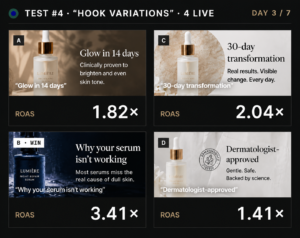

Most performance marketers spend hours perfecting their offer, discount, bundle, and free trial but only a few minutes on the line meant to get someone to actually see it. That’s backwards, and it’s exactly the kind of gap that tools like an AI hook scorer or AI hook generator are designed to close. According to ad recall research from MetrixLab, 90% of total ad recall gets decided within the first six seconds. The offer underneath it will never be read if the hook doesn’t land in that window.
The Offer Only Matters If the Hook Earns Attention First
A strong offer sitting behind a weak hook is invisible. Someone scrolling past an ad isn’t stopping to evaluate pricing or bundle value. They’re deciding in a fraction of a second whether the first line is worth their attention at all. The hook is the gate, and the offer only gets a chance once someone’s actually walked through it.
This phenomenon is why teams chasing performance gains by tweaking discounts or adding urgency badges often see flat results. The offer wasn’t the problem. Nobody stuck around long enough to read it.
What Actually Makes a Hook Work
A hook earns attention when it feels specific to the person seeing it, not when it’s clever for its own sake. The strongest hooks tend to do one of a few things: name a problem the viewer already recognizes, surprise them with an unexpected angle, or speak directly to something they care about. Generic openers, even well-written ones, rarely survive the scroll.
This stage is also where testing volume matters more than most teams expect. A single hook, however carefully written, is a guess. Five or six variations tested against each other start to reveal an actual pattern in what an audience responds to, which is a different exercise entirely from picking the line that sounds best in a meeting.
Why an AI Hook Generator Solves the Volume Problem
The challenge isn’t knowing that hooks matter. Most marketers already know that. The challenge is producing enough strong variations to actually test the theory. Writing one solid hook can take a while. Writing ten, each with a genuinely different angle instead of a reworded version of the same idea, tends to eat most of an afternoon.
This scenario is exactly where an AI hook generator changes the math. Instead of a marketer manually drafting variation after variation, it can produce a wide spread of angles, problem-first, curiosity-driven, benefit-led, from a single brief in a fraction of the time. That doesn’t replace judgment about what fits the brand. It just means there’s more material to choose from before a single dollar goes toward testing any of it live. A general-purpose hook generator solves the same bottleneck, though the AI-specific version tends to adapt faster to a brand’s actual voice across repeated use.
How an AI Hook Scorer Prioritizes What to Test
Generating more options solves half the problem. The other half is knowing which ones are worth testing live in the first place. This is where an AI hook scorer earns its place in the process, evaluating a batch of hook candidates and predicting which ones are more likely to actually stop a scroll before any ad spend gets committed.
An AI hook scorer doesn’t replace live testing, and it isn’t meant to. It narrows the field. Instead of testing ten hooks and hoping three of them perform, a scoring step can filter that list down to the three or four strongest candidates first, so ad spend goes toward validating genuinely promising ideas rather than eliminating obviously weak ones through trial and error.
The Bigger Shift in Performance Marketing
Targeting has become largely automated across most platforms, which means creative, and specifically the opening line of that creative, is doing more of the work than it used to. Teams that keep optimizing offers while treating the hook as an afterthought are polishing the part of the ad that fewer people actually see.
The marketers pulling ahead right now aren’t necessarily running better offers than everyone else. They’re running more hooks, testing them faster, and cutting the weak ones sooner. Platforms such as Imagive.ai are increasingly part of how performance teams manage that volume, pairing a hook generator with an AI hook scorer so testing doesn’t slow down waiting on the next batch of ideas.