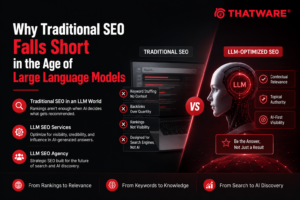

Search has changed faster than most marketing teams expected. For years, the playbook stayed familiar: target keywords, earn backlinks, optimize titles and meta descriptions, build topical authority, and watch rankings climb. That approach delivered reliable traffic when the primary interface was a list of ten blue links. Today the primary interface is often a synthesized answer generated by a large language model. Users type full questions into ChatGPT, Gemini, Perplexity, or Google’s AI Overviews and receive polished responses that may or may not send them onward to a website. The shift has exposed clear limitations in the old methods. Understanding Traditional SEO in an LLM World is no longer optional for any brand that depends on organic discovery.
The core mismatch is structural. Traditional SEO optimizes for document ranking. Algorithms evaluate pages against queries, surface a list, and hope users click. Large language models operate differently. They retrieve, synthesize, and generate. Relevance is judged by how cleanly a source can be folded into a coherent answer, how strong the entity signals are, and how consistently the brand appears across trusted contexts. Ranking number one for a high-volume keyword no longer guarantees a citation or even a mention. In many cases it barely registers. Click-through rates on queries that trigger AI summaries have dropped sharply in multiple independent studies, sometimes by more than half. Zero-click behavior has become the norm for informational intent. The traffic that once followed a top ranking now frequently stays inside the AI interface.
Content strategies built for the old world also struggle. High-volume keyword lists and mass-produced articles that once scaled rankings now compete against models that can generate similar text instantly. Freshness, unique insight, structured clarity, and verifiable claims matter more than sheer volume. Pages optimized only for exact-match density or superficial semantic coverage often fail to surface when models expand a user prompt into multiple related sub-queries. Authority signals have shifted emphasis as well. Classic backlink profiles still help with crawlability and baseline trust, yet brand mentions, co-citations, entity consistency across the open web, and source diversity increasingly influence whether a model chooses to reference a site. Measurement frameworks lag behind. Position tracking and organic sessions capture only part of the picture when success is defined by mention rate, citation share, and sentiment inside generated answers.
These pressures create a practical problem for teams still running purely traditional programs. Traffic can plateau or decline even while rankings appear stable. Competitors who adapt appear inside AI responses while others remain invisible. The gap widens as more users start their research inside conversational interfaces rather than classic search boxes. The solution is not to abandon foundational SEO. Crawlable HTML, logical site architecture, schema markup, Core Web Vitals, and genuine expertise remain essential. Those elements form the substrate many models still draw from. What must be added is deliberate optimization for how large language models retrieve and reason.
This is where focused LLM SEO Services become valuable. Rather than treating AI visibility as an afterthought, specialized work maps the actual prompts users issue, structures content so key claims can be cleanly extracted, strengthens entity signals, and builds the broader citation footprint models favor. It involves engineering answer-ready passages, reinforcing brand consistency across third-party sources, monitoring presence across multiple AI platforms, and iterating on the basis of citation data rather than position alone. The goal expands from driving clicks to becoming a preferred source inside the answers themselves. When that happens, residual traffic improves, brand awareness compounds, and downstream conversion opportunities increase even if fewer users leave the AI interface.
Choosing the right partner matters. An experienced LLM SEO agency understands both the enduring requirements of traditional search and the newer signals that influence generative systems. ThatWare LLP has positioned itself at the intersection of these disciplines, developing approaches that combine advanced semantic engineering, entity optimization, and AI-specific visibility tactics. Their work helps brands move beyond reactive content production toward intentional presence in the systems people now use for discovery. Clients gain strategies that protect existing rankings while opening new channels of exposure inside large language model responses.
The practical next steps are clear. Audit current content for extractability and claim density. Expand monitoring beyond rank trackers to include AI citation and mention tracking. Prioritize depth and originality over volume. Strengthen the brand’s presence in places models already trust. Align measurement with the outcomes that matter in an answer-first environment. Organizations that treat Traditional SEO in an LLM World as a continuity problem rather than a replacement problem position themselves to retain relevance as interfaces continue to evolve.
Search will keep changing. Models will improve, new interfaces will appear, and user habits will shift further. The brands that thrive will be those that maintain strong technical and content foundations while deliberately optimizing for the way machines now synthesize knowledge. Waiting for the dust to settle is not a strategy. Acting on the differences that already exist is.
If your current approach feels increasingly disconnected from the results you need, explore how specialized LLM SEO Services can close the gap. Visit here to learn more about the concrete problems and the practical path forward offered by ThatWare LLP. The conversation about visibility has already moved. The only question is whether your brand moves with it.