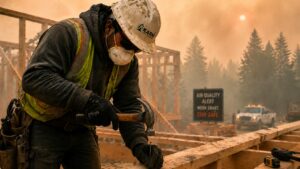

Wildfire smoke has become a recurring workplace hazard throughout Oregon and Washington. Smoke conditions can change quickly, travel hundreds of miles from the original fire, and expose employees even when flames are nowhere near the worksite.
For employers, wildfire smoke is not simply an outdoor air-quality concern. Both Oregon OSHA and Washington Labor & Industries have workplace rules requiring covered employers to prepare for smoke, monitor conditions, communicate with employees, provide training, implement exposure controls, and address respiratory protection when applicable.
Required wildfire smoke training gives employees the knowledge they need to recognize changing conditions, report symptoms, understand air-quality information, and follow their employer’s response plan.
Why Wildfire Smoke Is Dangerous to Workers
Wildfire smoke contains gases, chemicals, and extremely small particles. The primary concern under Oregon and Washington workplace rules is fine particulate matter known as PM2.5.
These particles are small enough to travel deep into the lungs. Exposure may cause:
- Burning, red, or watery eyes
- Runny nose or sore throat
- Coughing or wheezing
- Shortness of breath
- Headaches and fatigue
- Reduced lung function
- Asthma attacks
- Chest pain or irregular heartbeat
More serious exposure may contribute to cardiovascular and respiratory emergencies. Oregon OSHA notes that wildfire smoke can cause symptoms ranging from eye irritation and coughing to difficulty breathing, reduced lung function, chest pain, and heart attacks.
Workers who perform physically demanding work may breathe more deeply and inhale more smoke. Employees with asthma, chronic obstructive pulmonary disease, heart disease, diabetes, respiratory illness, pregnancy, or other medical conditions may also face increased risks.
Who Needs Wildfire Smoke Training?
Training requirements depend on the state, the employee’s work environment, and the anticipated level of wildfire-smoke exposure.
Employees who may need training include:
- Construction workers
- Agricultural employees
- Landscapers and grounds crews
- Utility workers
- Road and highway crews
- Public works employees
- Delivery and transportation workers
- Equipment operators
- Roofers
- Forestry workers
- Warehouse and shop employees working with open doors
- Employees who travel between outdoor jobsites
- Supervisors responsible for monitoring smoke conditions
The rules may also affect workers who spend only part of their shift outdoors. Employers should evaluate actual exposure rather than assume a worker is exempt because most work occurs inside a building or vehicle.
Enclosed buildings with adequately filtered mechanical ventilation and enclosed vehicles with functioning cabin-air filtration may qualify for exclusions when windows and doors remain closed except for entry and exit.
Oregon Wildfire Smoke Training Requirements
Oregon OSHA’s wildfire-smoke rule applies when employees are or may be exposed to wildfire smoke at a PM2.5 concentration of 35.5 micrograms per cubic meter or greater, corresponding to an AQI of approximately 101 under the rule.
Covered employers must prepare before employees are exposed. Required protections can include:
- Monitoring or assessing PM2.5 conditions
- Providing employee training
- Maintaining two-way communication
- Informing employees about changing conditions
- Using engineering and administrative controls
- Providing appropriate respirators
- Responding to symptoms and medical emergencies
- Maintaining required training documentation
Training must be provided in a language and vocabulary employees understand. Employers should complete the training before wildfire-smoke exposure occurs and repeat it as required by Oregon OSHA.
Oregon OSHA’s own online course satisfies only part of the required training elements, which shows why employers must also cover their specific communication system, response plan, controls, respirator procedures, and workplace conditions.
Learn more about KARM’s Oregon Wildfire Smoke Training
Washington Wildfire Smoke Training Requirements
Washington’s wildfire-smoke rules apply at a lower PM2.5 level than Oregon’s requirements.
Employers covered by the Washington rules must provide training before exposing employees to a PM2.5 concentration of 20.5 micrograms per cubic meter, corresponding to an AQI of approximately 72. Training must be provided before exposure and repeated annually.
Washington employers must prepare a written wildfire-smoke response plan and address:
- Employee and supervisor training
- PM2.5 monitoring
- Forecast monitoring
- Two-way communication
- Employee notification
- Exposure controls
- Respirator availability
- Prompt medical attention
- Employee reporting rights
- Procedures for responding to worsening conditions
Washington’s rules apply to general industry and agriculture, with separate regulatory sections covering each group.
Learn more about KARM’s Washington Wildfire Smoke Training
What Employees Should Learn During Wildfire Smoke Training
Effective training should do more than tell workers that smoke is dangerous. Employees need clear instructions they can apply during an actual smoke event.
Training should explain:
- What PM2.5 is and why it is hazardous
- How to check current air quality
- Which monitoring source the employer uses
- Symptoms of wildfire-smoke exposure
- Health effects and higher-risk conditions
- How employees will receive air-quality updates
- How to report symptoms or worsening conditions
- What exposure controls the employer will use
- Where respirators are stored and how to request one
- The benefits and limitations of N95 respirators
- How to properly put on, adjust, and inspect a respirator
- What to do during a medical emergency
- Employees’ rights to report hazards without retaliation
Supervisors may require additional instruction because they are often responsible for monitoring conditions, communicating changes, implementing controls, and responding to employee symptoms.
Respirators and Wildfire Smoke
Respirators are an important part of wildfire-smoke protection, but they must be used correctly.
A NIOSH-approved N95 respirator is generally the minimum respirator used for wildfire-smoke particulate exposure. Bandanas, scarves, cloth masks, surgical masks, and non-NIOSH-certified face coverings do not provide equivalent protection from wildfire-smoke particles. Washington L&I specifically notes that KN95 masks are not NIOSH-certified substitutes for approved respirators under its rule.
Respirators also have limitations:
- They must fit closely against the face.
- Facial hair can interfere with the seal.
- A damaged, dirty, wet, or misshapen respirator should not be used.
- N95 respirators filter particles but do not supply oxygen.
- They do not protect against every gas or vapor found in smoke.
- They may make breathing more difficult for some employees.
- Employees should leave the area and seek medical assistance if they experience serious symptoms.
The employer’s responsibilities increase as smoke concentrations rise.
In Oregon, filtering facepiece respirators must be made available for voluntary use beginning at the rule’s initial action level, and respirator use becomes mandatory at higher smoke concentrations. At the highest levels, a complete respiratory-protection program may be required.
In Washington, employers must make respirators available at PM2.5 concentrations of 35.5 micrograms per cubic meter or greater. Required respirator use and a full respiratory-protection program begin at much higher concentrations.
Training must clearly distinguish between voluntary respirator use and required respirator use.
Training Is Only One Part of Compliance
Completing employee training does not satisfy every wildfire-smoke requirement.
Employers may also need to:
- Develop a written wildfire-smoke response plan
- Identify an approved monitoring method
- Monitor current and forecasted conditions
- Establish two-way employee communication
- Determine exposure controls in advance
- Keep respirators available
- Train supervisors
- Document completed training
- Plan for prompt medical attention
- Update procedures when work conditions change
Exposure controls may include moving employees indoors, improving filtration, relocating work, changing schedules, reducing strenuous activity, increasing rest periods, rotating employees, or suspending work when conditions become unsafe.
Why Annual Training Matters
Wildfire-smoke requirements, air-quality tools, work locations, employee responsibilities, and company procedures can change.
Annual training helps employees remember:
- Where to find current air-quality information
- What symptoms should be reported
- Who to contact
- When work practices must change
- When respirators are available
- How to wear an N95 correctly
- What actions are prohibited
- When emergency medical care is needed
Training also gives employers an opportunity to update contact information, response plans, respirator locations, employee assignments, and monitoring procedures before wildfire season begins.
Waiting until the smoke arrives often leads to confusion, missing respirators, delayed communication, and inconsistent decisions between supervisors and jobsites.
Wildfire Smoke Training for Oregon and Washington Employers
KARM Safety Solutions provides practical wildfire-smoke training designed for employers and employees throughout Oregon and Washington.
Training options include:
- Online annual employee training
- Onsite group training
- Oregon-specific wildfire-smoke training
- Washington-specific wildfire-smoke training
- Employee and supervisor instruction
- Certificates and training documentation
- Respirator-use education
- Customized workplace procedures and discussion
Our goal is to help employees understand the hazard before smoke conditions become dangerous and help employers maintain the documentation and procedures needed to support regulatory compliance.
Oregon Training
Oregon OSHA Wildfire Smoke Safety Training
Washington Training
Washington L&I Wildfire Smoke Safety Training
Final Takeaway
Wildfire smoke can affect employee health, visibility, communication, concentration, equipment operation, and overall jobsite safety.
Employers should not wait until the air becomes smoky to decide how they will respond. Training employees in advance helps crews recognize symptoms, understand air-quality levels, use respirators correctly, follow exposure controls, and report hazards before someone becomes seriously ill.
Prepare before wildfire season. Train your employees, review your response plan, confirm your monitoring process, and make sure the correct respirators are available.
Contact KARM Safety Solutions at 503-304-7037 to schedule Oregon or Washington wildfire-smoke training.