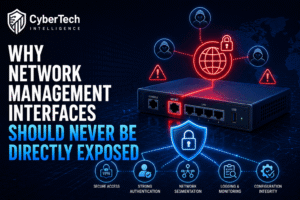

Network management interfaces provide administrators with powerful control over some of the most critical infrastructure in an enterprise. Routers, firewalls, VPN gateways, switches, security appliances, and other edge devices rely on management interfaces for configuration, monitoring, troubleshooting, and maintenance. Because these interfaces often provide privileged capabilities, exposing them directly to the internet can create a significant cybersecurity risk.
Read More: https://tinyurl.com/y3aw6fm7
The danger is becoming more serious as vulnerability exploitation accelerates. Attackers increasingly automate reconnaissance, vulnerability discovery, credential attacks, and exploit development. AI-assisted techniques can further reduce the time between vulnerability disclosure and active exploitation. Organizations can no longer assume they will always have enough time to deploy a patch before attackers begin targeting exposed infrastructure.
Network management interfaces are particularly attractive because compromising one can provide extensive control over the surrounding environment. An attacker who gains administrative access may be able to modify firewall rules, change routing configurations, create new accounts, intercept traffic, disable logging, establish persistence, or open pathways toward sensitive internal systems.
This makes internet exposure itself an important risk factor.
Organizations should begin by identifying every externally reachable management interface. Asset inventories should include device type, firmware version, public exposure, management protocols, authentication methods, business owner, support status, and connections to critical systems. External attack-surface monitoring can help identify interfaces that may have been exposed unintentionally.
Reducing reachability should then become a priority. Administrative interfaces should generally be accessible only through controlled management paths rather than directly from the public internet. Organizations can use dedicated management networks, secure administrative gateways, VPNs, privileged access systems, strict source allowlists, and network segmentation to reduce unnecessary exposure.
Strong authentication provides another essential layer. Administrative access should not depend solely on passwords, particularly for devices controlling critical network infrastructure. Phishing-resistant multi-factor authentication can make credential theft significantly more difficult to exploit.
Privileged access should also follow least-privilege principles. Administrators should receive only the permissions required for their responsibilities, and persistent administrative access should be minimized wherever possible. Just-in-time privileges and controlled administrative sessions can reduce opportunities for compromised accounts to be abused.
Management traffic should also be separated from ordinary production traffic. A dedicated management plane can restrict administrative communications to approved systems and identities. This makes it harder for an attacker who compromises a standard endpoint or application to reach privileged network controls.
Logging is especially important for edge infrastructure. Some appliances provide less telemetry than traditional servers and endpoints, making compromise more difficult to detect. Organizations should export authentication events, administrative activity, configuration changes, and other available logs to protected external systems.
External logging also provides resilience if an attacker compromises the appliance and attempts to delete or manipulate local records.
Configuration integrity should receive similar attention. Security teams should maintain trusted configuration backups and monitor critical settings for unexpected changes. New administrative accounts, modified firewall policies, altered routing rules, disabled security controls, or unexpected changes to authentication settings should trigger investigation.
Network behavior can provide additional indicators of compromise. Unexpected outbound connections, unusual management sessions, communication with unfamiliar destinations, abnormal authentication patterns, and sudden changes in traffic flows may reveal malicious activity even when endpoint-style detection is unavailable.
The risk becomes particularly serious during a zero-day event. When a vulnerability affects an internet-facing network appliance, organizations may enter a negative patch window in which exploitation is possible before a reliable vendor patch can be deployed.
During this period, security teams need controls that reduce exploitability without waiting for permanent remediation. Restricting source addresses, disabling unnecessary services, removing public management exposure, increasing authentication requirements, isolating affected devices, and deploying virtual protections can reduce immediate risk.
Organizations should also understand what would happen if a management appliance were compromised. Attack-path analysis can reveal whether the device could provide access to identity systems, sensitive applications, administrative networks, cloud resources, or other high-value assets.
Limiting downstream authority can significantly reduce the potential impact of compromise. An edge device should not automatically receive broad access to internal systems simply because it occupies a trusted position in the network architecture.
Credential dependencies must also be considered. Network appliances may store certificates, shared secrets, service credentials, API keys, or administrator credentials. Organizations should know which secrets are present and maintain procedures for rapidly rotating them if compromise is suspected.
Operational resilience is equally important. Some network appliances are so critical that immediately disconnecting them could disrupt business operations. Security teams should therefore prepare degraded operating modes before an emergency occurs.
Alternate connectivity, backup gateways, restricted service modes, temporary manual processes, or replacement infrastructure can give organizations options when an exposed appliance must be isolated.
These capabilities should be tested rather than assumed. Incident response exercises can validate whether teams can remove public exposure, restrict management access, rotate credentials, restore trusted configurations, activate replacement infrastructure, and preserve evidence quickly enough during an active exploitation event.
Read More: https://tinyurl.com/y3aw6fm7
Unsupported appliances require even stronger attention. If a device no longer receives vendor security updates, direct exposure creates a potentially persistent attack surface. Organizations should isolate management access, implement strong compensating controls, continuously monitor the appliance, and maintain a funded replacement plan.
Executive leadership should understand these risks as well. Metrics such as the number of publicly reachable management interfaces, percentage protected by phishing-resistant authentication, unsupported exposed appliances, time required to remove external exposure, and coverage of external logging can provide meaningful insight into infrastructure risk.
Ultimately, network management interfaces should be treated as privileged infrastructure rather than ordinary web services. Their administrative authority, location at network trust boundaries, and potential access to critical systems make direct internet exposure unnecessarily dangerous.
By removing public management access, strengthening authentication, separating management traffic, limiting privileges, exporting telemetry, monitoring configuration integrity, and preparing for pre-patch incidents, organizations can significantly reduce the likelihood that a vulnerable network appliance becomes the entry point for a broader enterprise compromise.