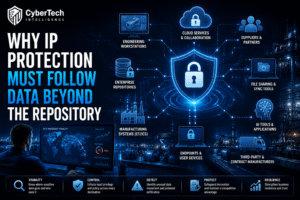

Intellectual property is one of the most valuable assets within modern manufacturing organizations. Product designs, engineering drawings, source code, formulas, process specifications, firmware, research data, manufacturing methods, and digital models can represent years of investment and competitive advantage. Traditionally, organizations have protected this information by securing the repositories where it is stored. However, modern manufacturing data rarely remains inside a single repository. It continuously moves between employees, applications, suppliers, cloud services, factories, and external partners. Effective intellectual property protection must therefore follow sensitive data wherever it travels.
Read More: https://tinyurl.com/4vj7buyb
Engineering environments illustrate this challenge clearly. A product design may originate within a Product Lifecycle Management platform before being downloaded to an engineering workstation, shared with a supplier, transferred into manufacturing systems, synchronized with cloud collaboration platforms, or analyzed using artificial intelligence tools. Each movement creates another opportunity for unauthorized access, accidental exposure, or deliberate theft.
Protecting the original repository remains important, but repository security cannot control what happens after authorized users access information. An employee with legitimate access may download hundreds of engineering files, upload sensitive documents to personal cloud storage, transfer information to removable media, or send intellectual property through unauthorized collaboration tools. Traditional access controls may consider these actions legitimate because the user was properly authenticated.
Organizations therefore need visibility into data movement rather than focusing solely on storage locations. Security teams should understand what information is considered critical, who can access it, where it moves, which applications interact with it, and whether its destination is appropriate. This context allows organizations to distinguish normal collaboration from potentially dangerous activity.
Identity plays a central role in this approach. Access decisions should consider more than whether a user possesses valid credentials. Organizations should evaluate the individual’s role, business purpose, privilege level, device security, destination, and behavior. An engineer accessing several design files during a normal project may represent legitimate activity. The same engineer suddenly downloading an entire repository shortly before leaving the company may require investigation.
Data classification provides another important foundation. Organizations cannot effectively protect intellectual property if they do not know which information is most valuable. Engineering teams, cybersecurity professionals, legal departments, and business leaders should work together to identify crown-jewel information and establish appropriate protection requirements.
Third-party collaboration makes data-centric protection particularly important. Manufacturers routinely exchange sensitive designs and specifications with suppliers, contractors, engineering partners, and contract manufacturers. Once intellectual property leaves the organization’s primary environment, traditional perimeter controls provide limited protection. Access should therefore be purpose-bound, time-limited, and restricted to the minimum information required for each relationship.
Cloud and SaaS adoption further expands the challenge. Engineering teams increasingly use cloud storage, collaboration platforms, development environments, and specialized SaaS applications. These services improve productivity but can also create uncontrolled copies of sensitive information. Organizations need governance capable of identifying where critical data resides and monitoring how it moves between approved and unapproved services.
Artificial intelligence introduces another emerging pathway. Employees may upload engineering documents, code, technical specifications, or proprietary information into AI tools to accelerate research and productivity. Without appropriate governance, sensitive information could leave controlled enterprise environments. Organizations should establish clear policies for AI usage and implement technical controls that prevent inappropriate sharing of intellectual property.
Endpoint visibility is equally important because employees frequently interact with sensitive information through laptops and engineering workstations. Security teams should monitor high-risk actions such as unusual bulk downloads, transfers to removable devices, printing, screen capture activity where appropriate, synchronization with unauthorized applications, and uploads to external destinations.
Behavioral analytics can help organizations identify suspicious patterns across these activities. A single file download may be insignificant, but hundreds of downloads followed by an external upload could indicate potential exfiltration. Correlating identity, endpoint, application, network, and data activity provides a stronger understanding of intent and risk.
Insider risk programs should also balance security with legitimate business requirements. Manufacturing environments depend on rapid collaboration between engineers, suppliers, and production teams. Excessively restrictive controls can interfere with innovation and productivity. Risk-based policies allow organizations to apply stronger protection to high-value information while maintaining efficient workflows for lower-risk data.
Read More: https://tinyurl.com/4vj7buyb
Incident response must also evolve. When intellectual property theft is suspected, organizations need evidence showing what information was accessed, who accessed it, where it traveled, and whether it reached an external destination. Comprehensive logging and telemetry can help investigators reconstruct data movement and assess potential business impact.
Executive leadership should view intellectual property protection as a business resilience issue. Metrics should extend beyond blocked attacks to include crown-jewel coverage, excessive access, unusual data transfers, supplier exposure, unmanaged cloud destinations, and time required to investigate suspected exfiltration.
Ultimately, intellectual property cannot be protected effectively by securing repositories alone. Modern manufacturing data moves continuously across identities, endpoints, applications, cloud services, suppliers, and emerging AI platforms. Organizations must build security controls capable of maintaining visibility and governance throughout this journey. By combining data classification, identity security, behavioral monitoring, third-party governance, cloud controls, and continuous data movement visibility, manufacturers can protect intellectual property wherever business processes require it to go.