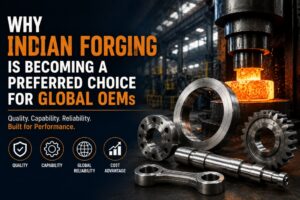

Global manufacturing is changing.
OEMs are no longer evaluating suppliers only on the basis of price. Quality, engineering expertise, production capabilities, delivery reliability, supply-chain resilience, and long-term value are becoming equally important.
This shift is creating new opportunities for India’s forging industry.
With a growing engineering ecosystem and increasing global manufacturing capabilities, Indian forging manufacturers are becoming an important sourcing option for global OEMs.
But what makes India increasingly attractive?
1. Competitive Manufacturing Costs
Cost remains an important factor in global procurement.
India offers a combination of competitive manufacturing economics and engineering expertise. For OEMs, this can create opportunities to optimize component costs without necessarily compromising on quality.
However, the real advantage should be evaluated through Total Cost of Ownership (TCO) rather than the initial component price alone.
Factors such as logistics, rejection rates, lead times, tooling, quality, and supplier reliability all contribute to the actual cost of sourcing.
2. Strong Engineering Expertise
Forging is not simply about shaping metal.
Complex industrial components require knowledge of:
- Material selection
- Die and process design
- Forging parameters
- Heat treatment
- Machining
- Inspection
- Dimensional control
India has a large engineering talent base supporting industries such as automotive, heavy engineering, power generation, infrastructure, aerospace, and oil & gas.
This engineering ecosystem helps Indian manufacturers support increasingly customized and technically demanding requirements.
3. Growing Manufacturing Capabilities
Modern forging requires advanced equipment and controlled manufacturing processes.
Indian forging manufacturers have increasingly invested in modern forging, heat treatment, machining, inspection, automation, and digital manufacturing systems.
For global OEMs, this means Indian suppliers can increasingly support projects that require more than basic component manufacturing.
4. Customization for Global OEM Requirements
Many OEMs require components manufactured according to specific drawings, materials, dimensions, tolerances, and inspection requirements.
Indian forging manufacturers are well positioned to support customized production for industries including:
- Oil & Gas
- Power Generation
- Mining
- Aerospace
- Construction
- Heavy Engineering
- Infrastructure
The ability to work closely with customers on engineering and production requirements can be a significant advantage for long-term B2B partnerships.
5. Supply-Chain Diversification
Recent global supply-chain disruptions have encouraged companies to reduce excessive dependence on a single sourcing location.
This has increased interest in strategies such as multi-source procurement and China + 1.
India can play an important role in this diversification.
For global OEMs, developing qualified Indian suppliers can provide another manufacturing option while improving supply-chain flexibility and resilience.
6. Quality and Traceability
For critical forged components, quality cannot be compromised.
Global buyers increasingly expect suppliers to provide:
- Material traceability
- Dimensional inspection
- Mechanical testing
- Heat-treatment records
- Non-destructive testing
- Quality documentation
- Consistent production processes
The key consideration for OEMs should therefore be the capabilities and quality systems of the individual supplier, rather than simply the country of origin.
CHW Forge: India’s Forging Expertise
One example of India’s established forging industry is CHW Forge, which has been involved in forging since 1956. The company describes itself as a leading Indian manufacturer and supplier of forged components, serving industries including aerospace, oil & gas, power generation, heavy industrial equipment, mining, construction, and infrastructure.
CHW Forge’s capabilities include forged and rolled components such as rings, gear rings, flanges, shafts, blocks, hubs, and hollow forgings, along with customized engineering solutions.
The company also highlights capabilities in advanced manufacturing, quality control, process engineering, traceability, and technology-enabled production.
For global OEMs, this type of integrated capability is important because the performance of a forged component depends on much more than the forging operation itself.
Why Global OEMs Should Consider India
India’s growing role in global forging is not based on one factor.
It is the combination of:
Competitive manufacturing + Engineering expertise + Manufacturing capabilities + Customization + Quality focus + Supply-chain diversification
that makes India increasingly relevant to international buyers.
For OEMs evaluating new suppliers, the question should not simply be:
“Is India cheaper?”
A better question is:
“Can an Indian forging partner deliver the quality, engineering capability, reliability, and long-term value our business requires?”
For many global OEMs, the answer is increasingly yes.
Final Thoughts
India’s forging industry is moving beyond its traditional role as a domestic manufacturing supplier.
As Indian manufacturers continue investing in technology, quality systems, engineering capabilities, and global supply chains, the country is becoming an increasingly attractive sourcing destination for international OEMs.
For companies looking to build resilient and diversified supply chains, Indian forging deserves serious consideration—not simply because of cost, but because of the combination of capability, expertise, and long-term manufacturing potential.