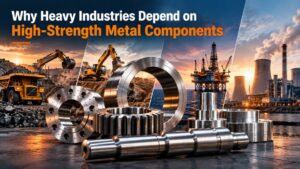

Heavy industries operate in environments where equipment is expected to perform under extreme loads, pressure, temperature, vibration, and continuous operation. From mining and construction to power generation, oil & gas, and heavy engineering, the reliability of industrial equipment often depends on one fundamental factor: the strength and durability of its components.
High-strength metal components play a critical role in these applications because they are designed to withstand demanding operating conditions while maintaining structural integrity over extended periods.
Among the various manufacturing processes used to produce such components, metal forging is widely used for applications where strength, reliability, and performance are essential.
But why are high-strength metal components so important to heavy industries?
1. Heavy Equipment Operates Under Extreme Loads
Industrial machinery often handles loads that would be impossible for conventional components to withstand.
Mining equipment, construction machinery, power-generation systems, and large industrial machines can experience:
- Heavy mechanical loads
- Repeated impact
- High torque
- Vibration
- Pressure
- Temperature fluctuations
- Continuous operating cycles
Components such as shafts, gears, rings, hubs, flanges, and structural parts must therefore be capable of handling these forces without premature failure.
High-strength metals provide the mechanical properties required to support these demanding applications.
2. Component Failure Can Be Extremely Costly
In heavy industries, component failure is rarely limited to the cost of replacing a single part.
A failed component can result in:
Equipment downtime → Production delays → Maintenance costs → Lost productivity
For industries operating large-scale machinery, even a short period of unexpected downtime can affect production schedules and operational efficiency.
This is why OEMs and industrial buyers increasingly focus on component reliability during supplier selection.
Using appropriately engineered, high-strength components can help reduce the risk associated with premature wear, deformation, and mechanical failure.
3. Forging Improves Component Strength and Reliability
Forging is one of the important manufacturing processes used to produce high-performance metal components.
During forging, metal is shaped using controlled compressive forces. The process can help develop a strong grain structure that follows the general shape of the component.
Compared with certain manufacturing methods that remove large amounts of material from a solid block, forging can produce components with properties suited to demanding mechanical applications.
This makes forged components particularly valuable for industries where strength and durability are critical.
4. High-Strength Components Support Longer Equipment Life
Heavy industrial equipment represents a significant investment.
OEMs and equipment operators therefore want machinery that can remain productive over long operating cycles.
The use of appropriately specified high-strength components can contribute to:
- Better resistance to mechanical stress
- Improved fatigue performance
- Greater durability
- Reduced risk of premature component failure
- More reliable equipment operation
However, component life depends on more than material strength alone. Design, heat treatment, manufacturing quality, operating conditions, maintenance, and application-specific requirements all influence performance.
5. Different Industries Require Different Material Properties
There is no single metal that is suitable for every heavy industrial application.
Depending on operating conditions, manufacturers may use different grades of:
- Carbon steel
- Alloy steel
- Stainless steel
- Duplex stainless steel
- Aluminium alloys
- Titanium
- Other specialized alloys
For example, a component exposed to corrosive conditions may require different material characteristics from one designed to handle extreme mechanical loads.
Therefore, material selection is an important part of component engineering.
OEMs should consider factors such as load requirements, temperature, corrosion exposure, fatigue, wear, and operating environment when specifying materials.
6. Precision Matters as Much as Strength
A component can have excellent material properties and still fail to perform correctly if it does not meet the required dimensional and engineering specifications.
Heavy industrial components often require controlled:
- Dimensions
- Tolerances
- Surface finish
- Geometry
- Heat treatment
- Mechanical properties
Precision becomes particularly important when forged components need to be integrated with other assemblies.
This is why modern forging manufacturing often combines forging with heat treatment, machining, inspection, and testing to achieve the required final specifications.
7. Quality Control Builds Confidence
For critical industrial components, quality cannot depend solely on visual inspection.
Manufacturers may use different inspection and testing methods depending on the component and application, including:
- Dimensional inspection
- Chemical analysis
- Hardness testing
- Mechanical testing
- Ultrasonic testing
- Magnetic particle testing
- Microstructure examination
Documentation and traceability are also important for industries where components need to be tracked from raw material through production and final inspection.
A structured quality system gives OEMs greater confidence that components are being manufactured consistently.
8. High-Strength Components Support Multiple Heavy Industries
The demand for durable metal components exists across a wide range of sectors.
Mining
Mining equipment operates under heavy loads, impact, abrasion, and harsh environmental conditions. Strong components are required for equipment such as crushers, conveyors, excavators, and other heavy machinery.
Oil & Gas
Oil and gas equipment may operate under high pressure, temperature, and corrosive conditions. Forged components are used in various critical applications where material integrity and reliability are important.
Power Generation
Power plants rely on large rotating and stationary equipment that can operate continuously for extended periods. Shafts, rings, flanges, and other forged components may be required to withstand significant mechanical and thermal stresses.
Construction & Infrastructure
Construction equipment must handle repeated loading and demanding site conditions. Durable components contribute to reliable operation of heavy machinery.
Aerospace and Engineering
Aerospace and advanced engineering applications can demand tight specifications, specialized materials, controlled manufacturing processes, and extensive inspection.
9. The Role of the Manufacturing Partner
For OEMs, selecting the right component manufacturer is as important as selecting the right material.
A capable forging manufacturer should ideally offer a combination of:
- Material expertise
- Forging capabilities
- Engineering support
- Heat treatment
- Machining
- Inspection and testing
- Traceability
- Quality certifications
- Production capacity
This integrated approach can simplify sourcing while helping OEMs maintain consistent quality across their supply chain.
Manufacturers such as CHW Forge operate across multiple industrial sectors and provide forged components for applications including engineering, heavy industrial equipment, power generation, mining, construction, aerospace, oil & gas, and other demanding industries.
What OEMs Should Consider
When sourcing high-strength metal components, OEMs should look beyond the basic question of whether a supplier can manufacture a particular part.
Important questions include:
- Does the manufacturer understand the application’s operating conditions?
- Can it work with the required material grades?
- Does it have the necessary forging capacity?
- Are heat treatment and machining capabilities available?
- What inspection and testing systems are used?
- Is complete traceability maintained?
- Can the supplier support long-term production requirements?
These considerations can help companies build a more reliable component supply chain.
Final Thoughts
Heavy industries depend on equipment that must perform reliably under demanding conditions. Behind that equipment are hundreds of components that carry loads, transfer power, withstand pressure, absorb impact, and operate through thousands of production cycles.
High-strength metal components are therefore more than individual machine parts—they are an important foundation of industrial reliability.
As heavy equipment becomes larger, more powerful, and more technologically advanced, the demand for reliable forged and engineered components will continue to grow.
For OEMs, investing time in material selection, manufacturing quality, testing, and supplier evaluation can help create components that deliver the strength and durability required for modern heavy industry.