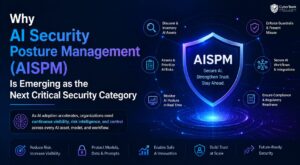

Artificial intelligence has rapidly evolved from an experimental technology into a strategic business asset. Organizations across industries are deploying AI-powered applications, large language models, AI agents, copilots, and automation platforms to improve productivity, accelerate innovation, and enhance decision-making.
As enterprise AI adoption accelerates, security teams face a new challenge. Traditional cybersecurity tools were designed to secure networks, endpoints, applications, identities, and cloud infrastructure. They were not built to provide visibility into AI models, training data, prompts, AI agents, and the unique risks associated with artificial intelligence.
This growing visibility gap has created an urgent need for a new security discipline: AI Security Posture Management (AISPM).
Much like Cloud Security Posture Management (CSPM) transformed cloud security and SaaS Security Posture Management (SSPM) improved SaaS visibility, AISPM is emerging as a critical category focused on identifying, assessing, and mitigating risks across enterprise AI ecosystems.
In 2026, organizations are beginning to recognize that securing AI requires more than governance policies and access controls. It requires continuous visibility into AI environments, ongoing risk assessments, and proactive security management. This is why AISPM is rapidly becoming one of the most important cybersecurity categories for the modern enterprise.
What Is AI Security Posture Management?
AI Security Posture Management is a cybersecurity approach focused on continuously assessing and improving the security posture of AI systems.
AISPM provides visibility into:
- AI models
- AI agents
- Large language models
- AI-powered applications
- Training datasets
- Prompt repositories
- Model configurations
- AI integrations
- AI infrastructure
- Third-party AI services
The goal is to identify security weaknesses, policy violations, data exposure risks, and configuration issues before attackers can exploit them.
AISPM helps organizations understand where AI is being used, how it is being accessed, and what risks it introduces.
Why Enterprise AI Is Creating New Security Challenges
Artificial intelligence introduces risks that traditional security frameworks were not designed to address.
Unlike conventional applications, AI systems often:
- Learn from data
- Generate dynamic outputs
- Interact with external systems
- Access sensitive information
- Operate autonomously
- Adapt based on user interactions
These characteristics create unique attack surfaces.
Security teams frequently struggle to answer critical questions such as:
- Which AI models are deployed?
- What data is being exposed to AI systems?
- Which users have access?
- What permissions do AI agents possess?
- Are AI systems compliant with security policies?
- What risks exist within AI workflows?
AISPM helps address these visibility challenges.
The Rapid Growth of Enterprise AI Environments
Organizations are deploying AI technologies at unprecedented speed.
Common AI deployments include:
Generative AI Platforms
Businesses use generative AI tools to create content, analyze information, and improve productivity.
AI Agents
Autonomous AI agents can execute workflows, retrieve information, and interact with enterprise systems.
Customer Service AI
Organizations increasingly use AI-powered chatbots and virtual assistants to support customers.
AI Development Platforms
Developers use AI-assisted coding tools and machine learning platforms to accelerate software development.
Security AI
Security teams leverage AI for threat detection, investigation, and incident response.
Each deployment expands the enterprise attack surface.
Why Traditional Security Tools Cannot Fully Protect AI
Most cybersecurity solutions focus on established domains such as:
- Network security
- Endpoint protection
- Identity security
- Application security
- Cloud security
While these controls remain important, they often lack visibility into AI-specific risks.
For example, traditional security tools may not detect:
- Prompt injection vulnerabilities
- Model misconfigurations
- Excessive AI permissions
- Data poisoning attempts
- Shadow AI deployments
- Unauthorized AI usage
AISPM fills these gaps by providing AI-specific visibility and risk assessment capabilities.
Key Risks Driving AISPM Adoption
Several emerging threats are accelerating interest in AI Security Posture Management.
Shadow AI
Shadow AI refers to unauthorized AI usage within organizations.
Employees frequently adopt AI tools without security approval.
Examples include:
- Public AI chatbots
- AI content generators
- AI coding assistants
- AI productivity tools
Without visibility, organizations cannot effectively manage the associated risks.
AISPM helps identify and monitor unauthorized AI deployments.
Prompt Injection Attacks
Prompt injection has become one of the most significant AI security threats.
Attackers attempt to manipulate AI systems by introducing malicious instructions.
Potential consequences include:
- Unauthorized data access
- Policy bypasses
- Workflow manipulation
- Sensitive information disclosure
AISPM helps identify vulnerable AI deployments and enforce security controls.
Data Leakage
Many AI systems process sensitive information.
This may include:
- Customer records
- Financial data
- Intellectual property
- Internal communications
- Business strategies
AISPM helps organizations identify data exposure risks and strengthen protection measures.
Excessive Permissions
AI agents often require access to enterprise systems.
However, excessive permissions can significantly increase risk.
AISPM helps security teams evaluate:
- Access privileges
- Identity permissions
- Role assignments
- Privileged AI activities
Reducing unnecessary access limits potential damage.
AI Agents Are Expanding the Security Challenge
AI agents represent one of the fastest-growing areas of enterprise AI adoption.
Unlike traditional applications, AI agents can:
- Access multiple systems
- Execute actions autonomously
- Retrieve sensitive information
- Trigger workflows
- Make recommendations
This autonomy creates significant security implications.
Organizations need visibility into:
- Agent permissions
- Connected systems
- Data access patterns
- Workflow activity
- Security controls
AISPM provides centralized visibility across AI agent environments.
Core Capabilities of AI Security Posture Management
Effective AISPM solutions typically include several key capabilities.
AI Asset Discovery
Organizations must first identify all AI systems operating within their environment.
AISPM helps discover:
- AI models
- AI agents
- AI applications
- Third-party AI services
- AI APIs
Visibility serves as the foundation of security.
Risk Assessment
AISPM continuously evaluates AI environments for:
- Security weaknesses
- Configuration errors
- Policy violations
- Compliance concerns
Continuous assessment enables proactive risk reduction.
Data Exposure Analysis
Organizations need visibility into how AI systems interact with sensitive information.
AISPM helps identify:
- Data leakage risks
- Excessive data access
- Improper sharing practices
- Regulatory concerns
Security Policy Enforcement
AISPM supports consistent governance by ensuring AI deployments align with organizational security requirements.
This helps reduce security drift over time.
The Relationship Between AISPM and AI Governance
AI governance and AISPM are closely connected but serve different purposes.
AI Governance Focuses On:
- Policies
- Oversight
- Accountability
- Compliance
- Responsible AI practices
AISPM Focuses On:
- Technical visibility
- Risk assessment
- Security monitoring
- Misconfiguration detection
- Continuous posture improvement
Together, these disciplines create a comprehensive AI risk management framework.
How AISPM Supports Zero Trust
Zero Trust principles are increasingly being applied to AI environments.
The guiding principle remains:
Never trust, always verify.
AISPM supports Zero Trust by helping organizations:
- Validate AI identities
- Monitor access activity
- Assess risk continuously
- Identify abnormal behavior
- Reduce excessive permissions
This strengthens the security of AI-powered environments.
The Role of Identity Security in AISPM
Identity has become a critical component of AI security.
Organizations must manage:
- Human identities
- AI agents
- Service accounts
- APIs
- Machine identities
AISPM helps identify identity-related risks across AI environments.
This includes:
- Excessive privileges
- Unauthorized access
- Credential exposure
- Identity sprawl
Identity visibility is essential for reducing AI-related risk.
Regulatory and Compliance Considerations
Regulators are increasingly scrutinizing AI deployments.
Organizations must demonstrate:
- Data protection
- Access controls
- Risk management
- Transparency
- Accountability
AISPM supports compliance efforts by providing:
- Visibility
- Auditability
- Risk reporting
- Security assessments
These capabilities help organizations prepare for evolving regulatory requirements.
Best Practices for Implementing AISPM
Organizations can strengthen AI security by following several best practices.
Create an AI Inventory
Identify all AI systems across the enterprise.
Assess Risk Continuously
Perform ongoing evaluations of:
- Models
- Agents
- Data flows
- Integrations
Monitor AI Activity
Track:
- Access patterns
- User interactions
- Data usage
- Agent behavior
Strengthen Identity Controls
Apply least privilege principles and identity governance across AI environments.
Integrate Security and Governance
Security teams and governance teams should collaborate to ensure AI deployments remain secure and compliant.
The Future of AI Security Posture Management
As AI adoption continues to accelerate, AISPM is expected to become a foundational cybersecurity category.
Future AISPM platforms will likely provide:
- AI risk scoring
- Automated remediation
- Agent security monitoring
- Model vulnerability assessments
- Advanced behavioral analytics
- Regulatory compliance reporting
Organizations that adopt AISPM early will gain a significant advantage in managing AI-related risk.
Conclusion
Artificial intelligence is rapidly becoming a core component of enterprise operations, but it also introduces entirely new security challenges. Traditional security tools often lack visibility into AI models, AI agents, training data, prompts, and the unique attack vectors associated with AI systems.
AI Security Posture Management is emerging as the solution to this challenge. By providing continuous visibility, risk assessment, configuration monitoring, and governance support, AISPM helps organizations secure their AI environments while maintaining innovation and business agility.
As enterprises continue deploying AI at scale, understanding and improving AI security posture will become essential. In 2026 and beyond, AISPM is poised to become a critical pillar of modern cybersecurity strategies, helping organizations manage risk, strengthen resilience, and safely embrace the future of artificial intelligence.
About Cyber Tech Intelligence
Cyber Tech Intelligence is a leading cybersecurity intelligence platform dedicated to delivering research-driven insights, threat intelligence, and strategic analysis across the evolving cybersecurity landscape. We help enterprises, CISOs, technology leaders, and cybersecurity vendors navigate emerging threats, security technologies, and business risks with confidence. Our expertise spans AI Security, Threat Intelligence, Cloud Security, Identity Security, Zero Trust, SIEM, XDR, DevSecOps, Application Security, and Enterprise Cyber Resilience. Through independent research, executive engagement, and market intelligence, we provide actionable insights that support informed decision-making and stronger security outcomes.
At Cyber Tech Intelligence, we believe effective cybersecurity strategies are built on trusted intelligence, transparency, and strategic relevance. Our services include cybersecurity research reports, threat trend analysis, executive briefings, vendor intelligence, CISO engagement programs, webinars, and advisory services designed to help organizations stay resilient in a rapidly changing threat environment. Whether you are looking for strategic cybersecurity insights, partnership opportunities, or expert guidance, our team is ready to help. Contact Us to connect with our cybersecurity experts and learn how we can support your organization’s security goals.