
Every parent and teacher has heard some version of the question: “Why do I have to learn this?”
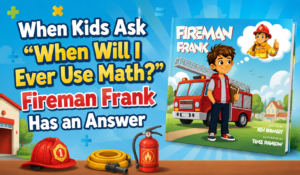
For a child, math can feel like a collection of numbers that belongs to a worksheet, a classroom, or a test. Fireman Frank: Learning Math to Save the Day turns that feeling inside out by showing a young reader that math can live inside a dream.
Franklin Spencer is a fifth grader who wants to become a firefighter. He loves fire trucks so much that a passing engine pulls his attention away from a math assignment. Instead of working, he starts drawing a hook-and-ladder truck and imagining himself racing toward an emergency.
His teacher, Mrs. Bartholomew, catches him. What follows is the most useful part of the story. She does not tell Frank that his dream is silly. She asks him to look more closely at it.
Start With What the Child Already Loves
Frank thinks firefighting means driving, talking on a radio, and using impressive equipment. Mrs. Bartholomew helps him notice the mathematics hidden inside that equipment.
A firefighter needs to read gauges; understand measurements; pay attention to water flow, pressure, temperature, tank levels, and percentages. Suddenly, the subject Frank was ignoring is connected to the future he talks about every day.
That is an idea adults can use immediately. If a child loves baking, fractions can become ingredients. If a child loves basketball, numbers can become scores, averages, and percentages. If a child loves building, measurement and geometry have a purpose. If a child loves animals, science and reading can lead toward questions about habitats, health, and care.
The goal is not to disguise every lesson as play. The goal is to help a child see that knowledge travels.
Ask Better Questions
One reason Mrs. Bartholomew reaches Frank is that she asks questions instead of simply delivering a speech.
What do you think you need to know to become a great firefighter?
That question invites Frank into the lesson. He answers from what he already understands, and then his teacher expands the picture.
At home, adults can do the same. Instead of saying, “You need math because I said so,” try asking, “Where do you think people use numbers in the job you want?” Instead of explaining every connection immediately, let the child guess.
The conversation becomes discovery rather than correction.
Connect Effort to Identity
Frank’s change is not that he suddenly loves every math problem. His change is that he begins to see math as part of becoming the person he wants to be.
That is powerful because identity can motivate effort. A child who says, “I want to be a scientist,” can begin hearing, “Scientists observe carefully.” A future writer can hear, “Writers read.” A future firefighter can hear, “Firefighters need to understand numbers and equipment.”
The message is not that children must choose a career early. Dreams change, and that is healthy. What matters is showing them that interesting futures are built from present skills.
Keep the Standard, Change the Reason
Mrs. Bartholomew does not excuse Frank for ignoring his assignment. She still expects him to do the work.
That balance is important. Making learning relevant does not mean removing discipline. It means giving discipline a reason. Frank understands that paying attention today can help him become capable tomorrow.
By the end of the book, he follows through. He completes his math assignments and earns one of the highest scores in his class.
The score is encouraging, but the real win is the shift in attitude.
Try This After Reading
Ask a child to name one job, hobby, or goal that feels exciting. Write it at the top of a page. Underneath, list five things a person would need to learn, practice, measure, read, remember, or communicate to do it well. Do not worry about creating a career plan. The exercise helps make learning visible. Children can begin noticing that skills are not random school requirements. They are tools people carry into situations.
Learning Can Become Service
The dedication of the Fireman Frank series describes learning as a gift that can be used in service to others. That idea gives the story a bigger purpose.
Frank is attracted to the excitement of firefighting, but firefighters also help people in moments that matter. The more prepared he becomes, the more useful he may one day be.
That is a meaningful answer to “Why do I have to learn this?” Sometimes the answer is not about the worksheet at all.
It is about becoming ready.
Fireman Frank reminds children that a dream can be fun to imagine, but learning is what begins to give that dream tools, direction, and the possibility of helping someone else.