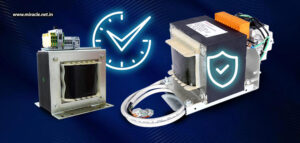

The EI transformer, one of the most common transformers used across industrial, commercial, and electronic applications, is known for its robustness and proven performance. Its widespread adoption is a result of decades of engineering refinement and real-world validation. However, not all EI transformers deliver the same level of reliability and performance; true long-term reliability comes from thoughtful design, high-quality materials, consistent manufacturing processes, and disciplined testing practices. Even small variations in core assembly, winding techniques, or insulation quality can significantly impact long-term durability. For any EI transformer manufacturer in India, building reliability requires attention to detail at every stage – from concept to final testing. The blog below explores what truly makes an EI transformer reliable over the long term, from the inside out.
Thoughtful EI transformer design for long-term reliability
Long-term reliability begins from the first step itself – the designing phase. A well-designed EI transformer is engineered to perform consistently under real-world operating conditions. This includes thoughtful consideration of the load profile, thermal design, and electrical margins. A reliable design accounts for how the transformer will actually be used in continuous operation, fluctuating loads, and inrush current during startup. Transformers designed only for steady ideal loads often fail prematurely when exposed to real operating conditions. Thermal behaviour is also an important consideration; proper core sizing, winding layout, ventilation paths, and insulation selection – all work together to manage heat effectively. There must also be adequate safety margins in temperature rise limits, voltage insulation levels, and current density in the windings. These electrical margins, when properly set, allow the transformer to tolerate minor overloads, voltage fluctuations, and environmental variations without degradation.
Core material quality and precision assembly
The core is the heart of the transformer, and the quality and consistency of the core material have a direct impact on efficiency, heat generation, noise, and aging. Reliable EI transformers use high-grade low-loss silicon steel with consistent grain structure. Poor quality steel increases core losses, heat buildup, and audible hum. Over time, excess heat accelerates insulation breakdown and shortens service life. The lamination thickness and insulation coating also plays a significant role. Uniform lamination thickness and proper surface insulation between the laminations reduce eddy current losses. Well-manufactured cores also maintain tighter magnetic coupling, improving performance consistency across production batches. Loose or poorly stacked laminations can lead to vibration, noise, and mechanical wear. Reliable transformers use proper clamping methods, accurate stacking pressure, and stable core assembly techniques to prevent long-term loosening caused by thermal cycling and magnetic forces.
Winding materials and construction quality
Windings are subjected to electrical stress, thermal stress, and mechanical forces throughout the transformer’s life. The material choice and construction quality are critical to withstand these stresses over time. High-purity copper or aluminium ensures current handling and minimizes hot spots. The size is also important – undersized or inconsistent conductors increase both resistance and operating temperature. The insulation also plays a crucial role, which includes the enamel coating, inter-layer insulation film, and final impregnation materials. Each layer must be compatible with the transformer’s temperature class and operating environment. The winding tension is of equal importance. Controlled winding tension ensures tight uniform coils that resist vibration and mechanical fatigue, while poorly wound coils can shift over time, causing insulation abrasion and eventual failure.
Thermal management and temperature control
Thermal management within a transformer is of utmost importance, as even small reductions in operating temperature can significantly extend service life. Transformers need to operate well below their maximum allowable temperature rise to prevent resilience to ambient temperature variations and overloads. The life of the insulation roughly halves for every 10°C increase in operating temperature, which makes conservative thermal design one of the most effective ways to ensure decades of reliable operation. Vacuum pressure impregnation or high-quality varnish impregnation improves heat transfer from windings to the core, while also enhancing mechanical strength and moisture resistance. Effective thermal management ultimately protects both electrical insulation and structural integrity.
Manufacturing consistency and quality testing standards
Even the best design can fail if manufacturing practices are inconsistent, which means process standardization is important. Reliable manufacturers follow documented processes for everything from core stacking, winding, and insulation placement, to impregnation and final assembly. This ensures that every transformer from every batch performs similarly. Steel, copper, insulation, and varnish from approved suppliers ensure material consistency across production runs. Consistent training, experienced supervision, and attention to detail are important to reduce variability and defects. As much as manufacturing consistency is important, so is testing, as it validates whether the transformer can survive real-world conditions. Routine tests like turns ratio verification, no-load and load loss measurement, insulation resistance testing, and high-voltage withstand testing confirm electrical integrity and workmanship quality. Tests like temperature rise tests, load endurance testing, and sample-based life testing identify weaknesses before the products reach the field. Consistent testing across batches ensures that reliability is maintained as volumes scale.
What makes an EI transformer reliable over the long term is a system of disciplined choices. It is not defined by a single feature, but by a series of well-considered decisions made at every stage of development. Thoughtful design, high-quality materials, controlled manufacturing, and rigorous testing, all work together to ensure stable performance. Each layer of this process reinforces the next, creating a product that performs consistently under real-world conditions. For businesses seeking a trusted EI transformer manufacturer in India, Miracle Electronics combines engineering expertise, high-grade materials, controlled manufacturing, and rigorous testing to deliver long-term reliability. With a strong focus on consistency and performance, Miracle Electronics ensures that every EI transformer meets demanding industrial and commercial standards. In a market where cost pressures often drive short-term decisions, long-term reliability remains a mark of engineering integrity.