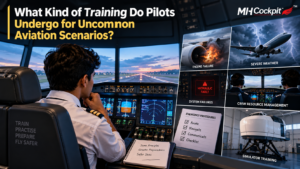

Commercial aviation is built around safety, procedures, and preparation. While most flights follow a predictable pattern, pilots also need to be ready for situations that are unusual or unexpected. Engine problems, severe weather, equipment failures, communication issues, and other abnormal situations may be rare, but pilots are trained to respond when they occur.
This is why pilot training involves much more than learning how to take off, fly a route, and land an aircraft. A large part of professional training focuses on how pilots manage situations that do not go according to plan.
Simulator Training for Abnormal Situations
One of the main methods used to prepare pilots for uncommon aviation scenarios is simulator training. Flight simulators allow pilots to practise situations that would be difficult or unsafe to recreate in an actual aircraft.
During simulator sessions, pilots can encounter scenarios such as engine failures, electrical problems, hydraulic failures, instrument malfunctions, rejected takeoffs, smoke or fire warnings, and difficult weather conditions.
The simulator can also introduce problems at different stages of a flight. An engine failure during takeoff requires a different response from an engine failure during cruise. Pilots therefore need to understand not only what has gone wrong, but also how the aircraft’s situation affects their available options.
Repeated practice helps pilots become familiar with the procedures and decision-making process required during these events.
Training for Severe Weather
Weather is another area where pilots receive specific training. Thunderstorms, windshear, icing, turbulence, strong crosswinds, and reduced visibility can all affect aircraft operations.
Pilots are taught how to identify potential weather hazards before and during a flight. In many cases, the safest response is to avoid hazardous weather rather than attempt to fly through it.
However, pilots also need to know how to respond when conditions change unexpectedly. Simulator exercises can provide situations involving turbulence, windshear warnings, instrument conditions, and other weather-related challenges.
The aim is to help pilots maintain control of the aircraft while following established procedures and making appropriate decisions.
Engine and Aircraft System Failures
Modern aircraft have multiple systems designed to provide redundancy, but pilots still train for failures.
Engine failure is one of the most commonly recognised examples. In a multi-engine aircraft, pilots are trained to continue flying the aircraft, complete the relevant procedures, communicate with air traffic control, and determine the safest course of action.
Training also covers failures involving systems such as hydraulics, electrical power, flight instruments, navigation equipment, and communications.
Pilots do not simply memorise a response to every possible failure. Aircraft systems are too complex and the number of possible combinations is too large. Instead, training teaches pilots how to identify the problem, maintain control, use the appropriate checklist, and work through the situation methodically.
Crew Resource Management
Uncommon aviation scenarios are not only technical problems. They can also place a high workload on the flight crew.
Crew Resource Management, commonly known as CRM, helps pilots work effectively as a team during normal and abnormal operations. Communication, task sharing, workload management, decision-making, and monitoring are all important parts of this training.
For example, one pilot may concentrate on flying the aircraft while the other works through a checklist, communicates with air traffic control, or coordinates with the cabin crew.
Clear communication becomes especially important when several tasks need to be completed within a short period.
Emergency Procedures and Checklists
Pilots also train extensively with emergency and abnormal procedures. Checklists provide a structured way to deal with many aircraft problems.
The purpose of a checklist is not to replace pilot judgement. Instead, it helps ensure that important actions are completed in the correct order and that critical steps are not missed during a stressful situation.
Pilots learn to prioritise the aircraft’s immediate needs. Maintaining control of the aircraft comes first, followed by identifying the problem, completing the appropriate procedures, and deciding on the safest next step.
This structured approach can be applied even when a pilot encounters a situation that is not exactly the same as something previously practised.
Recurrent Training
Pilot training does not end after initial qualification. Airline pilots typically return for recurrent training and assessments.
These sessions allow pilots to practise emergency and abnormal procedures regularly. They may repeat scenarios that involve aircraft system failures, weather problems, communication issues, or other operational challenges.
Regular training is important because emergency procedures need to remain familiar. A pilot may fly thousands of normal flights without experiencing a serious emergency, but still needs to be prepared to respond correctly if one occurs.
Preparing for the Unexpected
One of the most important parts of professional pilot training is learning how to deal with uncertainty.
It is impossible to predict every event that could occur during a flight. Instead of preparing pilots for every individual possibility, training develops skills that can be applied across different situations.
Pilots learn how to assess what is happening, maintain aircraft control, communicate with other crew members, use available information, follow procedures, and make decisions based on the situation.
This combination of technical knowledge and practical training helps pilots manage situations they may never have personally experienced before.
Why This Training Matters
Uncommon aviation scenarios are rare, but preparing for them is a normal part of professional flying. Simulator sessions, emergency procedures, CRM training, weather training, and recurrent assessments all help pilots maintain their ability to respond when conditions change.
For people considering a career in aviation, understanding this side of pilot training gives a better idea of what the profession involves. Flying an aircraft is only one part of the job. Professional pilots must also be prepared to manage abnormal situations calmly and systematically.
Resources such as MH Cockpit can also be useful for people researching pilot training, aviation education, and career paths in the industry. The more prospective pilots understand about the training process, the better prepared they can be for what lies ahead.