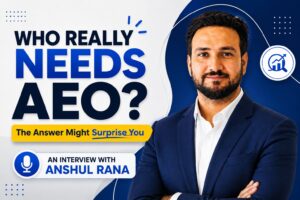

Anshul Rana has spent over eight years in SEO, with the last several years focused on a discipline that barely had a name when he started: optimizing for AI-generated answers. As the founder of The Digital Geek and a Top Rated Plus freelancer on Upwork with a 100% job success score, Rana has worked with clients across healthcare, legal, SaaS, and managed services in India, Australia, the US, and the UK. We sat down with him to cut through the growing noise around Answer Engine Optimization (AEO) and understand who actually needs it and why.

THE INTERVIEW
Q: AEO is a term a lot of marketers are throwing around right now. How do you define it in plain terms?
A: AEO is simply the practice of structuring your content so that AI-powered platforms can extract it, trust it, and deliver it as a direct answer to a user’s question. When someone asks ChatGPT or Perplexity a question, those systems do not browse a list of links. They pull specific passages from pages they understand well, synthesize an answer, and cite the source. AEO is about making sure your content is one of those sources. The goal shifts from ranking on page one to becoming the answer itself.
Q: How is that different from what SEO has always tried to do?
A: Traditional SEO was about ranking your page high enough that a user would click it. AEO is about making your content so clearly structured, so factually dense, and so unambiguous that an AI system can lift a passage out of it and use it without the user ever visiting your site. The intent is different, and so is the content architecture. In SEO you might write a 2,000-word guide that builds context gradually. In AEO, every section needs to be independently understandable. The AI is not reading your article top to bottom. It is extracting the paragraph that directly answers the question.
Q: The stat floating around is that nearly 60 percent of searches now end without a click. Does that make AEO more urgent or more pointless?
A: More urgent, not pointless, and here is why. Zero-click searches mean the traffic model is broken, but the visibility model is not. When an AI Overview or a ChatGPT response cites your brand, millions of users see your name associated with an authoritative answer. That builds recall, brand trust, and downstream searches. Research shows AI-referred visitors convert at significantly higher rates than standard organic traffic, because they arrive already having received a recommendation. The volume is lower, but the intent is much higher. Businesses that focus only on traffic metrics will misread the value entirely.
Q: So who actually needs AEO? Not every business, surely.
A: You are right, not every business needs to prioritize it equally. AEO delivers the most value for businesses where the buyer journey involves research questions before a purchase decision. Healthcare providers, law firms, financial services, SaaS companies, and B2B service businesses are good examples. When someone asks ChatGPT which personal injury attorney in Chicago handles trucking accidents, or which IT managed services provider works with Australian schools, being cited in that answer is enormously valuable. If you run a local bakery, you probably need Google Business Profile and local SEO more than a full AEO strategy.
Q: What does a basic AEO implementation look like?
A: It starts with content structure. You need clear, concise answers at the top of each section, not buried three paragraphs in. FAQ sections with genuine questions your clients ask, not keyword-stuffed filler. Proper schema markup, especially FAQPage, Article, and Organization schema, because structured data gives AI systems a verified signal about what your content is and who created it. Author credentials visible on the page. And consistent entity signals across your site and off-site profiles so that AI systems can confidently associate your brand with your claimed area of expertise.
Q: What is the single biggest mistake you see businesses make when they try to implement AEO?
A: They treat it as a content volume exercise. They publish fifty FAQ articles overnight and expect citations to follow. AEO is not about publishing more. It is about publishing content that AI systems can trust. That trust comes from E-E-A-T signals, from third-party mentions, from clean structured data, and from topical depth, not from quantity. I have seen clients with five well-built pages outrank competitors with two hundred thin pages in AI-generated answers. Depth beats volume every time.
Q: Final question: is AEO a temporary trend or a permanent shift?
A: It is structural, not cyclical. The underlying change is that AI is now mediating between users and information. That is not going to reverse. What will shift are the specific platforms and signals that matter, but the core need to optimize for machine-readable, citable, trustworthy content is here permanently. The businesses that adapt now will have a compounding advantage. Citation authority works a lot like domain authority. The sooner you start building it, the harder it becomes for competitors to catch up.
Anshul Rana is the founder of The Digital Geek a digital marketing agency based in Derabassi, Punjab, serving clients across India, Australia, the US, and the UK. He specializes in Technical SEO, AEO, GEO, and Schema Markup. You can connect with him at anshulrana.in or on LinkedIn.