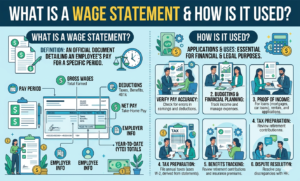

A wage statement, often called a pay stub or earnings statement, is a detailed document that employers provide to employees to outline how their wages are calculated for a specific pay period. It serves as a transparent record of income, deductions, and net pay, helping both employers and employees maintain accurate payroll records. In today’s digital workplace, tools like Paycheck Stubs Generator and Check Stub Template solutions have made creating and managing these documents faster, more efficient, and highly accurate.
What Is a Wage Statement?
A wage statement is a formal record that accompanies an employee’s paycheck. Whether issued in paper form or digitally, it provides a breakdown of earnings, taxes, and deductions. Employers must ensure that wage statements include all required details based on federal and state labour laws.
Typically, a wage statement includes:
- Employee name and identification details
- Employer information
- Pay period start and end dates
- Total hours worked (for hourly employees)
- Gross wages (before deductions)
- Itemised deductions (taxes, insurance, retirement contributions)
- Net pay (take-home amount)
This document ensures transparency and helps employees understand exactly how their earnings are calculated.
Why Wage Statements Matter
Wage statements play a crucial role in payroll management and financial accountability. They protect both employers and employees by creating a clear record of compensation.
For employees, wage statements help:
- Verify correct payment
- Track income over time
- Understand tax withholdings
- Provide proof of income for loans or rentals
For employers, they:
- Ensure compliance with labour laws
- Maintain organised payroll records
- Reduce disputes related to wages
- Support accurate tax reporting
Using a Paycheck Stubs Generator simplifies this process by automating calculations and reducing the chances of human error.
Key Components of a Wage Statement
Understanding the structure of a wage statement helps employees and employers use it effectively. Each section provides specific information:
1. Gross Pay
Gross pay represents the total earnings before deductions. It includes hourly wages, salaries, bonuses, and overtime.
2. Deductions
Deductions may be mandatory or voluntary. Common deductions include:
- Federal and state taxes
- Social Security and Medicare contributions
- Health insurance premiums
- Retirement contributions
A well-designed Check Stub Template ensures these deductions appear clearly and accurately.
3. Net Pay
Net pay is the final amount the employee receives after all deductions. This is often referred to as take-home pay.
4. Year-to-Date Totals
Many wage statements include cumulative totals for earnings and deductions, helping employees track their financial progress throughout the year.
How Wage Statements Are Used
Wage statements serve multiple practical purposes beyond simply showing earnings.
1. Proof of Income
Employees often use wage statements when applying for loans, mortgages, or rental agreements. Lenders and landlords rely on these documents to verify income stability.
2. Tax Filing
Wage statements help employees track taxes withheld throughout the year. They complement annual tax forms and ensure accurate filing.
3. Financial Planning
By reviewing wage statements regularly, employees can monitor spending, savings, and deductions. This insight supports better budgeting and financial decisions.
4. Dispute Resolution
If discrepancies arise in pay, wage statements provide a clear record that helps resolve issues quickly and fairly.
Digital tools like a Paycheck Stubs Generator allow employees to access their wage statements anytime, making these uses even more convenient.
Digital vs. Paper Wage Statements
Traditionally, employers issued paper wage statements alongside physical paychecks. However, digital wage statements have become the standard due to their convenience and efficiency.
Benefits of Digital Wage Statements:
- Easy access anytime, anywhere
- Reduced paper usage
- Faster distribution
- Secure storage and retrieval
Modern payroll systems and Paycheck Stubs Generator tools allow businesses to generate and distribute wage statements instantly.
How to Create a Wage Statement
Creating a wage statement involves gathering accurate payroll data and presenting it in a structured format.
Step 1: Collect Employee Information
Include the employee’s name, ID, and relevant details.
Step 2: Calculate Earnings
Determine gross pay based on hours worked or salary agreements.
Step 3: Apply Deductions
Subtract all applicable taxes and benefits.
Step 4: Determine Net Pay
Calculate the final take-home amount.
Step 5: Use a Template or Tool
A Check Stub Template ensures consistency and professionalism in formatting.
Automated tools streamline this entire process, reducing manual work and minimising errors.
Benefits of Using Online Tools
Online payroll tools have transformed how wage statements are created and managed.
Accuracy
Automated systems calculate wages and deductions precisely.
Efficiency
Employers can generate wage statements in minutes instead of hours.
Customization
Templates allow businesses to tailor wage statements to their needs.
Compliance
Built-in features ensure adherence to legal requirements.
A Check Stub Template combined with a digital generator provides a complete solution for modern payroll management.
The Future of Wage Statements
As businesses continue to adopt digital solutions, wage statements will become even more advanced. Features like real-time payroll tracking, mobile access, and integration with financial apps are already reshaping how employees interact with their earnings.
Conclusion
A wage statement is more than just a record of earnings—it is a vital tool for transparency, compliance, and financial management. It helps employees understand their income while enabling employers to maintain accurate payroll systems.