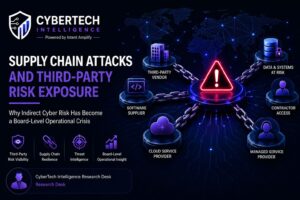

As businesses become increasingly dependent on third-party software vendors, cloud platforms, APIs, and managed service providers, cybersecurity risks are evolving beyond traditional network perimeters. One of the fastest-growing concerns in modern cybersecurity is the rise of supply chain attacks – a threat vector capable of disrupting entire ecosystems through a single compromised vendor or software dependency.
In today’s interconnected digital economy, organizations are no longer only responsible for securing their own infrastructure. They must also account for the cybersecurity posture of every external partner, supplier, and technology provider integrated into their operations.
For CISOs, IT leaders, security teams, and B2B technology decision-makers, understanding supply chain attack risks has become essential for maintaining business continuity and protecting sensitive data.
What Is a Supply Chain Attack?
A supply chain attack occurs when cybercriminals infiltrate an organization by compromising a trusted third-party vendor, software provider, contractor, or service dependency.
Rather than attacking a target organization directly, threat actors exploit vulnerabilities in external systems to gain indirect access.
Common supply chain attack methods include:
- Compromised software updates
- Malicious third-party code injections
- Vendor credential theft
- Open-source dependency poisoning
- API exploitation
- Managed service provider (MSP) compromise
Because organizations inherently trust external vendors, supply chain attacks are particularly dangerous and difficult to detect.
Why Supply Chain Risks Are Increasing in 2026
Modern enterprises rely on an increasingly complex digital ecosystem.
Today’s software environments often include:
- Cloud service providers
- SaaS applications
- Third-party APIs
- Open-source libraries
- DevOps pipelines
- External IT contractors
Each integration introduces potential vulnerabilities.
The challenge is that even highly secure organizations may remain exposed if one trusted partner suffers a breach. Attackers understand this and increasingly target weak links within vendor networks to maximize impact.
In many cases, a single compromise can cascade across thousands of customers.
Major Risks of Supply Chain Attacks
1. Widespread Operational Disruption
A successful supply chain attack can cripple business operations.
Compromised vendors may unintentionally distribute malicious code, disrupt software availability, or trigger system downtime.
Operational consequences often include:
- Service outages
- Productivity losses
- Delayed business operations
- Incident response costs
For organizations dependent on digital platforms, even temporary disruptions can result in significant financial losses.
2. Third-Party Data Exposure
Supply chain attacks often grant cybercriminals access to sensitive organizational data.
Threat actors may target:
- Customer information
- Intellectual property
- Financial records
- Healthcare or regulated data
- Authentication credentials
Because third-party vendors frequently handle critical workloads, breaches can quickly escalate into large-scale data exposure incidents.
This creates both reputational and regulatory risk.
3. Software Integrity Compromise
One of the most concerning risks is software tampering.
Attackers may insert malicious code into trusted applications, updates, or dependencies without immediate detection.
This tactic allows malicious payloads to spread across multiple customer environments simultaneously.
Examples include:
- Dependency poisoning in software packages
- Compromised software repositories
- Malicious update distribution
For software companies, maintaining code integrity has become a business-critical priority.
4. Increased Regulatory and Compliance Exposure
Organizations operating in regulated sectors face heightened consequences following third-party breaches.
Industries such as:
- Healthcare
- Financial services
- Government
- Critical infrastructure
must comply with strict cybersecurity and data privacy standards.
Failure to manage third-party risks effectively may result in:
- Compliance violations
- Financial penalties
- Legal exposure
- Customer trust erosion
As cybersecurity regulations mature, vendor accountability is becoming a larger component of governance frameworks.
How Organizations Can Reduce Supply Chain Risk
Cybersecurity leaders must move beyond traditional perimeter defense and adopt proactive third-party risk management strategies.
Best Practices for Supply Chain Security
- Conduct regular vendor security assessments
- Implement Zero Trust access principles.
- Continuously monitor third-party activity
- Audit software dependencies and open-source components
- Strengthen API security policies.
- Enforce software bill of materials (SBOM) practices.
Security resilience increasingly depends on visibility across the entire vendor ecosystem.
Why This Matters for Business Leaders
For executives, supply chain attacks are no longer isolated cybersecurity incidents – they are enterprise-wide business risks.
A single third-party compromise can disrupt revenue, damage customer trust, and create long-term operational setbacks.
Organizations that invest in vendor risk intelligence, continuous monitoring, and software integrity protections position themselves to reduce exposure and respond faster to emerging threats.
Final Thoughts
The risks of supply chain attacks continue to grow as organizations expand their digital ecosystems and reliance on external providers.
In 2026, cybersecurity is no longer limited to internal systems. It extends across every partner, platform, and software dependency connected to the business.
To better understand how third-party risk exposure and supply chain vulnerabilities are reshaping cybersecurity, organizations should continue evaluating emerging threats and strengthening security strategies before attackers exploit hidden weaknesses.