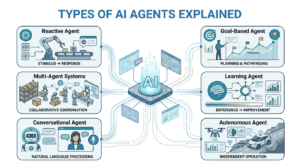

Types of AI Agents Explained
AI agents are changing how people interact with software. Unlike traditional software that follows fixed instructions, an AI agent can understand a goal and decide what steps are needed to complete it. It can use information from different sources and interact with other systems. This makes AI agents useful for tasks that need reasoning and several actions.
The interest in AI agents is growing across industries. McKinsey reported in 2025 that 62% of organizations were experimenting with AI agents. The same research found that 23% were already scaling an agentic AI system in at least one business function.
What Is an AI Agent?
An AI agent is a software system that can act toward a specific goal. It can understand information and make decisions based on the situation. It can also use tools and access business systems when needed.
For example, a customer service agent can understand a customer request. It can check an order system and identify the issue. It can then suggest a solution or complete an approved action. The agent does more than provide an answer because it can take steps to solve the problem.
1. Reactive AI Agents
Reactive agents are among the simplest types of AI agents. They respond to the information they receive at a specific moment. They do not maintain a complex memory of previous interactions.
These agents work well for simple and predictable tasks. A basic support chatbot is one example. It can identify a question and provide a suitable response. These agents are useful when the workflow does not require long-term planning.
2. Goal-Based AI Agents
Goal-based agents work toward a defined outcome. Instead of simply reacting to an input they consider the goal before deciding what action to take.
A sales agent could have a goal to qualify a new lead. It may review customer information and ask relevant questions. It can then classify the lead based on predefined business rules. This approach makes agents useful for workflows that involve multiple steps.
3. Utility-Based AI Agents
Utility-based agents choose actions by comparing possible outcomes. Their purpose is to select an action that provides the best result based on specific criteria.
For example a logistics agent could consider delivery time and transportation cost. It can compare available options and select a suitable route. This makes utility-based agents useful for planning and optimization tasks.
4. Learning AI Agents
Learning agents can improve their performance by using feedback and new information. They can identify patterns from previous interactions and adjust their future decisions.
These agents can be useful in areas such as recommendations and customer support. A learning agent can understand which responses work better over time. It can then use those insights to improve future interactions.
5. Autonomous AI Agents
Autonomous agents can perform tasks with limited human involvement. They can plan actions and use connected tools to complete a workflow.
An autonomous IT agent could monitor a system for unusual activity. It could investigate the issue and follow an approved process to resolve it. Human employees can remain involved when a decision requires approval or carries higher risk.
However autonomy needs clear controls. Gartner reported in 2025 that only 15% of surveyed IT application leaders were considering piloting or deploying fully autonomous AI agents.
6. Multi-Agent Systems
A multi-agent system uses several AI agents that work together. Each agent can have a different role within the same workflow.
For example one agent can collect customer information. Another can analyze the information. A third can prepare a recommendation. A coordinator agent can manage the overall process.
This approach can make complex workflows easier to manage. It also allows businesses to assign specific responsibilities to different agents.
7. Conversational AI Agents
Conversational agents are designed to communicate with people through natural language. They can understand questions and respond in a conversational way.
Modern conversational agents can go beyond basic question answering. They can connect with databases and business applications. They can also complete approved actions during a conversation.
8. Decision-Making AI Agents
Decision-making agents help users evaluate information and choose an action. They can analyze data and consider different conditions before making a recommendation.
These agents can support finance and operations teams. They can also assist with risk analysis and business planning. Human oversight remains important when decisions have significant business consequences.
Choosing the Right AI Agent
The right type of AI agent depends on the problem you want to solve. A simple task may need a reactive agent. A complex workflow may require an autonomous or multi-agent system.
Businesses should first identify the process and its desired outcome. They should then define the data sources and tools the agent needs. Security and human approval should also be considered before deployment.
AI Agent Development Services can help businesses design agents around specific workflows. The focus should be on solving a real business problem rather than adding AI to a process without a clear purpose.
Conclusion
AI agents come in different forms. Each type is designed for a different level of complexity and autonomy. Reactive agents can handle simple responses while learning agents can improve through feedback. Autonomous and multi-agent systems can support more complex workflows.
The growth of AI agent adoption shows that businesses are exploring new ways to automate work. McKinsey found that many organizations are experimenting with agents but most have yet to scale them broadly.
For businesses planning their next AI initiative, the goal should be clear outcomes and controlled deployment. Tech.us can help organizations explore practical AI agent solutions that fit their workflows and business requirements.