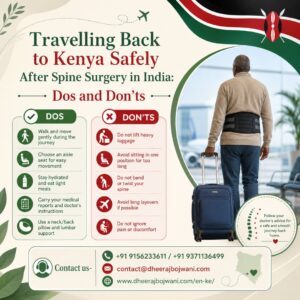

For Kenyan patients who travel to India for spine surgery, returning home is an important part of the recovery plan. A long-haul flight can be physically demanding soon after surgery, particularly when sitting for several hours, moving through airports and managing luggage are involved.
The right time to travel depends on the type of spine surgery, recovery progress, mobility and the surgeon’s assessment. Some spine-surgery guidance recommends avoiding long-haul flights for several weeks because surgery and prolonged immobility can increase the risk of blood clots. In some cases, surgeons may advise waiting up to three months for long-haul travel.
For Kenyan patients, the safest approach is therefore to plan the return journey around medical recovery rather than a pre-booked flight date.
When Is It Safe to Fly After Spine Surgery?
There is no universal waiting period for every spinal procedure. Recovery after a lumbar decompression may differ considerably from recovery after spinal fusion, major trauma surgery or complex cervical surgery.
Before booking your return flight, ask your Indian spine surgeon:
- Am I medically fit to fly?
- How long should I wait before a long-haul journey?
- Do I need a follow-up examination or X-ray before travelling?
- Can I sit comfortably for the duration of the flight?
- Do I need airport wheelchair assistance?
- What precautions should I take to reduce blood-clot risk?
Your surgeon should make the final decision based on your specific operation and recovery.
Read More Here:- Safe Travel After Spine Surgery in India to Kenya
Dos Before Travelling Back to Kenya
1. Get Medical Clearance
Do not leave India simply because you have completed your planned hospital stay. Your treating team should confirm that your wound is healing appropriately, your pain is reasonably controlled and you can travel safely.
2. Keep Your Medical Documents With You
Carry your discharge summary, operative report, imaging reports, medication list and follow-up instructions in your cabin baggage. These records can be important if you need medical attention during your journey or after arriving in Kenya.
3. Arrange Airport Assistance
Indian airports can involve considerable walking between check-in, security, immigration and boarding gates. Request wheelchair or mobility assistance from the airline in advance if you need it.
This can reduce unnecessary strain on your back during the journey.
4. Keep Medicines in Your Cabin Baggage
Carry your prescribed medicines in your hand luggage rather than putting them in checked baggage. Keep them properly labelled and follow the dosing schedule provided by your doctor.
Do not change pain medicines or other prescriptions simply because you are travelling.
5. Move as Advised by Your Medical Team
Remaining completely still for a long period is generally not desirable after surgery. When your surgeon permits it, gentle walking and movement can help you maintain mobility. Some spine-surgery guidance recommends walking regularly during long journeys and taking precautions against blood clots.
Read More Here:- Travel Guidelines After Spine Surgery in India to Kenya
Don’ts Before and During the Journey
Don’t Carry Heavy Luggage
Avoid lifting suitcases or placing heavy cabin bags in overhead compartments. Ask airport staff or your travelling companion for assistance.
Your surgeon or physiotherapist should tell you how much weight you can safely lift during your recovery.
Don’t Sit in One Position for Too Long
If you are medically cleared to move around, change position and walk periodically according to your surgeon’s instructions. Long periods of immobility during a long-haul flight can increase clot risk after surgery.
Don’t Ignore New Symptoms
Contact your medical team promptly if you develop increasing wound pain, redness, swelling, discharge, fever, worsening weakness or other unexpected symptoms before travelling.
During or after the journey, sudden breathing difficulty, chest pain or significant leg swelling requires urgent medical assessment.
Don’t Rush Back to Normal Activities
Reaching Kenya does not mean that your spine has fully recovered. Continue the walking, physiotherapy and activity restrictions given by your surgeon.
Choosing the Right Flight
If your medical team has approved long-haul travel, try to make the journey as straightforward as possible.
|
Travel factor |
What Kenyan patients should consider |
|
Flight route |
Choose the most practical route and avoid unnecessary connections where possible |
|
Airport assistance |
Request wheelchair or mobility support in advance |
|
Seating |
Choose a position that allows comfortable movement according to medical advice |
|
Luggage |
Avoid carrying or lifting heavy bags |
|
Connecting flights |
Allow sufficient time between flights |
|
Medication |
Keep essential medicines accessible in cabin baggage |
|
Travel companion |
Consider travelling with someone who can assist with luggage and mobility |
If a connection is unavoidable, avoid planning a rushed transfer between distant gates.
What Should You Do During the Flight?
Once seated, follow the positioning and movement instructions given by your spine team. If you are permitted to walk, take short walks when appropriate rather than remaining seated throughout the entire journey.
Gentle ankle and leg movements may also be recommended, particularly on long flights, but patients should follow their own medical team’s instructions.
Drink fluids normally according to your doctor’s advice and avoid experimenting with medications to make yourself sleep through the flight.
What Should Happen After Landing in Kenya?
Arrange transportation from the airport before leaving India. Choose a vehicle in which you can sit comfortably and avoid unnecessary bending or twisting.
If your mobility is limited, have a family member or caregiver meet you at the airport. Try to avoid carrying luggage yourself.
Once home, continue your prescribed rehabilitation and follow-up plan. If your Indian surgeon has recommended a review or imaging at a specific time, arrange this with an appropriate healthcare professional in Kenya.
Planning Follow-Up Care Before Leaving India
Before travelling home, ask the Indian spine team for a written recovery plan covering:
- Wound care
- Medication schedule
- Walking and exercise recommendations
- Lifting restrictions
- Physiotherapy requirements
- Follow-up appointment timing
- Recommended imaging
- Warning signs requiring medical attention
Spine-surgery aftercare commonly includes gradual increases in mobility, wound care and follow-up assessment.
Final Thoughts
For Kenyan patients returning home after spine surgery in India, safe travel depends on recovery rather than a fixed timetable. Get clearance from your surgeon, arrange airport assistance, avoid heavy lifting, keep medicines and medical records with you, and follow movement and rehabilitation instructions throughout the journey. Planning transportation and follow-up care in Kenya before leaving India can make the return home more comfortable and better organised.
Official Indian Government References
- National Medical Commission (NMC): https://www.nmc.org.in/
The NMC is India’s statutory medical regulator responsible for medical education, professional standards and medical registration. It is a useful official source when reviewing specialist medical qualifications in India. - Indian Council of Medical Research (ICMR): https://www.icmr.gov.in/
ICMR is India’s apex biomedical research organisation. Its research and evidence-based clinical resources provide useful reference material for understanding medical conditions and healthcare practices.
Our Commitment to Patients
“Our mission is to place patients at the centre of every healthcare decision by providing trustworthy, evidence-based, and unbiased medical information. We believe that informed patients make better decisions. Backed by personalised guidance from our experienced advisory team, we help patients understand their treatment options, compare them objectively, and confidently choose the path that best aligns with their medical needs, personal preferences, and long-term health goals.”
Dr. Dheeraj Bojwani
Medical Travel Advisor for International Patients Seeking Treatment in India
📍 New Delhi, India
🏆 24+ Years of Experience | Assisted 5,000+ International Patients
🌐 Website: www.dheerajbojwani.com/en-ke/
📧 Email: contact@dheerajbojwani.com
📞 Phone: +91 9156233611 | Alternate Phone: +91 9371136499
Disclaimer
This article is intended for educational and informational purposes only and should not be considered medical, legal, or visa advice. Medical recommendations, treatment plans, and procedures may vary from one patient to another based on individual health conditions and circumstances. Readers are strongly advised to consult qualified healthcare professionals before making any medical-related decisions.