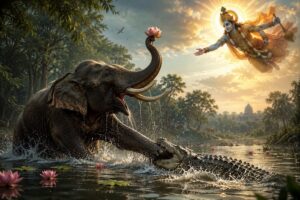

Story of Gajendra
What does it take to make God drop everything, mid-conversation, and rush to save someone? Not a temple full of priests chanting in perfect Sanskrit. Not years of ritual perfection. According to the Bhagavatam, it took a dying elephant, a crocodile’s jaws, and one desperate cry from a creature who had nothing left to offer except surrender. This is the story of Gajendra, the elephant king, and it’s one of the most emotionally direct devotional accounts in Vedic literature. The complete narrative, along with detailed commentary explaining its philosophical weight, is available through the ISKCON Mayapur Online Store, where authentic Srimad Bhagavatam editions cover this episode in the eighth canto with remarkable depth.
Gajendra’s story doesn’t open with devotion at all. It opens with something far more ordinary: an animal enjoying a peaceful day, completely unaware that his life was about to change forever.
A King Among Elephants, Living an Enviable Life
Gajendra ruled as the leader of a massive herd of elephants on a mountain called Trikuta, a place described as lush, abundant, and largely free of danger. He wasn’t struggling for survival or facing any particular hardship. By every measure available to an elephant, his life was comfortable, even privileged.
One day, during the intense heat of summer, Gajendra led his herd toward a large lake to bathe and drink, as he had likely done countless times before. Nothing about that afternoon suggested anything unusual was coming. He waded into the cool water with his usual confidence, enjoying the relief from the heat, surrounded by his family and the rest of his herd.
That confidence was about to be tested in a way nothing in his life had prepared him for.
The Crocodile That Changed Everything
Beneath the calm surface of that lake lived a powerful crocodile, and the moment Gajendra’s leg entered the water within reach, the crocodile clamped down with brutal force. What followed wasn’t a quick skirmish. It became an exhausting, prolonged struggle that stretched on for what the texts describe as an extraordinarily long time, some versions suggesting it lasted years rather than hours.
Think about the physical reality of that struggle for a moment:
- An enormous, powerful elephant, easily capable of overpowering most threats on land, found himself utterly helpless in water
- The crocodile had home-field advantage, operating in its natural environment while Gajendra fought against unfamiliar terrain
- Every attempt to pull free only tightened the crocodile’s grip, turning the struggle into a slow, draining war of attrition
- His own herd, family included, eventually gave up and walked away, unable to help and unwilling to risk their own safety
That last detail deserves attention. Gajendra wasn’t abandoned by strangers. His own family, the elephants who had lived alongside him his entire life, watched him struggle and eventually left him to face it alone.
Strength Alone Wasn’t Going to Save Him
Here’s where the story becomes genuinely instructive rather than just dramatic. Gajendra fought with everything his massive body could offer. He used his trunk, his legs, every ounce of physical power available to an animal of his size and strength. None of it worked.
As the struggle dragged on, his body weakened. Years of fighting, or even just the sheer duration described in the account, eventually depleted every physical resource he had. The crocodile, patient and relentless, simply waited him out.
This is the part of the story that resonates far beyond its literal details. Gajendra represents something almost universal: a being who had relied entirely on physical strength and worldly capability finally reaching the exact point where that strength runs out completely. No amount of struggle, no clever maneuvering, no reserve of stamina remained. He had genuinely exhausted every material option available to him.
The Moment Everything Shifted
With his body failing and death approaching, Gajendra did something that changed the entire trajectory of the story. He stopped struggling physically and turned inward instead. According to the account, a memory surfaced from some earlier point in his life, or perhaps from a previous existence, recalling devotional practice and knowledge of the Supreme Lord.
With whatever strength remained, he lifted his trunk toward the sky, holding a lotus flower as an offering, and called out with complete sincerity for help. His prayer wasn’t calculated or performed for an audience. There was no audience left. His family had already walked away.
This detail matters enormously: Gajendra’s prayer came from genuine desperation, not ritual obligation. He wasn’t reciting memorized verses to fulfill religious duty. He was a dying creature with nothing left except raw, unfiltered surrender, calling out because every other option had been stripped away.
An Answer That Arrived Without Delay
The moment Gajendra’s cry reached out, Lord Vishnu responded with an urgency almost unheard of in devotional literature. According to the account, the Lord didn’t wait for the right moment, didn’t finish whatever cosmic business he was attending to, and didn’t send an intermediary. He rushed immediately, so quickly that even his own consort, Lakshmi, was left behind mid-conversation, unable to keep pace with how fast he moved.
Arriving at the lake, Vishnu used his discus, the Sudarshana Chakra, to kill the crocodile instantly and pull Gajendra free from its grip. The elephant, moments from death, was not just physically rescued but spiritually transformed by the encounter.
This urgency is worth sitting with. Throughout the Bhagavatam, the Lord’s appearances often involve context, buildup, and preparation. Here, there’s none of that. The response is instantaneous, almost as though genuine desperate surrender bypasses whatever normal cosmic protocol might otherwise apply.
Why Was an Elephant So Important?
A reasonable question surfaces here: why would the Supreme Lord drop everything for an elephant, of all creatures? Wouldn’t a great sage or powerful king warrant a faster response?
The story’s implicit answer challenges assumptions people often carry about devotion. Gajendra wasn’t rescued because of his status, his species, or his accomplishments. He was rescued because of the quality of his surrender in that final moment. Nothing about his social position, his species, or his prior conduct factored into the Lord’s response. What mattered was the sincerity of a being with nothing left to offer except complete, unguarded reliance on divine help.
This detail carries weight for anyone studying devotional philosophy. It suggests that:
- Position and background don’t determine spiritual worthiness
- Genuine desperation, stripped of pretense, often produces more authentic connection than years of formal ritual performed out of habit
- The Lord’s attention isn’t reserved for the powerful or the accomplished, but responds to sincerity regardless of who is offering it
The Backstory Rarely Told in Short Versions
Most retellings stop at the crocodile rescue, treating it as a complete story on its own. But the fuller account includes an earlier life that explains why this rescue carried such deep symbolic weight.
According to extended versions of the narrative, Gajendra was once a devoted king named Indradyumna in a previous life, known for his genuine worship of the Lord. Due to a curse from a sage, provoked by an unintentional lapse in respect, he was transformed into an elephant, losing his memory of his former devotional life along with his human form.
This backstory reframes the entire crocodile encounter. Gajendra wasn’t a spiritually blank creature suddenly discovering devotion for the first time. He was a devotee whose connection to the divine had been buried under a curse and years of an animal existence, waiting for the right moment of crisis to resurface. The crocodile’s attack, as painful as it was, became the exact circumstance needed to strip away everything separating him from that earlier devotion.
The Detail About Lakshmi That Gets Overlooked
There’s a small moment in this story that rarely gets the attention it deserves: when Vishnu rushed to save Gajendra, he moved so quickly that Lakshmi, his eternal consort, couldn’t keep pace with him. Some versions of the account describe her being left mid-sentence, unable to finish whatever she was saying before he had already departed.
This detail isn’t just decorative color added for dramatic effect. It illustrates something important about how urgency functions differently in devotional contexts compared to ordinary storytelling. Even the Lord’s closest, most intimate companion couldn’t slow down his response to a devotee’s cry. Nothing, not protocol, not comfort, not even his own consort’s presence, took priority over answering Gajendra in that instant.
For readers studying devotional philosophy, this detail reinforces a recurring theme found throughout the Bhagavatam: sincere calls for help from a devotee in genuine distress tend to override every other consideration, including circumstances that would normally command immediate attention. It’s a small narrative choice, but it does a lot of work in establishing exactly how seriously this rescue was treated within the story’s own internal logic.
What This Story Actually Teaches About Crisis
It’s tempting to read Gajendra’s account purely as a rescue story with a happy ending. But the deeper lesson sits in what happened before the rescue, not after it.
Crisis strips away pretense faster than comfort ever could. Gajendra’s years of comfortable living on Trikuta mountain never produced the depth of surrender his crocodile struggle eventually forced out of him. Sometimes it takes losing every option, every reserve of strength, and every source of external help before genuine reliance on something greater becomes possible.
Physical strength has limits that spiritual surrender doesn’t. Gajendra’s story doesn’t dismiss the value of effort or strength. He fought hard, using everything available to him, before turning toward surrender. The lesson isn’t that effort is pointless. It’s that effort alone, without acknowledging its limits, eventually reaches a point where something else becomes necessary.
Abandonment by others doesn’t mean abandonment by everything. Gajendra’s own herd walked away. His isolation in that moment could have easily produced despair rather than prayer. Instead, being left alone became the exact condition that allowed him to turn his attention somewhere else entirely.
Why This Story Still Gets Told Centuries Later
Gajendra’s account remains one of the most referenced stories in devotional teaching because it captures something almost everyone eventually experiences: a moment where personal capability simply isn’t enough anymore. Illness, loss, financial ruin, broken relationships. The specific crisis changes, but the underlying experience of reaching the end of your own resources stays remarkably consistent across human experience.
What makes this story distinct from a generic message about faith is its emotional honesty. Gajendra wasn’t rewarded for perfect behavior or flawless devotion throughout his life. He was rescued because, in his most desperate moment, he turned toward something beyond himself with total sincerity. Readers wanting the complete philosophical treatment of this episode, including its connection to broader themes of surrender within Vaishnava thought, can find full translated editions carrying Srila Prabhupada’s original commentary through ISKCON’s established publishing lineage.
A Story That Still Applies Long After the Lake
Set aside the mountain, the crocodile, and the discus for a moment. Look at the emotional shape of this story instead: a capable being fights hard using every resource available, watches support disappear, and only turns toward genuine surrender once every other option has been exhausted. That shape repeats constantly in ordinary life, minus the mythological scale.
People often resist asking for help until circumstances leave them no other choice, treating self-reliance as the only acceptable approach until exhaustion makes it impossible to continue that way. Gajendra’s story doesn’t shame that instinct to keep fighting. It simply shows what waits on the other side of it, once fighting alone stops being enough.
The Real Weight Behind a Cry for Help
Strip away the crocodile, the discus, and the urgency of divine rescue, and Gajendra’s story leaves behind something remarkably human: the realization that strength has boundaries, that abandonment by others doesn’t have to mean total isolation, and that surrender, when genuine, tends to arrive exactly when everything else has already failed.
His cry wasn’t polished. It wasn’t strategic. It was simply the last thing available to a dying creature who had run out of every other option. Sometimes, according to this story, that’s precisely the kind of call that gets heard the fastest.