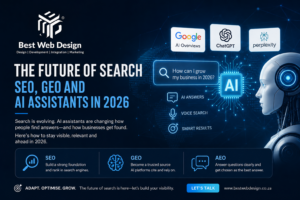

Search is undergoing its biggest transformation since the rise of mobile devices. For years, businesses focused on improving rankings in traditional search engines through keywords, backlinks, and technical optimization. While these elements remain important, the emergence of AI-powered search experiences has fundamentally changed how users discover information online.
Today, people increasingly turn to Google AI Overviews, ChatGPT, Gemini, Perplexity, and voice assistants for direct answers rather than clicking through multiple search results. This shift means businesses must think beyond traditional rankings and begin optimizing for AI-driven search experiences.
In 2026, success in digital marketing depends on a combination of Search Engine Optimization (SEO), Generative Engine Optimization (GEO), and Answer Engine Optimization (AEO). Together, these strategies help brands improve visibility across search engines, AI assistants, voice search platforms, and answer engines.
This guide explains what has changed, why it matters, and how businesses can adapt to remain visible in the age of AI-powered search.
How Search Has Changed in 2026
Traditional search was built around keywords. Users typed a phrase into a search engine, reviewed a list of results, and clicked through to find information.
Modern search behaves differently.
Instead of searching for “web design company,” users now ask:
- Which web design agency is best for small businesses?
- How can I improve my website rankings in 2026?
- What factors help websites appear in AI search results?
AI-powered search systems understand conversational language, user intent, context, and follow-up questions. Rather than presenting a list of links, they often generate direct answers.
This shift has led to the rapid growth of:
- AI Overviews
- Conversational search
- Voice search
- Zero-click searches
- AI-generated recommendations
- Personalized search experiences
As AI continues to evolve, businesses that optimize solely for traditional rankings risk losing visibility even when they appear on the first page of search results.
The challenge is no longer just ranking higher. The challenge is becoming the source AI systems trust and recommend.
Understanding SEO, GEO and AEO
To compete effectively in modern search, businesses must understand the role each optimization strategy plays.
SEO: The Foundation of Search Visibility
Search Engine Optimization remains the foundation of digital visibility.
SEO focuses on improving a website’s ability to rank in traditional search results through:
- Technical optimization
- Website performance
- Mobile usability
- Content quality
- Internal linking
- Backlink acquisition
- User experience
Without strong SEO fundamentals, neither GEO nor AEO can perform effectively.
Key SEO priorities for 2026 include:
- Core Web Vitals
- Mobile-first design
- Structured site architecture
- Helpful content creation
- User experience optimization
- Search intent alignment
SEO remains the engine that drives discoverability across the web.
GEO: Generative Engine Optimization
Generative Engine Optimization focuses on helping AI systems understand, trust, and cite your content.
Unlike traditional search engines, generative AI platforms analyze information from multiple sources before creating a response. They look for content that is:
- Accurate
- Well-structured
- Easy to understand
- Trustworthy
- Supported by evidence
GEO ensures your content is optimized for platforms such as:
- ChatGPT
- Google AI Overviews
- Gemini
- Perplexity
- Copilot
- Voice AI assistants
The goal is simple:
Instead of merely ranking on Google, your content becomes a source that AI systems reference when generating answers.
AEO: Answer Engine Optimization
Answer Engine Optimization focuses on providing direct answers to user questions.
Modern users increasingly search using complete questions rather than short keyword phrases.
Examples include:
- What is Generative Engine Optimization?
- How do AI assistants choose websites?
- Is traditional SEO still important in 2026?
AEO helps businesses optimize content for:
- Featured snippets
- Voice search
- AI assistants
- Smart devices
- Conversational search engines
The objective is to become the preferred answer rather than simply another search result.
Why AI Assistants Are Transforming Search
AI assistants have become information gateways.
Millions of users now rely on AI platforms for:
- Research
- Product recommendations
- Business discovery
- Learning
- Content summaries
- Purchase decisions
Instead of browsing multiple websites, users increasingly trust AI-generated responses.
This creates both challenges and opportunities.
Businesses that build authority and publish high-quality content can gain visibility across multiple AI ecosystems.
Businesses that ignore AI optimization risk becoming invisible despite having strong traditional rankings.
The future belongs to brands that can communicate effectively with both humans and AI systems.
Why Topical Authority Matters More Than Ever
One blog post is no longer enough to establish expertise.
Search engines and AI assistants evaluate entire websites to determine credibility.
This concept is known as topical authority.
Topical authority is built when a website consistently covers a subject from multiple angles.
For example, a web design agency should publish content about:
- Website design
- User experience
- SEO
- Local SEO
- Conversion optimization
- AI search
- Website performance
- Digital marketing
The more comprehensive your content ecosystem becomes, the more likely search engines and AI assistants are to view your website as a trusted source.
Topical authority increases:
- Search rankings
- AI citations
- Brand visibility
- Trust signals
- Lead generation opportunities
Businesses that invest in content clusters and topic coverage gain a significant competitive advantage.
How AI Assistants Decide Which Websites to Recommend
AI systems evaluate content differently than traditional search engines.
Several factors influence whether your website gets cited.
1. Accuracy and Reliability
AI assistants prefer factual, trustworthy information.
Content supported by:
- Data
- Research
- Statistics
- Expert insights
is more likely to be referenced.
2. Clear Structure
Content should be easy to scan and understand.
Well-structured pages include:
- Headings
- Subheadings
- Bullet points
- Tables
- FAQs
This helps AI systems extract information efficiently.
3. Brand Recognition
Brands mentioned consistently across reputable websites gain stronger entity recognition.
Positive signals include:
- Industry citations
- Reviews
- Media mentions
- Backlinks
- Business directory listings
4. E-E-A-T Signals
Experience, Expertise, Authoritativeness, and Trustworthiness remain critical.
Businesses should demonstrate:
- Real-world experience
- Expert knowledge
- Author credentials
- Transparent information
- Trust indicators
5. Technical Performance
Fast websites perform better.
AI systems and search engines favor websites that offer:
- Fast loading speeds
- Mobile optimization
- Secure connections
- Accessible content
Technical excellence remains a competitive advantage.
Keyword Research for AI-First SEO
Keyword research has evolved significantly.
Instead of focusing exclusively on short phrases, businesses should target conversational search patterns.
Examples include:
Traditional Keyword:
- SEO Services
AI-First Keyword:
- How do SEO services help businesses grow in 2026?
Traditional Keyword:
- Web Design Agency
AI-First Keyword:
- What should I look for when hiring a web design agency?
Long-tail keywords provide greater context and align closely with how users interact with AI assistants.
Effective research sources include:
- Google Search Console
- People Also Ask
- AnswerThePublic
- Industry forums
- Customer support questions
- Sales conversations
Understanding real user questions is the foundation of AI-focused content creation.
How to Create Content That Ranks and Gets Cited by AI
Answer Questions Immediately
Users and AI systems both prefer direct answers.
Address the primary topic within the opening paragraphs.
Avoid lengthy introductions that delay valuable information.
Use Clear Heading Structures
Organize content logically.
Each heading should focus on a specific topic or question.
This improves readability and AI comprehension.
Include Evidence
Data improves credibility.
Statistics, research findings, and expert insights increase the likelihood of citation.
Write Naturally
Modern search systems understand conversational language.
Write for people first.
Avoid keyword stuffing and robotic phrasing.
Add Structured Data
Schema markup helps search engines and AI systems interpret content.
Useful schema types include:
- FAQ Schema
- Article Schema
- Organization Schema
- Local Business Schema
- How-To Schema
Structured data improves content understanding and visibility.
Measuring Success in the Age of AI Search
Traditional SEO metrics remain valuable, but they are no longer sufficient.
Businesses should also monitor:
- AI Overview visibility
- Brand mentions
- Branded search growth
- AI referral traffic
- Conversion rates
- Engagement metrics
- Topic authority growth
The focus should shift from traffic alone to overall visibility and business outcomes.
A brand cited frequently by AI systems can generate trust and leads even when users never click a traditional search result.
Building Long-Term Authority for AI Search
The brands winning in 2026 are investing in authority rather than shortcuts.
Key strategies include:
Publish Consistently
Create valuable content regularly.
Consistency signals expertise and commitment.
Strengthen Internal Linking
Connect related articles to build topic clusters.
This helps users and search engines navigate your expertise.
Earn Quality Backlinks
Authority grows when respected websites reference your content.
Focus on relevance and quality rather than quantity.
Build Your Brand
Brand recognition increasingly influences AI recommendations.
Invest in:
- Public relations
- Thought leadership
- Industry partnerships
- Reviews and testimonials
Strong brands earn stronger visibility.
The future of search is evolving rapidly, and businesses that adapt early will gain a significant competitive advantage. If you want to improve your visibility across Google Search, AI Overviews, ChatGPT, Gemini, and other AI-powered platforms, contact Best Web Design today and discover how a modern SEO, GEO, and AEO strategy can help your business grow.
Frequently Asked Questions
What is GEO in SEO?
Generative Engine Optimization (GEO) focuses on helping AI-powered search platforms understand, trust, and cite your content in generated responses.
What is AEO?
Answer Engine Optimization (AEO) involves structuring content to provide direct answers for voice search, AI assistants, featured snippets, and conversational search experiences.
Is traditional SEO still important in 2026?
Yes. SEO remains the foundation of online visibility. GEO and AEO enhance SEO rather than replace it.
How do AI assistants choose sources?
AI assistants evaluate content quality, factual accuracy, authority, trust signals, website performance, and relevance to user intent.
Can small businesses compete in AI search?
Absolutely. AI systems often prioritize the most helpful and accurate answer rather than the largest brand. Small businesses can succeed by building strong topical authority within a focused niche.
What is the biggest SEO trend in 2026?
The integration of SEO, GEO, and AEO into a unified visibility strategy is one of the most significant trends shaping search in 2026.