

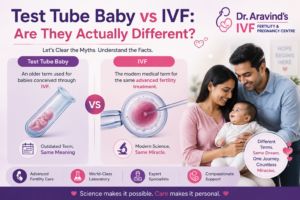

Many couples exploring fertility treatment often wonder whether a “test tube baby” and IVF are two different procedures. If you’ve searched for IVF vs test tube baby explained, you’re asking one of the most common questions in reproductive medicine. The simple answer is no—they both refer to the same fertility treatment. The difference lies only in the terminology. Understanding this can help reduce confusion and make your fertility journey easier to navigate.
What Is IVF?
In Vitro Fertilization (IVF) is an advanced fertility treatment that helps couples conceive when pregnancy does not happen naturally. During IVF, mature eggs are collected from the ovaries and fertilized with sperm inside a highly specialized laboratory. After a healthy embryo develops, it is carefully placed into the uterus, where pregnancy continues naturally.
IVF has become one of the most successful assisted reproductive technologies available today and has helped millions of families achieve their dream of parenthood.
What Is a Test Tube Baby?
The phrase “test tube baby” became popular when IVF was first introduced many years ago. However, the name is medically outdated because fertilization does not happen inside a test tube. Instead, it occurs in a sterile laboratory culture dish under carefully controlled conditions.
For this reason, healthcare professionals now use the term IVF baby, which more accurately describes the treatment process. Although the older phrase is still commonly used, both terms refer to babies conceived through IVF.
IVF vs Test Tube Baby: Is There Any Difference?
The answer is straightforward—there is no medical difference.
“Test tube baby” is simply an older, non-medical expression for a baby conceived through IVF. The procedure, the pregnancy, and the baby’s development remain exactly the same.
Once fertilization takes place in the laboratory and a healthy embryo is transferred into the uterus, pregnancy progresses naturally, just like any other pregnancy.
How Does IVF Work?
Although every patient’s treatment plan is unique, IVF generally follows these steps:
- Fertility medications stimulate the ovaries to produce multiple mature eggs.
- Doctors collect the eggs through a minor procedure.
- Eggs and sperm are combined in a specialized laboratory.
- Healthy embryos are observed for several days.
- One carefully selected embryo is transferred into the uterus.
- A pregnancy test is performed approximately two weeks later.
Every stage is monitored closely to improve safety and maximize the chances of pregnancy.
Benefits of IVF
IVF offers hope to couples facing a wide range of fertility challenges. Some of its key benefits include:
- Helps overcome both male and female infertility.
- Offers treatment for blocked fallopian tubes and ovulation disorders.
- Supports couples with unexplained infertility.
- Allows specialists to monitor embryo development carefully.
- Provides fertility preservation options for selected patients.
If you are planning fertility treatment, consulting an experienced IVF Specialist in Perambalur can help you understand your options and receive a treatment plan tailored to your needs.
Common Myths and Facts
Myth 1: Test Tube Babies Are Different
Fact: Babies born through IVF grow and develop just like naturally conceived children.
Myth 2: IVF Is Only for Women
Fact: Male infertility contributes to many infertility cases, and IVF often helps couples overcome these challenges.
Myth 3: IVF Always Works on the First Attempt
Fact: Success depends on several factors, including age, reproductive health, and embryo quality.
Myth 4: IVF Is Painful
Fact: Most patients experience only mild discomfort during different stages of treatment, and modern techniques have made IVF much more comfortable than before.
When Should You Consult a Fertility Specialist?
You should consider consulting a fertility specialist if:
- You have been trying to conceive for one year without pregnancy.
- The woman is over 35 and pregnancy has not occurred after six months.
- You have irregular menstrual cycles.
- You have experienced recurrent miscarriages.
- There are known male fertility concerns.
Seeking help early allows doctors to identify potential problems sooner and recommend the most appropriate treatment.
Frequently Asked Questions
1. Is a test tube baby different from an IVF baby?
No. Both terms refer to babies conceived through the IVF procedure.
2. Why is the term “test tube baby” outdated?
Because fertilization takes place in a laboratory culture dish rather than a test tube, making “IVF baby” the medically accurate term.
3. Is IVF a safe treatment?
Yes. IVF is a well-established fertility treatment performed safely around the world by trained fertility specialists.
4. Who may benefit from IVF?
Couples with blocked fallopian tubes, male infertility, ovulation disorders, endometriosis, unexplained infertility, or age-related fertility decline may benefit from IVF.
5. Does IVF guarantee pregnancy?
No. Success depends on factors such as age, embryo quality, and overall reproductive health.
Conclusion
Understanding IVF vs test tube baby explained helps clear one of the biggest misconceptions about fertility treatment. A “test tube baby” is simply an older term for a baby conceived through IVF. With modern technology and expert fertility care, IVF continues to help millions of couples build healthy families. At Dr.Aravind’s IVF Fertility & Pregnancy Centre, couples receive compassionate guidance and evidence-based fertility care to support them throughout their parenthood journey.