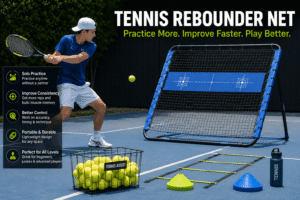

A tennis rebounder net can be a useful training tool for players who want more repetition without depending on a practice partner. Instead of waiting for another player to feed the ball, a rebounder returns the ball toward you, allowing you to repeat strokes, work on timing, and practise movement in a controlled way.
Tennis Assist provides tennis training solutions for different practice needs and playing levels.
What Is a Tennis Rebounder Net?
A tennis rebounder net is a training net designed to return a tennis ball after it is hit into the netting. Depending on the design and angle, the ball can return at different heights and speeds.
It can be used for:
- Forehand practice
- Backhand practice
- Volley drills
- Reaction exercises
- Ball-control activities
- Footwork training
- Solo tennis practice
- Junior training
Unlike a traditional tennis net, a rebounder is designed to send the ball back to the player rather than simply allowing it to pass over the net.
Why Use a Tennis Rebounder Net?
The biggest advantage is repetition. Players can hit one ball after another and continue practising without needing another person to feed the ball.
Regular repetition can help players work on:
- Timing
- Contact point
- Racket preparation
- Follow-through
- Hand-eye coordination
- Recovery position
- Reaction speed
The aim should not be to hit every ball as hard as possible. Controlled repetitions with good technique are generally more useful for skill development.
Improve Tennis Skills at Home
A rebounder can make it easier to improve tennis skills at home when a full tennis court is unavailable.
Depending on your available space, you can use it in a backyard or another suitable outdoor training area. Before practising, make sure there is enough clearance around the rebounder and that people, pets, vehicles, windows, and other objects are away from the hitting area.
A simple 30-minute session could include:
5 minutes: Warm-up and movement
10 minutes: Forehand repetition
10 minutes: Backhand repetition
5 minutes: Footwork and recovery drills
This keeps the session focused without making the training unnecessarily complicated.
Tennis Training Equipment for Solo Practice
A rebounder is only one part of useful tennis training equipment. Players can combine it with other simple training aids according to their goals.
Useful equipment can include:
- Training cones
- Agility ladders
- Target markers
- Practice balls
- Portable training nets
- Ball baskets
- Footwork equipment
- Training machines
For beginners, it is usually better to start with equipment that solves a specific training problem rather than purchasing a large collection of products.
Practice Tennis Balls With a Rebounder
Having enough practice tennis balls makes solo training more convenient. Balls can be used for rebound drills, target exercises, ball-control activities, and other repetitive exercises.
During a rebounder session, players can work on different shot patterns. For example, begin with forehands and focus on returning to a balanced ready position after every shot. Then move to backhands and finally alternate between both sides.
Players should inspect their balls regularly. Heavily worn balls may have different bounce characteristics and can make certain drills less consistent.
Practice Tennis at Home With Better Structure
When you practice tennis at home, structure is important. Without a plan, it is easy to spend an entire session hitting the same shot without addressing other parts of your game.
Try dividing training into specific goals:
Forehand Session
Focus on early preparation, controlled contact, and recovery.
Backhand Session
Work on racket preparation, balance, and consistent contact.
Movement Session
Place cones around the rebounder and move between them before hitting.
Accuracy Session
Choose specific target areas and count successful shots.
Reaction Session
Use shorter, quicker feeds to work on reaction speed and preparation.
Changing the objective keeps home practice more useful and engaging.
Tennis Practice With Ball Machine
A rebounder and a ball machine offer different training experiences. Tennis practice with ball machine allows players to receive repeated feeds from different directions, depending on the machine’s settings.
A ball machine can be useful for:
- Groundstroke repetition
- Movement patterns
- Return practice
- Shot placement
- Timing
- Endurance
The rebounder, on the other hand, gives immediate ball return after the player hits it. Both options can complement each other when used for specific training objectives.
Tennis Drills at Home for Juniors
A rebounder can also be useful for tennis drills at home for juniors when the activities are age-appropriate and supervised where necessary.
Simple junior drills include:
Forehand Count
Ask the player to complete a set number of controlled forehands while maintaining balance.
Backhand Count
Repeat the exercise on the backhand side.
Alternating Drill
Alternate between forehand and backhand shots to encourage movement and preparation.
Cone Movement
Place cones around the training area and ask the player to move around them before returning the ball.
Target Challenge
Create safe target zones and count how many controlled shots reach each area.
Keep junior sessions short and enjoyable. The focus should be on coordination, movement, technique, and confidence rather than maximum hitting power.
Best Knee Support for Tennis Players
Tennis includes running, stopping, lunging, and repeated changes of direction. Players searching for the best knee support for tennis players should consider fit, comfort, flexibility, and the intended purpose of the support.
Supportive equipment can be part of a wider training and recovery routine, but it should not replace appropriate warm-ups, footwear, conditioning, or professional advice when needed.
If you experience persistent, severe, or worsening knee pain, stop the activity and consider speaking with an appropriate healthcare professional.
How to Make Rebounder Training More Effective
A rebounder becomes more useful when players focus on technique instead of simply increasing the number of shots.
Follow these principles:
- Start with controlled shots.
- Keep your eyes on the ball.
- Prepare the racket early.
- Maintain a balanced stance.
- Recover after every shot.
- Introduce movement gradually.
- Increase speed only when technique remains consistent.
Recording your practice sessions can also help you identify habits that are difficult to notice while playing.
Common Mistakes When Using a Rebounder
Avoid these common mistakes:
- Standing too close to the net
- Hitting every ball with maximum power
- Ignoring footwork
- Failing to recover after each shot
- Using unsuitable balls
- Practising without a clear goal
- Setting up the rebounder in an unsafe area
Correct positioning and controlled technique are more important than hitting hard.
Building a Complete Home Training Routine
A practical home setup can combine a rebounder with practice balls, cones, fitness exercises, and other training equipment.
For example:
|
Training Goal |
Useful Activity |
|
Stroke consistency |
Rebounder repetition |
|
Footwork |
Cone drills |
|
Accuracy |
Target practice |
|
Reaction speed |
Quick rebound drills |
|
Endurance |
Longer controlled sessions |
|
Ball placement |
Target-based exercises |
|
Independent practice |
Rebounder training |
This allows players to adapt their routine as their skills develop.
Conclusion
A tennis rebounder net provides a practical way to increase repetition and practise independently. It can support forehand and backhand work, coordination, reaction training, footwork, and junior tennis exercises when used correctly.
Whether you want to improve tennis skills at home, practice tennis at home, or supplement regular court sessions, the key is to use the rebounder with a clear training goal. Combine controlled repetitions with suitable tennis training equipment, practice tennis balls, movement exercises, and occasional tennis practice with ball machine sessions to create a balanced routine.
Consistent, purposeful practice is more valuable than simply spending more time hitting the ball.
Frequently Asked Questions
Is a tennis rebounder net good for beginners?
Yes. Beginners can use a rebounder to practise basic forehand and backhand movements, coordination, and ball control at a comfortable pace.
Can I use a tennis rebounder net without a partner?
Yes. Independent practice is one of its main advantages because the net returns the ball after each controlled shot.
Can children use a rebounder?
Yes, provided the equipment is appropriate for the child’s age and ability and the practice area is safe. Younger players should be supervised when necessary.
Can a rebounder help improve tennis skills at home?
Yes. It can provide repeated opportunities to work on timing, contact, coordination, and stroke consistency without requiring a full tennis court.
Is a rebounder better than a ball machine?
Neither is universally better. A rebounder provides immediate return after a player’s shot, while a ball machine can deliver repeated feeds from different positions and directions. The better option depends on the training goal.
What other equipment can I use with a rebounder?
Practice balls, cones, agility equipment, targets, and suitable fitness or support equipment can be combined with rebounder training to create a more complete home practice routine.