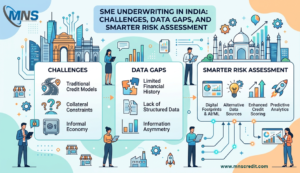

The Scale of the SME Underwriting Challenge
India’s MSME sector is simultaneously the country’s most important economic engine and its most underserved credit market. Tens of millions of small and medium enterprises contribute the majority of the country’s employment, a substantial share of its GDP, and virtually all of its entrepreneurial dynamism — yet access to formal credit remains chronically inadequate for a large proportion of this population. The credit gap is not primarily a product of unwillingness to lend; most banks and NBFCs would welcome greater SME exposure if they could assess the risk reliably. The gap persists because traditional underwriting frameworks were designed for a borrower profile that most SMEs simply do not fit.
Understanding the specific challenges that make SME underwriting difficult — and the data and analytical tools that are progressively overcoming those challenges — is essential for any lending institution seeking to grow its SME portfolio responsibly and profitably.
Challenge 1: Informal and Incomplete Financial Records
The most fundamental challenge in SME underwriting is the quality and completeness of financial information available about the borrower. A significant proportion of India’s SME sector maintains financial records primarily for tax compliance purposes rather than business management, resulting in statements that may systematically underreport revenues, mix personal and business finances, and lack the accounting rigour that formal credit assessment requires.
Many smaller SMEs — particularly proprietorships and partnership firms — have no audited financial statements at all, relying instead on informally prepared accounts that reflect the proprietor’s understanding of the business’s finances rather than any standardised accounting treatment. Applying underwriting frameworks built around audited corporate financial statements and the Financial Ratios derived from them to this population of borrowers produces either exclusion — declining creditworthy businesses for the wrong reasons — or miscalibration — approving credits at terms that do not reflect actual risk.
Challenge 2: Thin or Absent Credit Bureau Data
India’s credit bureau infrastructure has expanded significantly in recent years, but coverage remains incomplete for a substantial portion of the SME population. First-time borrowers, businesses that have exclusively used informal financing, and enterprises in sectors or regions that are less well-connected to the formal financial system may have thin or entirely absent bureau records. Without bureau data, the conventional credit scoring approach that underpins much retail and SME lending loses its primary input — leaving underwriters with limited structured information about the borrower’s historical repayment behaviour.
The thin-file problem is particularly pronounced for young businesses and for women-owned enterprises, which are disproportionately represented in the informal economy and less likely to have accessed formal credit previously. Addressing this gap is not just a commercial opportunity — it is a financial inclusion imperative that risk intelligence tools are increasingly capable of supporting.
Challenge 3: Collateral Availability and Valuation
Traditional SME lending in India has been heavily collateral-dependent — extending credit primarily against the security of property, equipment, or other tangible assets rather than on the basis of cash flow-based repayment capacity assessment. While collateral provides lenders with a recovery mechanism in the event of default, collateral-centric underwriting has two significant drawbacks: it excludes creditworthy businesses that lack adequate collateral, and it creates a false sense of security that can lead to inadequate assessment of actual repayment capacity.
A business that can provide collateral but cannot service debt from its cash flows is not a sound credit risk regardless of the security value. Surety underwriting principles apply here as in other credit contexts: collateral is a loss mitigation tool, not a substitute for capacity assessment. Underwriting frameworks that over-weight collateral relative to cash flow capacity consistently produce portfolios with elevated realised NPAs — credits that required collateral enforcement because the repayment capacity assessment was inadequate.
Smarter Risk Assessment: The Data Solutions
The data gaps that have historically made SME underwriting difficult are being progressively closed by the emergence of alternative data sources that provide more current, more objective, and more granular risk intelligence than traditional documentation-based assessment can deliver.
GST filing data is one of the most valuable alternative data sources available for Indian SME underwriting. Monthly or quarterly GST returns provide a government-verified, contemporaneous record of business revenues and transaction volumes that is independent of whatever financial statements the borrower may present. Cross-referencing stated revenues against GST filing data immediately reveals discrepancies that indicate either misrepresentation or informal revenue streams not captured in formal accounts.
Bank transaction data, accessed through India’s Account Aggregator framework with borrower consent, provides real-time cash flow visibility that enables cash flow-based credit assessment — evaluating repayment capacity from actual transaction patterns rather than reported profit figures. For businesses whose formal accounts are incomplete or unreliable, cash flow analysis based on bank data provides the most objective available measure of financial health.
Business Information Reports that incorporate MCA Master Data verification, director history cross-association analysis, and trade creditor payment behaviour data add the corporate governance and commercial conduct dimensions that financial data sources alone cannot supply. A borrower whose financial data looks adequate but whose director has a history of involvement in struck-off companies, or whose trade payment behaviour shows a pattern of dispute and delay, represents a risk profile that only multi-source assessment can fully reveal.
The Path Forward: Integrated, Technology-Driven Underwriting
The SME underwriting frameworks that will define the next decade of Indian lending are those that integrate these multiple data sources — bureau data where available, alternative data where it is not, Business Information Reports for corporate verification, and cash flow analysis for repayment capacity — into automated, risk-tiered workflows that deliver credit decisions at the speed SME borrowers need and the accuracy that portfolio quality requires. The lenders that build these frameworks will access the SME credit market’s enormous potential; those that persist with traditional documentation-centric approaches will continue to face the credit gap that has characterised the sector for decades.
Conclusion
SME underwriting in India is genuinely difficult — but the data and analytical tools available to address those difficulties have never been better. The challenges of informal financials, thin bureau files, and collateral dependence are all addressable through smarter, multi-source risk assessment frameworks that leverage GST data, Account Aggregator transaction information, and Business Information Reports alongside traditional credit analysis. Lenders that invest in these capabilities are not just improving their underwriting accuracy — they are helping to close the credit gap that constrains India’s most important economic sector.