
A revenue operations platform exists because most companies do not have a strategy problem—they have an execution problem. Leadership teams spend months building growth plans, only to watch those plans stall in a maze of disconnected spreadsheets, siloed CRMs, manual handoffs between sales and finance, and dashboards that never quite agree with each other. The strategy was sound. The systems underneath it were not.
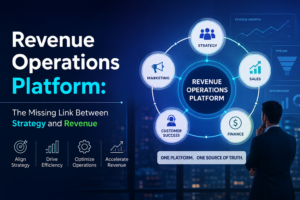
This is where Revenue Operations, often shortened to RevOps, has moved from a nice-to-have function to a core business discipline. Rather than treating sales, marketing, finance, and customer success as separate departments with separate tools and separate metrics, a revenue operations platform ties them together around one shared source of truth. It turns strategic intent into daily, measurable action.
This article breaks down what a Revenue Operations Platform actually is, why strategy alone rarely produces predictable revenue, how these platforms connect planning to execution, and what features, practices, and metrics matter most. It also looks ahead at where RevOps is heading as AI reshapes how businesses forecast, automate, and grow.
What Is a Revenue Operations Platform?
A revenue operations platform is a unified system that brings together the processes, data, and technology behind every stage of the customer and revenue lifecycle—from the first marketing touchpoint through the sales cycle, contract execution, billing, renewal, and expansion. Instead of sales operations, marketing operations, and customer success operations running as isolated functions with their own tools and reporting, a RevOps platform gives every revenue-generating team a shared operational backbone.
Traditional sales operations tend to focus narrowly on supporting the sales team: managing the CRM, running sales compensation, and producing pipeline reports. It rarely extends into marketing attribution, billing accuracy, or customer success workflows. Revenue Operations takes a broader view. It treats revenue as a single, connected process rather than a set of departmental outcomes that happen to add up at the end of the quarter.
This shift has become a business priority for a simple reason: growth has gotten harder to manage through spreadsheets and department-specific tools. Buyers move between channels, deals involve more stakeholders, and finance teams need real-time visibility into forecasted revenue rather than static, once-a-month reports. A revenue operations platform gives leadership a single, reliable view of how strategy is actually performing in the field.
Why Strategy Alone Doesn’t Drive Revenue Growth
A well-designed go-to-market strategy is only as strong as the operations that execute it. In practice, several recurring problems keep good strategies from turning into predictable revenue.
Organizational silos are the most common culprit. When sales, marketing, and finance each work from their own systems and their own definitions of a “qualified lead” or a “closed deal,” strategic alignment breaks down almost immediately. Inconsistent customer data compounds the problem — the same account might look different in the CRM, the billing system, and the customer success platform, making it nearly impossible to get a single accurate picture of account health.
Manual processes slow everything down. Deal approvals, contract redlines, and pricing exceptions that require multiple emails and spreadsheet updates introduce delay and error at exactly the moments when speed matters most. This feeds into poor visibility: leadership often cannot see where deals are stuck, why forecasts miss, or which parts of the funnel are underperforming until the quarter is already over.
Communication gaps between departments mean marketing doesn’t know what messaging is actually converting in sales conversations, and customer success doesn’t know what commitments were made during the sales process. All of this leads to slow decision-making — by the time a problem surfaces in a report, the revenue impact has often already happened.
Strategy sets the direction. Execution determines whether the business actually gets there. This is precisely the gap that Revenue Operations is built to close.
How a Revenue Operations Platform Connects Strategy to Execution
A revenue operations platform operationalizes strategy by giving every team the same operational foundation to work from.
Unified business processes replace department-specific workflows with standardized, end-to-end processes that span the full customer lifecycle. Cross-functional collaboration becomes easier because sales, marketing, finance, and customer success are working inside the same system rather than passing information across disconnected tools.
Centralized customer data ensures that everyone, from a sales rep to a finance analyst, is looking at the same account history, contract terms, and engagement record. Automated workflows remove manual bottlenecks from quoting, approvals, contract routing, and renewal management, so deals move at the speed the business needs rather than the speed of the slowest handoff.
Shared KPIs align teams around common outcomes instead of siloed departmental goals, and revenue visibility gives leadership a real-time, end-to-end view of pipeline, forecast, and performance—not a rearview mirror. Together, these elements turn a strategic plan into a set of daily, trackable actions across the organization.
Key Business Benefits of a Revenue Operations Platform
Organizations that adopt a revenue operations platform typically see improvement across several interconnected areas of the business.
- Faster sales cycles, driven by streamlined approvals, quoting, and contract processes.
- Better forecasting, because forecasts are built on consistent, real-time data rather than manually assembled spreadsheets.
- Improved pipeline visibility, giving sales leaders and executives a clear view of deal health at every stage.
- Increased operational efficiency, as automation removes repetitive manual work from revenue teams.
- Higher customer retention, since customer success teams have full visibility into the sales and onboarding history behind each account.
- Better pricing consistency, with governed pricing rules that reduce unauthorized discounting and pricing errors.
- Reduced revenue leakage by closing the gaps between what was sold, what was contracted, and what was billed.
- Scalable business growth, because standardized processes can support more volume without a proportional increase in headcount or complexity.
Essential Features of a Modern Revenue Operations Platform
Not every RevOps tool offers the same depth of functionality. Businesses evaluating a platform should look for a core set of capabilities.
CRM integration ensures the platform works with, rather than around, the systems sales teams already use daily. CPQ integration connects pricing, quoting, and configuration logic directly to the sales process, reducing errors in complex deals. Workflow automation handles approvals, escalations, and routine tasks without manual intervention.
Revenue analytics and AI-powered insights help teams spot risk and opportunity earlier, whether that means a deal stalling in the pipeline or an account showing early signs of churn. Dashboard reporting brings this information together in a format leadership can act on quickly, while revenue forecasting tools turn historical and real-time data into forward-looking projections.
Customer lifecycle management extends the platform’s value beyond the initial sale into onboarding, renewal, and expansion. Approval workflows keep governance intact even as processes are automated, and strong data governance ensures that as more systems and teams plug into the platform, data quality and security remain consistent.
Common Business Challenges Solved by Revenue Operations Platforms
Most of the operational pain points that slow down revenue teams have a direct RevOps solution.
Data silos are resolved by consolidating customer and deal data into a single system of record instead of scattering it across disconnected tools. Department misalignment improves when sales, marketing, and finance share the same definitions, dashboards, and KPIs.
Inefficient reporting gives way to real-time dashboards that eliminate the need for manual report assembly. Manual approvals are replaced with automated, rules-based workflows that route requests to the right person instantly. Poor forecasting is addressed through consistent, centralized data that removes the guesswork from projections.
Inconsistent processes are standardized across teams and regions, which reduces training time and operational errors. Revenue leakage, often caused by mismatches between contracts and billing, is minimized through connected quote-to-cash processes. And limited operational visibility is solved by giving leadership a single dashboard that reflects what is actually happening across the revenue lifecycle, not a delayed or partial view.
Best Practices for Implementing a Revenue Operations Platform
Successful RevOps implementations tend to share a few common characteristics.
Executive sponsorship is essential, since RevOps requires cross-departmental buy-in that only leadership can enforce. Process standardization should happen before or alongside implementation—a platform cannot fix a fundamentally broken process; it can only make a good process run faster.
Technology integration matters as much as the platform itself; a RevOps platform is only as useful as its connections to the CRM, billing, and marketing systems already in place. Data governance should be established early, with clear ownership over how customer and deal data is entered, maintained, and updated.
Employee training ensures teams actually adopt new workflows instead of reverting to old habits, and clear KPI definition gives everyone a shared understanding of what success looks like. Implementation should be treated as an ongoing effort through continuous optimization, not a one-time project, and supported by deliberate change management so teams understand why processes are shifting and how it benefits their daily work.
Measuring Success with Revenue Operations
Revenue Operations succeeds or fails based on measurable outcomes, not intentions. Organizations typically track a combination of the following:
- Revenue growth over time, both overall and by segment.
- Sales cycle length, to confirm that deals are actually moving faster.
- Forecast accuracy, comparing projected revenue against actual results.
- Customer acquisition cost (CAC), to ensure growth remains efficient.
- Customer lifetime value (CLV), reflecting the long-term value of retained accounts.
- Win rate, showing how effectively opportunities convert to closed deals.
- Customer retention, a direct indicator of post-sale experience and account health.
- Pipeline velocity, measuring how quickly deals move through each stage.
Tracking these metrics consistently allows businesses to treat revenue operations as a discipline of continuous improvement rather than a one-time system rollout. Without this measurement layer, it becomes difficult to know whether operational changes are actually improving revenue outcomes.
Future Trends in Revenue Operations Platforms
Revenue Operations continues to evolve rapidly, shaped largely by advances in automation and data intelligence.
Artificial intelligence and predictive analytics are increasingly built into RevOps platforms, helping teams anticipate deal risk, forecast more accurately, and identify expansion opportunities before they become obvious. Revenue intelligence tools are extending this further, analyzing conversations, engagement patterns, and account signals to surface insights that used to require manual analysis.
Agentic AI is beginning to take on operational tasks directly — routing approvals, flagging anomalies, and even drafting recommended next steps — rather than simply reporting on what already happened. Low-code automation is making it easier for RevOps teams to build and adjust workflows without heavy engineering support, speeding up the pace at which processes can be refined.
Looking further ahead, intelligent forecasting, unified business platforms, and real-time analytics are converging toward end-to-end revenue lifecycle automation — a model where the entire journey from lead to renewal is monitored, optimized, and adjusted continuously, rather than reviewed only at the end of a quarter. Platforms like Mobileforce reflect this direction, combining automation and analytics into a single operational layer for revenue teams.
Conclusion
A revenue operations platform is what turns a well-designed strategy into a business that actually performs the way leadership intended. By connecting sales, marketing, finance, and customer success around shared data, shared processes, and shared metrics, RevOps closes the gap between planning and execution that causes so many growth strategies to underdeliver.
The long-term benefits go beyond faster deal cycles or cleaner dashboards. Businesses that invest in revenue operations build the kind of scalability, operational excellence, and predictable growth that are difficult to achieve when teams operate in isolation. Customers benefit too, experiencing a more consistent journey from first contact through renewal, because the internal systems supporting that journey are finally working together instead of against each other.
As AI continues to mature within revenue operations, the discipline is moving from reactive reporting toward proactive, predictive, and increasingly autonomous decision-making. Companies like Mobileforce are part of this shift, illustrating how modern platforms are turning revenue operations from a support function into a genuine driver of business strategy. The organizations that treat RevOps as a long-term operational investment, not a one-time project, will be the ones best positioned to grow predictably in the years ahead.
Ready to Transform Your Revenue Operations?
Disconnected systems, manual approvals, and inconsistent data shouldn’t be what stands between your strategy and your revenue targets. MobileForce helps businesses unify sales, marketing, finance, and customer success onto one platform—automating workflows, improving forecasting accuracy, and giving leadership real-time visibility into the entire revenue lifecycle. If your team is ready to close the gap between strategy and execution, schedule a demo or speak with a RevOps specialist to see how Mobileforce can support your growth.
Frequently Asked Questions
What is a Revenue Operations Platform? A unified system connecting sales, marketing, finance, and customer success around shared data and processes, replacing siloed tools with one operational foundation.
How does a revenue operations platform improve revenue growth? It removes manual bottlenecks and gives leadership real-time pipeline and forecast visibility, so operational issues get fixed before they hurt revenue.
What features should businesses look for in a revenue operations platform? Look for CRM and CPQ integration, workflow automation, revenue analytics, AI-powered insights, and strong data governance.
How is revenue operations different from sales operations? Sales Operations narrowly supports the sales team, while Revenue Operations connects sales, marketing, finance, and customer success into one integrated function.
Why are revenue operations platforms important for scaling a business? They standardize processes and centralize data, letting businesses grow revenue without a proportional rise in operational complexity.