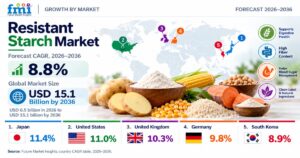

The global resistant starch market is projected to grow from USD 6.5 billion in 2026 to USD 15.1 billion by 2036, registering a compound annual growth rate (CAGR) of 8.8%, according to Future Market Insights (FMI).
Get detailed market forecasts, competitive benchmarking, and pricing trends:
https://www.futuremarketinsights.com/reports/sample/rep-gb-15290
Resistant starch is used in bakery products, snacks, cereals, beverages and other food formulations where manufacturers seek to increase fiber content without substantially changing established recipes. Its commercial value depends on how much resistant starch remains in the finished product after processing, making application testing and technical documentation important parts of ingredient selection.
Fiber-focused reformulation drives demand
Food manufacturers are looking for ways to increase dietary fiber in products that consumers already buy. Resistant starch can be incorporated into selected formulations, including bakery products, cereals and convenience foods, without necessarily requiring a completely new product format.
The technical challenge is maintaining the intended resistant-starch content through production. Heating, moisture, shear, cooling and storage can affect different starch types in different ways. An ingredient specification alone may therefore be insufficient to establish the fiber content of the final product.
Where growth is fastest
FMI’s country-level forecasts indicate that Japan and the United States will record the strongest growth among the five profiled markets between 2026 and 2036.
- Japan — 11.4% CAGR: National dietary reference guidance keeps fiber intake visible in food development. Manufacturers still need to demonstrate that resistant starch works with local processing methods, texture expectations and labeling requirements.
- United States — 11.0% CAGR: FDA guidance identifies certain high-amylose starches and cross-linked phosphorylated resistant starches within its dietary-fiber framework. Ingredient qualification and finished-product substantiation remain important.
- United Kingdom — 10.3% CAGR: Dietary fiber intake remains a focus of public nutrition guidance, creating opportunities for reformulation in bread, cereals, snacks and convenience foods.
- Germany — 9.8% CAGR: A documented dietary-fiber intake gap and an established starch-processing base support interest in new formulations, provided suppliers can demonstrate processing performance and traceability.
- South Korea — 8.9% CAGR: National diet-quality data provide a broader context for grain and fiber reformulation. Commercial adoption will depend on taste, texture, local food preferences and labeling requirements.
What leads the market
FMI identifies three leading segments in the resistant starch market for 2026.
- Conventional resistant starch — 80.5%: Established sourcing and fewer certification requirements support its position in large-volume food production.
- Type 3 resistant starch — 34.9%: Formed through starch retrogradation during cooking and cooling, this type can be developed through thermal processes already used in several food applications.
- Cereals and grains — 41.6%: Commercial maize and wheat processing infrastructure supports the availability of cereal-derived resistant starch ingredients.
FMI also forecasts food applications to account for 23.3% of market demand in 2026, supported by use in bakery products, snacks, cereals and convenience foods.
The hurdle: retaining fiber through processing
The main technical constraint is process-dependent retention. A resistant starch ingredient may meet its incoming specification but deliver a different result after baking, extrusion or other manufacturing steps.
For product developers, that means validating the finished recipe rather than relying solely on raw ingredient data. Changes in temperature, moisture, cooling conditions and storage can affect the resistant fraction, while adjustments made to improve fiber content may also influence dough handling, water binding or texture.
Longer validation can delay product launches and increase development costs. Suppliers that provide application-specific evidence and support testing under customers’ actual production conditions may be better positioned to convert initial trials into recurring orders.
Recent developments and industry investment
Three developments illustrate continued activity in resistant starch ingredients and related starch-processing capabilities.
- August 19, 2025: Ingredion Incorporated updated the HI-MAIZE 260 product data sheet, specifying a minimum total dietary fiber content of 53% on a dry basis and a 24-month shelf life.
- March 27, 2025: KMC Amba announced a EUR 40 million investment to expand its granules factory in Brande, Denmark, with completion expected in autumn 2026. The investment supports wider potato-ingredient capacity and is not limited exclusively to resistant starch.
- January 19, 2026: Roquette Frères published a technical resource on native pea starch and a controlled-recipe study examining glycemic response. The work relates to starch development but does not independently establish a commercial resistant-starch market outcome.
FMI profiles the following companies in the market: Ingredion Incorporated, Tate & Lyle PLC, Cargill, Incorporated, Archer Daniels Midland Company, Roquette Frères, MGP Ingredients, Inc., Emsland Group, AGRANA Beteiligungs AG and KMC Amba.
Competition spans dedicated resistant-starch suppliers and broader starch and fiber businesses. Buyers evaluate ingredient specifications, botanical source, finished-product performance, technical support and supply availability when deciding whether to approve a grade for commercial production.
Analyst perspective
“Demand will move toward grades that retain measured fiber after processing. Over the years of analysis, I can say that suppliers with application evidence are likely to convert more trials into regular purchasing.”
— Nandini Roy Choudhury, Principal Consultant, Future Market Insights.
What this means for food and beverage manufacturers
- Validate fiber content in the finished product. Test resistant starch after the intended baking, extrusion, cooling and storage steps. Use those results to determine whether the formulation meets the target specification.
- Evaluate ingredient cost alongside production performance. Compare sourcing, processing behavior, texture, water binding and technical support before approving a new grade. A lower ingredient price may not offset the cost of reformulation or repeated production trials.
- Match supplier evidence to the target market. Review applicable labeling requirements and ingredient documentation for each destination market. Ask suppliers for application data relevant to the intended recipe and manufacturing process before committing to large-scale production.
For detailed market forecasts, segment shares, country-level growth rates and competitive analysis, read Future Market Insights’ Resistant Starch Market Report:
https://www.futuremarketinsights.com/reports/resistant-starch-market
Explore More Research Reports by FMI
Omega-3 Ingredients Market –
https://www.futuremarketinsights.com/reports/omega-3-ingredients-market
tarch Derivatives Market –
https://www.futuremarketinsights.com/reports/starch-derivatives-market
Pet Food Ingredients & Sustainable Protein Market –
https://www.newstrail.com/pet-food-ingredients-sustainable-protein-market/
About Future Market Insights (FMI)
Future Market Insights, Inc. (FMI) is an ESOMAR-certified, ISO 9001:2015 market research and consulting organization, trusted by Fortune 500 clients and global enterprises. With operations in the U.S., UK, India, and Dubai, FMI provides data-backed insights and strategic intelligence across 30+ industries and 1200 markets worldwide.
For Press & Corporate Inquiries
Rahul Singh AVP – Marketing and Growth Strategy
Future Market Insights, Inc.
+91 8600020075
For Sales: sales@futuremarketinsights.com
For Media: Rahul.singh@futuremarketinsights.com
For Web: https://www.futuremarketinsights.com/