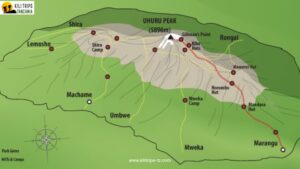

Standing at 5,895 meters (19,341 feet), Mount Kilimanjaro is not just the highest peak in Africa; it is the tallest free-standing mountain in the world. It is a place where you can walk through five distinct climate zones—from tropical rainforest to arctic ice—all in the span of a single week.
For many, standing on Uhuru Peak is a lifelong dream. However, the journey to the summit begins long before you step foot in Tanzania. The most critical decision you will make (aside from choosing the right guide) is selecting from the various Mount Kilimanjaro climbing routes. Each path offers a different perspective of the mountain, varying difficulty levels, and, most importantly, different rates of acclimatization success.
At Kilitrips, we believe that the “best” route is the one that aligns with your fitness level, your desire for scenery, and your body’s ability to adapt to high altitudes. In this guide, we break down the primary trails to help you choose your path to the sky.
The Seven Main Arteries of Kilimanjaro
There are seven established routes to the summit. While they all lead to the same snowy peak, the experience on each is vastly different.
1. The Machame Route (The “Whiskey” Route)
The Machame route is arguably the most popular path on the mountain. It is known for its stunning scenery and the “climb high, sleep low” opportunities that are vital for acclimatization.
Duration: 6 or 7 days.
Difficulty: High. It involves steeper trails and the famous Baranco Wall.
Scenery: Spectacular. You get views of the Shira Plateau and the Lava Tower.
Who it’s for: Fit hikers who want a classic Kilimanjaro experience and don’t mind sharing the trail with others.
2. The Lemosho Route (The Most Scenic Path)
Often considered the most beautiful route, Lemosho starts on the western side of the mountain. It is a newer trail that offers a more remote experience during the first few days.
Duration: 7 or 8 days.
Difficulty: Medium to High.
Scenery: Unrivaled. It crosses the entire Shira Plateau from west to east.
Who it’s for: Those who want the highest success rate. The 8-day Lemosho route has one of the best acclimatization profiles on the mountain.
3. The Marangu Route (The “Coca-Cola” Route)
Marangu is the oldest and most established route. It is often mistakenly labeled as “easy” because it is the only path that offers sleeping huts instead of camping.
Duration: 5 or 6 days.
Difficulty: Medium, but with a lower success rate due to the short duration.
Scenery: Less varied, as you ascend and descend on the same path.
Who it’s for: Hikers who prefer a bed over a tent, but we strongly recommend the 6-day version to avoid altitude sickness.
4. The Rongai Route (The Northern Approach)
Rongai is the only route that approaches Kilimanjaro from the north, near the Kenyan border. It is much drier than the southern routes, making it an excellent choice during the rainy season.
Duration: 6 or 7 days.
Difficulty: Medium. The climb is gradual.
Scenery: Remote and wild. You may see more wildlife here than on other trails.
Who it’s for: Those looking for a quieter trek and a different perspective of the peak.
5. The Northern Circuit (The Grand Tour)
The Northern Circuit is the newest and longest route. It follows the Lemosho trail initially but then circles around the quiet northern slopes.
Duration: 9 days.
Difficulty: High (due to endurance), but easiest for acclimatization.
Scenery: Complete 360-degree views of the mountain.
Who it’s for: Serious trekkers who want to see every inch of the mountain and maximize their chance of reaching the top.
6. The Umbwe Route (The Direct Challenge)
Umbwe is the most taxing and direct route. It ascends very quickly, offering little time for the body to adjust to the altitude.
Duration: 6 days.
Difficulty: Very High.
Who it’s for: Only for very experienced high-altitude climbers who acclimatize quickly.
7. The Shira Route
Similar to Lemosho, but the starting point is higher. We generally recommend Lemosho over Shira because Lemosho starts at a lower altitude, allowing for a better start to your acclimatization journey.
Why Acclimatization is Your Secret Weapon
The main reason climbers fail to reach Uhuru Peak isn’t a lack of fitness—it’s Altitude Sickness (AMS). When looking at Mount Kilimanjaro climbing routes, you must prioritize the “Climb High, Sleep Low” principle.
Routes like Lemosho (8 days) and Machame (7 days) allow you to trek to a high point during the day and descend to a lower camp to sleep. This “stresses” the body just enough to produce more red blood cells without making you ill. When you rush the mountain (as many do on the 5-day Marangu route), you significantly decrease your chances of success.
The Five Climate Zones: A Journey Through Worlds
One of the most magical aspects of any Kilimanjaro route is the transition through ecological “islands”:
Cultivation Zone (800m – 1,800m): Lush farmland and rainforest foothills.
Rainforest Zone (1,800m – 2,800m): Home to Colobus monkeys and exotic birds.
Heather and Moorland (2,800m – 4,000m): Giant lobelias and otherworldly shrubs.
Alpine Desert (4,000m – 5,000m): A stark, volcanic landscape with extreme temperature swings.
Arctic Zone (5,000m+): The kingdom of ice, slate, and the final push to the summit.
Preparing for Your Trek
Choosing your route is step one. Step two is physical and mental preparation.
Physical: Focus on “time on feet.” Long weekend hikes with a weighted pack are more beneficial than sprinting on a treadmill.
Gear: Quality layers are essential. You will go from sweating in the rainforest to sub-zero winds on summit night.
Mental: Kilimanjaro is a “pole pole” (slowly, slowly) mountain. Patience and a positive mindset are your best assets when the air gets thin.
Frequently Asked Questions (FAQ)
What is the best month to climb Mount Kilimanjaro?
The best windows are the dry seasons: from late June to October and late December to early March. Climbing during these times offers clearer skies and safer trail conditions.
Which route has the highest success rate?
The 8-day Lemosho route and the 9-day Northern Circuit have the highest success rates (approaching 95%) because they allow the most time for acclimatization.
Do I need technical climbing skills?
No. Kilimanjaro is a “trekking mountain.” No ropes, ice axes, or technical rock-climbing skills are required. However, you should be in good cardiovascular shape and comfortable hiking on uneven terrain for several hours a day.
Is the Marangu route the easiest?
While it is the shortest and has huts, it is often considered the hardest to summit successfully because the rapid ascent makes altitude sickness much more likely.
Can I climb Kilimanjaro alone?
No. Tanzanian law requires all climbers to be accompanied by a licensed guide. A support team typically includes a lead guide, assistant guides, a cook, and several porters who carry the heavy gear and set up camp.
Final Thoughts: Choosing with Kilitrips
Your choice of route will define your memories of Africa’s greatest giant. Whether you crave the social atmosphere of Machame, the quiet solitude of Rongai, or the scenic grandeur of Lemosho, the mountain is waiting to challenge and inspire you.
Ready to find your path? Explore our detailed itineraries at Kilitrips Kilimanjaro Routes and let’s start planning your journey to the Roof of Africa.